Estimating and Tendering for Construction Work 3rd Edition: A Complete Guide for Engineers and Contractors
Introduction 🏗️📐
Construction projects rarely begin with concrete, steel, machinery, and workers. They begin with information, quantities, prices, assumptions, and decisions. Estimating and tendering transform drawings and specifications into a commercial proposal that can determine whether a project becomes profitable—or becomes a costly mistake.
A construction estimate attempts to predict the resources and costs required to complete a project. Tendering then turns that estimate into a formal offer submitted to a client or main contractor. Together, these processes connect engineering knowledge with project management, procurement, finance, and commercial strategy.


For students, estimating provides an excellent introduction to the commercial side of engineering. For professionals, accurate estimating and tendering can improve competitiveness, reduce financial exposure, and support better project planning.
The process is particularly important in markets such as the USA, UK, Canada, Australia, and Europe, where construction contracts can involve detailed specifications, competitive bidding, subcontractor packages, regulatory requirements, insurance conditions, and strict commercial documentation.

Background Theory
The relationship between estimating and tendering
Estimating and tendering are related but different activities.
Estimating focuses primarily on determining what a project is expected to cost.
Tendering focuses on preparing and submitting an offer to perform that work under specified contractual conditions.
A simplified construction workflow can be represented as:
Drawings → Quantities → Resources → Costs → Risks → Markup → Tender → Evaluation → Contract
Each stage influences the next.
A mistake in interpreting a drawing can produce an incorrect quantity. An incorrect quantity can lead to an inaccurate material requirement. That can produce an incorrect price, which eventually affects the tender value.
Why accuracy matters
Construction projects contain uncertainty. Material prices can change, productivity can vary, weather can interrupt work, and site conditions may differ from the information contained in tender documents.
Therefore, a professional estimate is not simply a list of prices.
It is a structured prediction of project cost and commercial risk.
Direct and indirect costs
Construction costs are often divided into several categories.
Direct costs
Direct costs are closely associated with physical construction activities.
Examples include:
- Concrete
- Reinforcement steel
- Structural steel
- Bricks and blocks
- Timber
- Pipes
- Electrical equipment
- Construction labor
- Equipment used directly for an activity
- Specialist subcontractor work
Indirect costs
Indirect costs support the project but cannot always be assigned to one physical construction element.
Examples include:
- Site management
- Temporary facilities
- Site security
- Insurance
- Temporary utilities
- Office expenses
- Mobilization
- Supervision
- Quality control
- Safety management
Understanding this distinction helps estimators build more reliable cost structures.
Definition
What is construction estimating?
Construction estimating is the systematic process of forecasting the quantities, resources, costs, risks, and other financial requirements necessary to complete construction work.
An estimate may include:
- Material quantities
- Labor requirements
- Equipment
- Plant
- Subcontractor costs
- Site overhead
- General overhead
- Contingency
- Profit
- Taxes and applicable charges
- Commercial allowances
What is construction tendering?
Construction tendering is the process through which a contractor prepares and submits an offer to execute specified construction work under defined contractual conditions.
The tender package may contain:
- Drawings
- Specifications
- Bills of quantities
- Scope descriptions
- Contract conditions
- Schedules
- Technical requirements
- Completion requirements
- Pricing documents
Estimator vs. tendering team
A small contractor may have one person performing several roles. Larger organizations may separate responsibilities.
| Role | Typical responsibility |
|---|---|
| Estimator | Develops project cost |
| Quantity surveyor | Measures and evaluates quantities |
| Procurement team | Obtains supplier quotations |
| Engineer | Reviews technical requirements |
| Project manager | Reviews construction methodology |
| Commercial manager | Reviews contractual and financial exposure |
| Senior management | Approves final bid strategy |
Step-by-Step Explanation 🧱➡️📊
Step 1: Review the tender documents
Never begin pricing immediately.
First, examine the complete tender package.
Look for:
- Missing drawings
- Conflicting information
- Unclear specifications
- Contract duration
- Site restrictions
- Access requirements
- Working-hour limitations
- Quality requirements
- Testing requirements
- Temporary works
- Client-supplied materials
- Required completion dates
Create a tender document register so that the team knows which documents have been received and which revisions are current.


Step 2: Understand the scope
Scope definition is one of the most important parts of estimating.
Ask:
What exactly are we required to construct?
The answer should cover both what is included and what is excluded.
For example, a building tender might include structural works but exclude certain specialist systems.
Failing to recognize exclusions can create significant commercial problems later.
Step 3: Perform quantity takeoff
Quantity takeoff converts drawings and specifications into measurable construction items.
Typical items include:
- Excavation
- Concrete
- Reinforcement
- form-work
- Masonry
- Plaster
- Flooring
- Roofing
- Painting
- Pipework
- Cable installation
- Mechanical equipment
Digital estimating and Building Information Modeling can make this process faster, but professional review remains essential.
Step 4: Develop the work breakdown structure
Divide the project into logical packages.
For example:
Building Project
→ Earthworks
→ Foundations
→ Structural frame
→ External walls
→ Internal finishes
→ Mechanical systems
→ Electrical systems
→ External works
This structure makes the estimate easier to review and update.
Step 5: Determine resource requirements
Each construction activity requires resources.
Consider:
- Materials
- Labor
- Plant
- Equipment
- Subcontractors
- Temporary works
The estimator must also consider productivity.
Two contractors may purchase identical materials but achieve very different costs because their labor productivity, equipment utilization, and site organization differ.
Step 6: Obtain supplier and subcontractor quotations
Market quotations can significantly improve estimate accuracy.
Request quotations for major packages such as:
- HVAC
- Electrical systems
- Elevators
- Structural steel
- Curtain walls
- Fire protection
- Specialized finishes
Compare quotations carefully rather than automatically selecting the cheapest one.
Step 7: Build the cost estimate
Combine measured quantities with appropriate resource prices.
The estimate should clearly separate:
Materials + Labor + Plant + Subcontractors + Project Overheads + Commercial Allowances
Step 8: Analyze risks
Before submitting a tender, identify uncertainties.
Potential risks include:
⚠️ Price volatility
⚠️ Difficult ground conditions
⚠️ Design changes
⚠️ Delayed approvals
⚠️ Labor shortages
⚠️ Restricted site access
⚠️ Long-lead materials
⚠️ Weather exposure
⚠️ Currency fluctuations
⚠️ Contractual penalties
Step 9: Add overhead and profit
A contractor must recover business costs and generate an acceptable return.
However, markup should not be selected blindly.
A competitive tender requires a balance between:
Price competitiveness ↔ Risk ↔ Capacity ↔ Expected profit
Step 10: Review and submit the tender
The final review should check:
- Arithmetic
- Quantities
- Supplier quotations
- Scope
- Exclusions
- Assumptions
- Contract conditions
- Completion period
- Taxes
- Insurance
- Bonds
- Required signatures
- Submission format
- Submission deadline
Only after this commercial review should the final tender be submitted.
Comparison: Estimating vs. Tendering
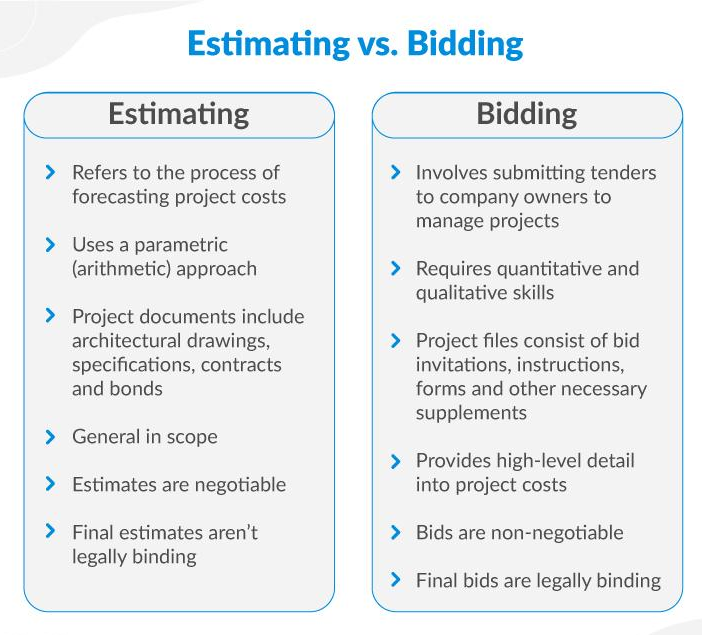


| Feature | Estimating | Tendering |
|---|---|---|
| Main purpose | Predict project cost | Submit commercial offer |
| Main output | Cost estimate | Tender proposal |
| Main focus | Quantities and resources | Price, terms, and competitiveness |
| Participants | Estimators, engineers, QS | Estimators, commercial team, management |
| Risk analysis | Important | Critical |
| Supplier quotations | Frequently required | Incorporated into bid |
| Contract review | Supporting activity | Major activity |
| Final approval | Internal | Internal before client submission |
Bottom-up vs. top-down estimating
Bottom-up estimating starts with individual activities and resources before building the complete project cost.
It is generally detailed and useful when sufficient project information is available.
Top-down estimating starts with broader historical information or benchmark costs and develops an approximate project value.
It can be useful during early feasibility studies when detailed drawings are unavailable.
Manual vs. digital estimating
| Method | Advantages | Limitations |
|---|---|---|
| Manual spreadsheet | Flexible and inexpensive | More opportunity for human error |
| Estimating software | Faster calculations and structured databases | Requires training |
| BIM-based estimating | Can connect quantities with models | Depends on model quality |
| Historical database | Useful for early estimates | Requires reliable historical data |
Diagrams & Tables 📊
Construction estimating workflow
Tender Documents
       ↓
Scope Review
       ↓
Quantity Takeoff
       ↓
Resource Identification
       ↓
Supplier/Subcontractor Quotes
       ↓
Cost Build-Up
       ↓
Risk Review
       ↓
Overhead + Profit
       ↓
Tender Review
       ↓
Final Submission
Typical estimate structure
| Cost layer | Examples |
|---|---|
| Materials | Concrete, steel, pipes |
| Labor | Skilled and unskilled workers |
| Plant | Excavators, cranes |
| Subcontractors | HVAC, electrical |
| Site overhead | Management, security |
| Head-office overhead | Administration |
| Risk allowance | Identified uncertainties |
| Profit | Commercial return |
Tender evaluation checklist
| Question | Check |
|---|---|
| Is the scope complete? | ✅ |
| Are current drawings being used? | ✅ |
| Have quantities been reviewed? | ✅ |
| Are major quotations included? | ✅ |
| Are exclusions documented? | ✅ |
| Have risks been assessed? | ✅ |
| Are contractual conditions understood? | ✅ |
| Has the final price been independently reviewed? | ✅ |
Examples 🏢
Example 1: Small commercial building
A contractor receives drawings for a small office building.
The estimator reviews the drawings, identifies foundations, concrete framing, masonry, finishes, electrical works, and mechanical services, then develops quantities for each package.
Supplier quotations are requested for major materials and specialist subcontractors.
The estimator then considers site overhead, construction duration, project risks, and company requirements before preparing the tender.
Example 2: Road construction
A road project requires earthworks, drainage, pavement layers, asphalt, road markings, and traffic management.
The estimator must consider not only material quantities but also:
- Haul distances
- Equipment productivity
- Fuel
- Traffic restrictions
- Weather
- Temporary traffic arrangements
- Testing requirements
A tender that ignores these factors may appear competitive while creating serious cost exposure.
Example 3: Industrial facility
An industrial project may contain complex mechanical and electrical systems.
The main contractor may rely heavily on specialist subcontractors.
Here, tender coordination becomes particularly important because the estimator must understand how different packages interact.
Real-World Application 🌍
Residential construction
Estimating helps builders establish realistic budgets for homes, apartments, and housing developments.
Commercial construction
Office buildings, shopping centers, hotels, and educational facilities often require detailed trade-based estimates.
Infrastructure
Roads, bridges, tunnels, rail projects, water systems, and airports involve large quantities, specialized equipment, and complex risk factors.
Industrial construction
Factories, warehouses, power facilities, and processing plants often require sophisticated subcontractor and equipment pricing.
Renovation and refurbishment
Existing buildings introduce additional uncertainty because hidden conditions may not be visible before construction.
This makes site inspections and risk identification especially important.
Common Mistakes ❌
Ignoring the latest drawings
Using an outdated drawing revision can result in incorrect quantities and pricing.
Pricing without reading specifications
Drawings alone rarely communicate every requirement.
Specifications may define:
- Material standards
- Installation methods
- Testing
- Quality requirements
- Performance criteria
Assuming every quotation is comparable
One supplier may include delivery, installation, warranty, and testing while another may exclude them.
Forgetting temporary works
Temporary fencing, access routes, protection, scaffolding, temporary power, and site facilities can represent meaningful costs.
Underestimating project duration
A longer project can increase:
- Site overhead
- Equipment costs
- Supervision
- Security
- Temporary facilities
Adding excessive contingency
A very high contingency may make the bid commercially unattractive.
Risk allowances should be based on identifiable uncertainties rather than arbitrary numbers.
Failing to document assumptions
Unwritten assumptions can become disputes.
Important assumptions should be clearly recorded before tender submission.
Challenges & Solutions 🛠️
| Challenge | Practical solution |
|---|---|
| Incomplete drawings | Identify gaps and submit clarification requests |
| Rapid material price changes | Obtain current supplier quotations |
| Poor productivity data | Maintain historical project records |
| Complex subcontractor packages | Use detailed scope comparison sheets |
| Design uncertainty | Document assumptions and exclusions |
| Short tender periods | Establish a structured review workflow |
| Large quantities | Use digital measurement tools |
| Contractual uncertainty | Conduct commercial and legal review |
| Multiple drawing revisions | Maintain strict document control |
Managing uncertainty
No estimate can eliminate uncertainty completely.
The objective is to identify, quantify, communicate, and manage uncertainty.
A professional estimator should therefore maintain a risk register throughout the tender process.
Case Study 🏗️
Hypothetical office development
Consider a contractor bidding for a medium-sized office development.
The initial tender documents contain architectural drawings, structural drawings, mechanical specifications, and electrical requirements.
During the first review, the estimating team identifies several potential problems.
The architectural drawings show one type of external façade, while a specification references another system.
Instead of making an assumption silently, the estimator records the conflict and requests clarification.
The team then conducts a site visit.
They discover that vehicle access is restricted during certain hours. This affects delivery schedules and potentially increases handling requirements.
Next, the procurement team obtains quotations from several suppliers.
One quotation appears cheapest but excludes delivery and installation. Another quotation has a higher initial price but includes a broader scope.
The estimating team compares the quotations on an equivalent basis.
The project manager then reviews the proposed construction sequence. The team identifies that certain specialist equipment has a long procurement period.
This information is incorporated into the tender strategy.
Before submission, senior management reviews:
- Total estimated cost
- Major risks
- Construction duration
- Available company resources
- Contract conditions
- Expected commercial return
The final tender is submitted with clearly documented assumptions and exclusions.
Lessons from the case
The most important lesson is that successful tendering is not simply about finding the lowest price.
A strong tender is based on:
Good information + accurate quantities + realistic resources + risk awareness + commercial discipline.
Essential Tips ⭐
Build a historical cost database
Keep records of completed projects.
Useful information includes:
- Actual material costs
- Labor productivity
- Equipment performance
- Subcontractor prices
- Project duration
- Final quantities
- Major variations
Historical data can dramatically improve future estimates.
Visit the site whenever possible
A site visit can reveal conditions that drawings cannot communicate.
Observe:
- Access
- Storage
- Ground conditions
- Existing structures
- Utilities
- Traffic
- Neighboring properties
- Working restrictions
Use a standardized tender checklist
A checklist reduces the chance of forgetting small but important requirements.
Separate facts from assumptions
Clearly distinguish:
Known information from estimated information.
This makes commercial risk easier to understand.
Review large-value items first
Not every estimate component carries the same financial significance.
Focus detailed review efforts on major cost drivers and high-risk packages.
Keep procurement involved
Estimators should communicate with procurement teams throughout the tender.
Market intelligence can reveal:
- Supplier capacity
- Price movements
- Delivery periods
- Material availability
- Alternative products
Never rush the final review
The final hours before tender submission can be stressful.
A structured review process is safer than relying on memory.
FAQs ❓
What is the difference between estimating and tendering?
Estimating determines the expected cost of completing construction work. Tendering uses that cost information, together with commercial strategy and contract requirements, to prepare an offer for the client.
Who prepares a construction estimate?
Depending on the project, estimates may be prepared by estimators, quantity surveyors, civil engineers, cost engineers, contractors, or commercial teams.
Why is quantity takeoff important?
Quantity takeoff converts drawings and specifications into measurable construction work. Accurate quantities provide the foundation for reliable material, labor, equipment, and subcontractor pricing.
Should the cheapest supplier quotation always be selected?
No. The cheapest quotation may exclude important services or contain unrealistic assumptions. Quotations should be compared on an equivalent scope and commercial basis.
What is contingency in construction estimating?
Contingency is an allowance intended to address defined uncertainties or risks within the estimating strategy. It should not simply be used to hide poor quantity measurement or incomplete scope analysis.
How can technology improve estimating?
Digital takeoff tools, estimating databases, spreadsheets, estimating software, BIM, and document-management systems can improve speed, consistency, traceability, and collaboration.
Why are construction tenders sometimes unsuccessful?
A tender may fail because the price is uncompetitive, the scope was misunderstood, risks were priced incorrectly, documentation was incomplete, or the contractor did not demonstrate sufficient technical or commercial capability.
What is the most important skill for a construction estimator?
Strong estimators combine technical understanding, numerical discipline, attention to detail, market awareness, communication, and commercial judgment.
Conclusion 🏆
Estimating and tendering form the commercial foundation of construction projects. A successful process begins long before a final bid price is entered into a tender form.
The estimator must understand the drawings, interpret specifications, measure quantities, evaluate resources, obtain market prices, assess risks, and communicate assumptions clearly. The tendering team must then transform this information into a competitive and commercially responsible proposal.
Modern construction is becoming increasingly digital, with BIM, automated quantity extraction, estimating platforms, historical databases, and collaborative project systems improving the way contractors prepare bids. Yet technology does not eliminate the need for engineering judgment.
The strongest estimating process combines accurate data + engineering knowledge + practical construction experience + disciplined risk management. 🏗️📐💼
For students, learning these principles provides a valuable bridge between engineering theory and real construction practice. For professionals, continuous improvement in estimating and tendering can help create more reliable bids, better project planning, and stronger commercial performance across the construction industry.