Essential Data Analytics, Data Science, and AI: The Complete Engineering Guide for Students and Professionals 📊🤖🚀
Introduction 🌍📈
Data has become one of the world’s most valuable resources. Every second, billions of searches, online purchases, financial transactions, healthcare records, engineering simulations, and IoT sensor readings generate enormous amounts of information.
Modern organizations no longer rely on intuition alone. Instead, they use Data Analytics, Data Science, and Artificial Intelligence (AI) to transform raw data into valuable insights and intelligent decision-making.
Whether you’re an engineering student, software developer, researcher, business analyst, or machine learning engineer, understanding these three interconnected fields is now an essential skill.
These technologies power:
- 🚗 Self-driving vehicles
- 🏥 Medical diagnosis
- 💳 Fraud detection
- 📱 Recommendation systems
- 🛰️ Smart cities
- ⚡ Industrial automation
- 🌍 Climate prediction
- 📦 Supply chain optimization
Today, nearly every engineering discipline—from civil and mechanical engineering to electrical, biomedical, and aerospace engineering—depends on data-driven decision-making.

Background Theory 📚
To understand AI, we must first understand how information evolves into intelligence.
The typical engineering workflow follows this hierarchy:
Raw Data
      ↓
Processed Information
      ↓
Knowledge
      ↓
Prediction
      ↓
Automation
      ↓
Artificial Intelligence
Every engineering project generates data.
Examples include:
- Temperature sensors
- Pressure measurements
- Financial transactions
- Satellite imagery
- Website visitors
- Manufacturing defects
- Medical records
- Power consumption
Without analysis, this information has little value.
The objective is converting data into actionable decisions.
Definition 📖
Data Analytics 📊
Data Analytics is the process of examining data to discover useful patterns, trends, relationships, and insights that support better decisions.
It answers questions like:
- What happened?
- Why did it happen?
- What will happen next?
- What should we do?
Data Science 🧪
Data Science is a multidisciplinary field combining:
- Mathematics
- Statistics
- Computer Science
- Machine Learning
- Programming
- Domain Knowledge
Its purpose is extracting knowledge from structured and unstructured data.
Artificial Intelligence 🤖
Artificial Intelligence refers to computer systems capable of performing tasks that normally require human intelligence.
Examples include:
- Speech recognition
- Language translation
- Object detection
- Decision making
- Image recognition
- Autonomous navigation
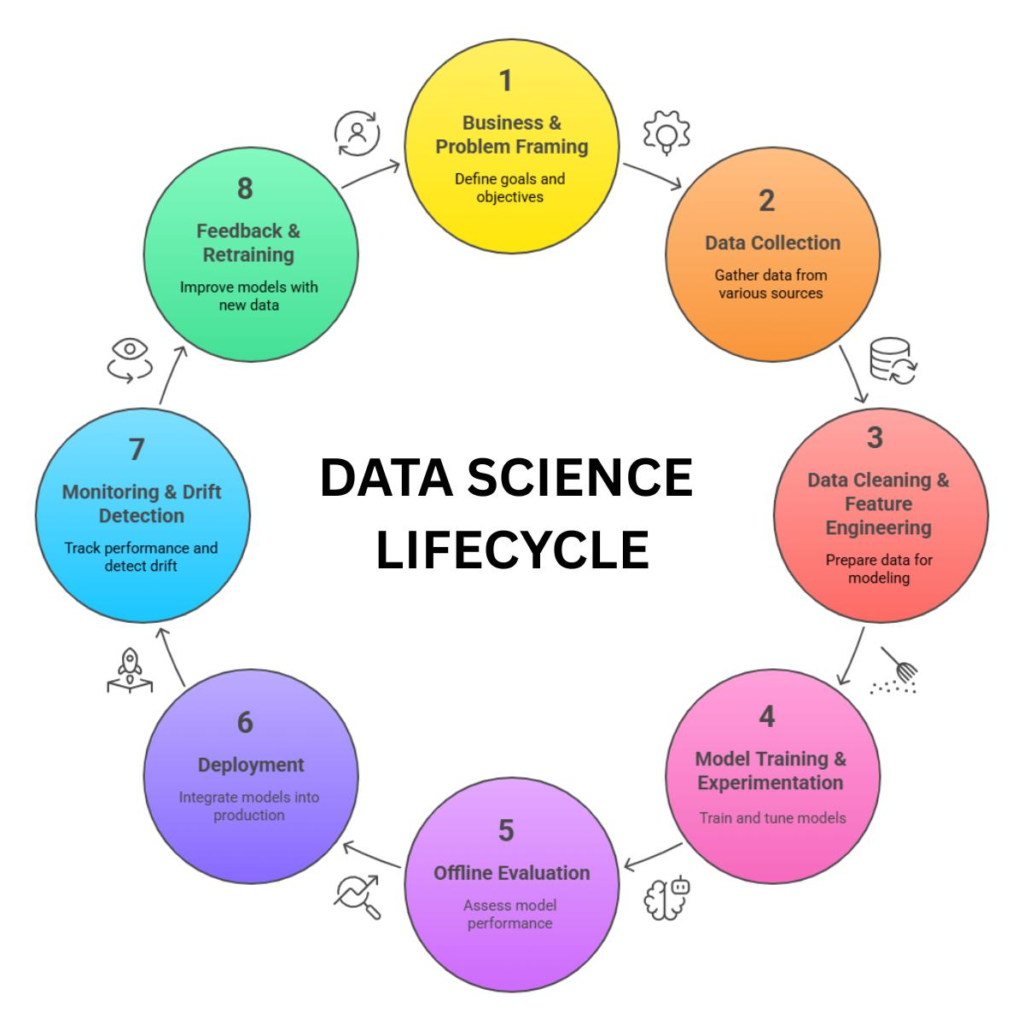
How Data Analytics, Data Science, and AI Work Together 🔄
Step 1 — Data Collection 📥
Organizations gather data from:
- Sensors
- Databases
- APIs
- Mobile apps
- Websites
- ERP systems
- Manufacturing equipment
- IoT devices
Step 2 — Data Cleaning 🧹
Raw datasets often contain:
- Missing values
- Duplicate records
- Incorrect entries
- Noise
- Outliers
Cleaning improves data quality.
Step 3 — Data Exploration 🔍
Analysts identify:
- Trends
- Correlations
- Distributions
- Seasonal effects
- Anomalies
Visualization tools simplify exploration.
Step 4 — Feature Engineering ⚙️
Important variables are selected or created to improve model performance.
Examples:
- Average temperature
- Customer age
- Machine vibration level
- Purchase frequency
Step 5 — Model Building 🤖
Machine learning algorithms learn from historical data.
Examples include:
- Decision Trees
- Random Forest
- Neural Networks
- Support Vector Machines
- Gradient Boosting
Step 6 — Evaluation 📈
Performance metrics include:
- Accuracy
- Precision
- Recall
- F1 Score
- RMSE
- MAE
Step 7 — Deployment 🚀
The trained model becomes part of a real application.
Examples:
- Chatbots
- Recommendation engines
- Smart manufacturing
- Medical diagnosis
- Fraud detection



Data Analytics vs Data Science vs AI ⚖️
| Feature | Data Analytics | Data Science | Artificial Intelligence |
|---|---|---|---|
| Primary Goal | Understand data | Build predictive models | Automate intelligence |
| Programming | Moderate | High | Very High |
| Statistics | Medium | High | High |
| Machine Learning | Limited | Extensive | Core |
| Output | Reports | Predictions | Intelligent decisions |
| Common Tools | Excel, SQL, Power BI | Python, R | Python, TensorFlow |
| Complexity | Low-Medium | Medium-High | High |
Data Science Workflow Diagram 📊
Data Sources
      │
      ▼
Collection
      │
      ▼
Cleaning
      │
      ▼
Exploration
      │
      ▼
Feature Engineering
      │
      ▼
Machine Learning
      │
      ▼
Evaluation
      │
      ▼
Deployment
      │
      ▼
Business Decision
Popular Tools and Technologies 🛠️
| Category | Examples |
|---|---|
| Programming | Python, R |
| Databases | SQL, PostgreSQL, MySQL |
| Visualization | Power BI, Tableau, Matplotlib |
| Big Data | Hadoop, Spark |
| Machine Learning | Scikit-learn |
| Deep Learning | TensorFlow, PyTorch |
| Cloud | AWS, Azure, Google Cloud |
| Version Control | Git |


Practical Examples 💡
Example 1 — Predictive Maintenance ⚙️
A manufacturing plant collects vibration data from motors.
Analytics identifies abnormal patterns.
Machine learning predicts equipment failures before breakdowns.
Result:
✅ Lower maintenance costs
✅ Reduced downtime
Example 2 — Healthcare 🏥
Hospitals analyze patient histories.
AI predicts disease risk.
Doctors receive early alerts.
Benefits:
- Faster diagnosis
- Better treatments
- Lower costs
Example 3 — E-commerce 🛒
Online stores analyze:
- Browsing history
- Purchases
- Product ratings
AI recommends personalized products.
Result:
Higher sales.
Example 4 — Banking 💳
Banks detect unusual transactions.
AI models identify fraud within milliseconds.
Millions of dollars are saved annually.
Example 5 — Smart Traffic 🚦
Cities collect:
- Camera feeds
- GPS locations
- Vehicle speeds
AI optimizes traffic lights automatically.
Real-World Engineering Applications 🌍
Civil Engineering 🏗️
- Structural health monitoring
- Traffic prediction
- Smart infrastructure
- Earthquake analysis
Mechanical Engineering ⚙️
- Predictive maintenance
- Manufacturing optimization
- Robotics
- Quality inspection
Electrical Engineering ⚡
- Smart grids
- Load forecasting
- Energy optimization
- Fault detection
Aerospace Engineering ✈️
- Flight optimization
- Engine monitoring
- Satellite image processing
- Autonomous drones
Biomedical Engineering 🩺
- Medical imaging
- Disease prediction
- Drug discovery
- Personalized medicine
Environmental Engineering 🌱
- Air quality monitoring
- Flood prediction
- Climate modeling
- Water quality analysis
Common Mistakes ❌
Ignoring Data Quality
Poor data produces poor predictions.
Using Too Much Data
More data isn’t always better.
Relevant data matters more.
Skipping Data Cleaning
Unclean datasets reduce accuracy dramatically.
Overfitting Models
Complex models may memorize instead of learning.
Ignoring Business Goals
Technical accuracy without solving real problems provides little value.
Not Validating Results
Always test models using unseen datasets.
Challenges and Solutions 🛠️
| Challenge | Solution |
|---|---|
| Missing data | Data imputation |
| Large datasets | Distributed computing |
| Bias | Balanced datasets |
| Privacy | Data anonymization |
| Security | Encryption |
| Poor accuracy | Better feature engineering |
| Model drift | Continuous retraining |
| Limited computing power | Cloud platforms |
Case Study 🏭
AI-Based Predictive Maintenance in Manufacturing
A manufacturing company experienced frequent motor failures.
Problem:
Unexpected breakdowns caused expensive production delays.
Solution:
The engineering team collected:
- Temperature
- Vibration
- Noise
- Power consumption
Using machine learning, they trained a predictive model.
Results:
📉 45% fewer failures
💰 30% lower maintenance costs
⏱️ 22% less downtime
⚡ Higher production efficiency
The project demonstrated how integrating analytics, data science, and AI can deliver measurable operational improvements.
Essential Tips ⭐
- 📚 Learn SQL before advanced AI.
- 🐍 Master Python programming.
- 📊 Practice data visualization regularly.
- 📈 Understand statistics and probability.
- 🤖 Study machine learning fundamentals.
- ☁️ Learn cloud computing basics.
- 🔄 Build real-world projects.
- 📂 Create a professional GitHub portfolio.
- 📖 Read research papers and industry reports.
- 🚀 Continuously update your skills as tools evolve.
Frequently Asked Questions ❓
Is Data Analytics easier than Data Science?
Yes. Data Analytics generally focuses on interpreting existing data, while Data Science often involves predictive modeling and programming.
Do I need programming?
For basic analytics, Excel and SQL may be enough. For Data Science and AI, Python is highly recommended.
Which language is best?
Python is the most popular language because of its extensive ecosystem for analytics, machine learning, and AI.
Is mathematics important?
Yes. Statistics, probability, linear algebra, and calculus become increasingly important as you progress into machine learning and AI.
Can engineers transition into AI careers?
Absolutely. Engineers already possess analytical and problem-solving skills that transfer well to AI-related roles.
Which industries hire data professionals?
Healthcare, finance, manufacturing, energy, aerospace, retail, telecommunications, government, logistics, and technology companies all employ data professionals.
What is the difference between Machine Learning and AI?
Machine Learning is a subset of AI that enables systems to learn from data, while AI is the broader field focused on creating intelligent systems.
Conclusion 🎯
Data Analytics, Data Science, and Artificial Intelligence have become foundational technologies across modern engineering and business. Data Analytics transforms raw information into meaningful insights, Data Science extends those insights with predictive models, and AI automates intelligent decision-making at scale.
For students, mastering these disciplines opens doors to careers in software engineering, research, robotics, healthcare, finance, manufacturing, and countless other sectors. For professionals, these skills enhance efficiency, improve innovation, and support evidence-based decisions in increasingly data-driven environments.
Success in this field requires more than learning tools—it involves developing a strong understanding of statistics, programming, domain knowledge, and critical thinking. By building practical projects, working with real datasets, and continuously learning emerging technologies, you can confidently contribute to the next generation of intelligent engineering solutions that are shaping industries across the USA, UK, Canada, Australia, Europe, and beyond. 🚀📊🤖