Effective Python 2nd Edition: 90 Specific Ways to Write Better Python – The Complete Guide for Modern Python Developers 🐍🚀
Introduction 📘
Python has become one of the world’s most influential programming languages. From artificial intelligence and machine learning to cybersecurity, web development, cloud computing, automation, and scientific research, Python continues to dominate modern software engineering.
Among the countless Python books available today, Effective Python, Second Edition: 90 Specific Ways to Write Better Python by Brett Slatkin stands out as one of the most practical resources for programmers who already understand Python fundamentals and want to write cleaner, faster, and more professional code.
Unlike beginner tutorials that teach syntax, this book teaches how experienced Python developers think. Every chapter introduces specific recommendations that improve readability, maintainability, performance, and reliability.
Whether you’re a computer science student, software engineer, data scientist, DevOps engineer, automation specialist, or backend developer, learning these 90 techniques can dramatically improve your Python programming skills.


Background Theory 📚
Python follows several important design philosophies that make it unique among programming languages.
These philosophies are summarized in The Zen of Python, which emphasizes ideas such as:
- Simplicity
- Readability
- Explicit code
- Maintainability
- Practicality
- Beautiful design
As Python projects become larger, writing code that merely works is no longer enough.
Professional developers focus on:
- Code quality
- Scalability
- Performance
- Testing
- Documentation
- Collaboration
- Security
The book addresses these professional engineering principles through 90 independent recommendations.
Definition 🔍
Effective Python 2nd Edition is a professional programming guide that presents 90 practical techniques (“items”) for writing better Python code using modern Python 3 features.
Instead of teaching basic syntax, it explains:
- Best coding practices
- Performance optimization
- Object-oriented programming
- Functional programming
- Concurrency
- Testing
- Type hints
- Packages
- Standard library usage
- Memory optimization
- Debugging strategies
Each recommendation includes:
- Explanation
- Good examples
- Bad examples
- Best practices
- Common pitfalls
Why This Book Matters ⭐
Many programmers know Python syntax.
Few know how to write professional Python.
The difference appears when projects become larger.
Professional code should be:
✅ Easy to read
✅ Easy to test
🐍 Easy to maintain
✅ Fast
✅ Reusable
🐍 Secure
✅ Scalable
That is exactly what this book teaches.
Main Topics Covered 📖
The second edition is organized into several major categories.
Python Thinking
Topics include:
- Pythonic mindset
- Readability
- Idiomatic coding
- Assignment expressions
- Comprehensions
- Generators
Functions
Learn how to build better functions using:
- Keyword arguments
- Positional arguments
- Default values
- Closures
- Decorators
- Variable arguments
Classes
Professional object-oriented programming including:
- Inheritance
- Composition
- Mixins
- Properties
- Data classes
- Multiple inheritance
Metaclasses
Advanced object customization including:
- Dynamic class creation
- Validation
- Registration
- Plugins
Concurrency
Modern Python supports multiple concurrency models.
The book explains:
- Threads
- Processes
- Async programming
- asyncio
- Queues
- Synchronization
Built-in Modules
Python’s standard library is one of its greatest strengths.
The book teaches efficient usage of:
- collections
- pathlib
- functools
- itertools
- datetime
- statistics
- typing
- contextlib
Step-by-Step Learning Roadmap 🛠️
Step 1 — Learn Python Fundamentals
Understand:
- Variables
- Loops
- Functions
- Lists
- Dictionaries
- Classes
Step 2 — Read One Item at a Time
The book contains 90 independent lessons.
Study one recommendation each day.
Step 3 — Rewrite Existing Code
Take old Python programs.
Apply each recommendation.
Notice improvements in:
- Simplicity
- Performance
- Readability
Step 4 — Build Small Projects
Practice using:
- Classes
- Packages
- Generators
- Decorators
- Type hints
Step 5 — Follow Python Best Practices
Continue applying the recommendations until they become habits.


Comparison ⚖️
| Feature | Beginner Python Books | Effective Python |
|---|---|---|
| Learn syntax | ✅ | ❌ |
| Professional coding | ❌ | ✅ |
| Best practices | Limited | Excellent |
| Performance optimization | Basic | Advanced |
| Real-world examples | Few | Many |
| Clean architecture | Limited | Extensive |
| Concurrency | Rare | Excellent |
| Pythonic coding | Limited | Comprehensive |
| Intermediate programmers | Partial | Excellent |
| Professional engineers | Limited | Highly recommended |
Key Python Concepts Explained 🧠
Comprehensions
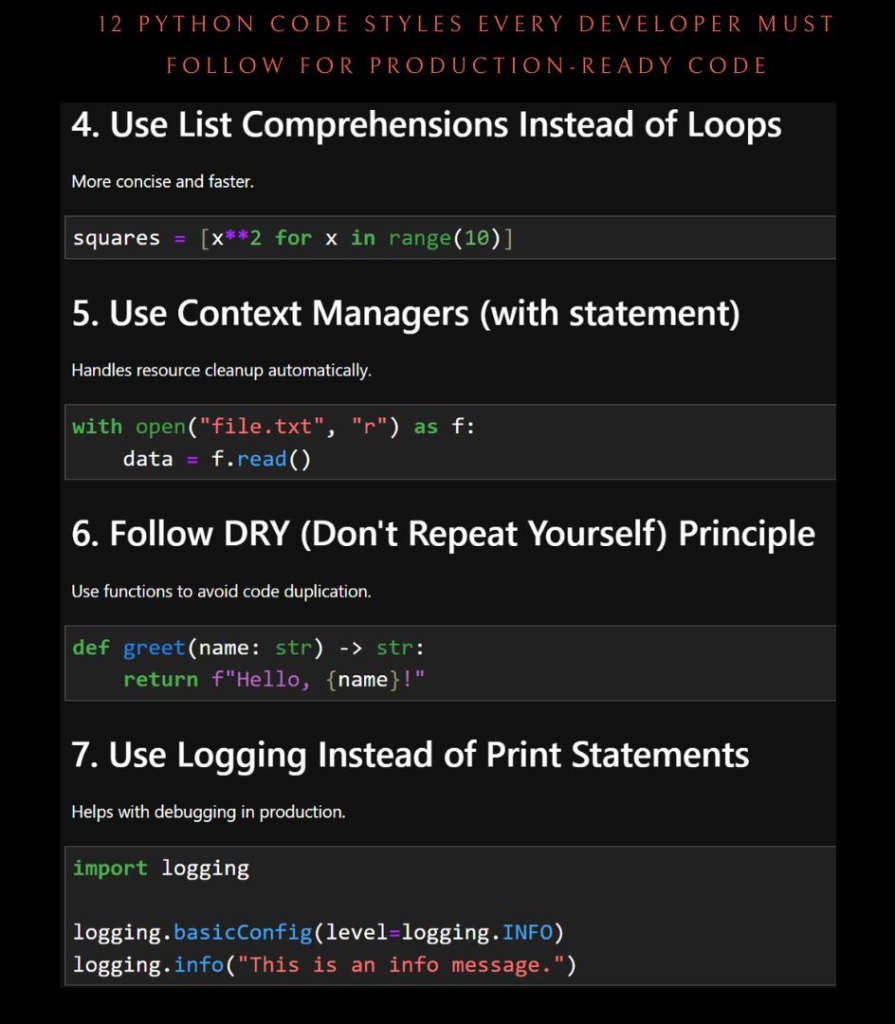
Instead of lengthy loops, Python supports concise list, dictionary, and set comprehensions.
Benefits include:
- Cleaner code
- Better readability
- Fewer lines
Generators
Generators create values lazily.
Advantages include:
- Low memory usage
- Faster processing
- Ideal for large datasets
Decorators
Decorators modify function behavior without changing the original function.
Common uses:
- Logging
- Authentication
- Timing
- Caching
Context Managers
Using with statements ensures resources are cleaned up automatically.
Examples:
- Files
- Database connections
- Network sockets
Type Hints
Modern Python supports optional static typing.
Benefits include:
- Better IDE support
- Fewer bugs
- Easier collaboration
Python Features Covered in the Second Edition 🚀
The second edition includes modern Python features such as:
- Assignment expressions
- Data classes
- pathlib
- f-strings
- typing
- asyncio improvements
- Keyword-only arguments
- Positional-only arguments
- Context variables
Diagrams and Comparison Tables 📊
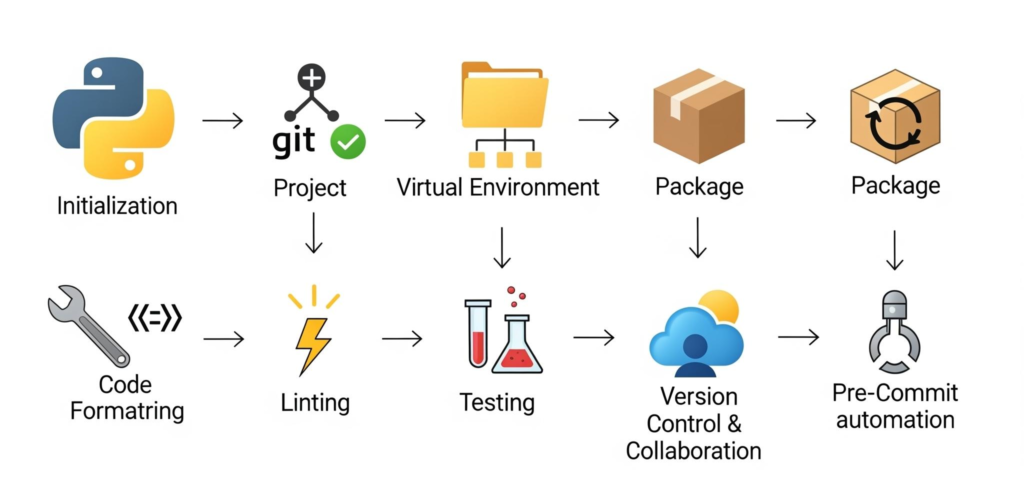
Python Development Workflow
| Phase | Goal |
|---|---|
| Design | Plan architecture |
| Coding | Implement features |
| Testing | Detect bugs |
| Refactoring | Improve quality |
| Deployment | Release application |
| Maintenance | Add new features |
Python Code Quality Pyramid
| Level | Focus |
|---|---|
| Beginner | Syntax |
| Intermediate | Readability |
| Advanced | Maintainability |
| Professional | Scalability |
| Expert | Architecture |
Skills Improved by the Book
| Skill | Improvement |
|---|---|
| Clean Code | ⭐⭐⭐⭐⭐ |
| Debugging | ⭐⭐⭐⭐ |
| Performance | ⭐⭐⭐⭐⭐ |
| Readability | ⭐⭐⭐⭐⭐ |
| Object-Oriented Design | ⭐⭐⭐⭐ |
| Testing | ⭐⭐⭐⭐ |
| Software Architecture | ⭐⭐⭐⭐ |



Practical Examples 💡
Example 1: Data Analysis
A data analyst uses generators to process millions of records efficiently, reducing memory consumption.
Example 2: Web Development
A backend developer applies decorators for authentication, logging, and caching in a REST API.
Example 3: Automation
An IT engineer uses context managers to safely handle thousands of files during automated backups.
Example 4: Machine Learning
A data scientist leverages type hints and modular design to build maintainable machine learning pipelines.
Real-World Applications 🌍
The techniques from this book are widely used in:
- 🤖 Artificial Intelligence
- 📊 Data Science
- ☁️ Cloud Computing
- 🌐 Web Development
- 🔐 Cybersecurity
- 📱 Mobile Backend Systems
- 🏭 Industrial Automation
- 🚀 Robotics
- 📈 Financial Technology (FinTech)
- 🧬 Scientific Computing
- 🛰️ Aerospace Engineering
- 🏥 Healthcare Analytics
- 🎮 Game Development
- 📡 Internet of Things (IoT)
Common Mistakes ❌
Many Python programmers make mistakes such as:
- Writing overly complex code
- Ignoring the standard library
- Misusing inheritance
- Forgetting context managers
- Creating unnecessary loops
- Not using generators
- Avoiding type hints
- Ignoring exceptions
- Poor variable naming
- Copying code instead of creating reusable functions
Challenges and Solutions 🛠️
| Challenge | Solution |
|---|---|
| Slow programs | Use generators and efficient algorithms |
| High memory usage | Lazy evaluation |
| Difficult debugging | Modular code |
| Poor readability | Follow Pythonic conventions |
| Large codebases | Object-oriented design |
| Duplicate code | Create reusable functions |
| Complex APIs | Use decorators and context managers |
Case Study 🏢
Modernizing a Python Automation System
A software consulting company maintained an automation platform containing over 100,000 lines of Python code. The system worked but suffered from duplicated logic, inconsistent naming, and increasing maintenance costs.
Problems
- Repeated code blocks
- Difficult debugging
- High memory usage
- Limited test coverage
- Complex inheritance hierarchy
Improvements Inspired by Effective Python
The engineering team:
- Replaced duplicated code with reusable functions.
- Introduced context managers for safer file and network operations.
- Used generators for processing large datasets.
- Added type hints to improve readability and IDE support.
- Simplified class hierarchies using composition where appropriate.
Results
| Metric | Before | After |
|---|---|---|
| Code duplication | High | Low |
| Memory usage | High | Reduced |
| Readability | Moderate | Excellent |
| Bug frequency | Frequent | Lower |
| Development speed | Slower | Faster |
| Maintainability | Difficult | Easier |
This case demonstrates how adopting proven Python practices can significantly improve software quality without changing the application’s core functionality.
Essential Tips 💎
- 📖 Learn Python fundamentals before reading this book.
- 🧩 Study one recommendation at a time.
- 🔄 Refactor existing projects using the book’s advice.
- 🧪 Write automated tests for new features.
- 🏗️ Favor clear, readable code over clever shortcuts.
- 📦 Use Python’s standard library before adding external dependencies.
- 🧠 Embrace type hints for larger projects.
- 📝 Follow consistent naming conventions.
- 🔍 Profile performance before optimizing.
- 🚀 Keep learning as Python evolves with new language features.
Frequently Asked Questions ❓
Is this book suitable for complete beginners?
No. It is most valuable after you’ve learned Python basics, such as variables, loops, functions, and classes.
Does it teach Python syntax?
Not in depth. It focuses on writing better Python rather than introducing the language.
Is the second edition updated for Python 3?
Yes. It covers modern Python 3 features, including data classes, type hints, assignment expressions, and improvements to asynchronous programming.
Is it useful for data scientists?
Absolutely. Cleaner, more maintainable code benefits data analysis, machine learning, and scientific computing workflows.
Can experienced developers benefit from it?
Yes. Even seasoned Python programmers often discover new idioms, standard library features, and design techniques that improve productivity.
Does it cover asynchronous programming?
Yes. The book introduces modern concurrency concepts such as threads, processes, and asyncio for building scalable applications.
Is it good for interview preparation?
While it is not an interview guide, mastering its recommendations helps you write high-quality code that is often discussed in technical interviews.
Conclusion 🎯
Effective Python, Second Edition: 90 Specific Ways to Write Better Python is more than a programming book—it’s a guide to professional software craftsmanship. Rather than focusing on syntax alone, it teaches the habits and techniques that distinguish maintainable, efficient, and Pythonic code from code that merely works.
By studying its 90 practical recommendations and applying them consistently, developers can improve readability, reduce bugs, optimize performance, and build software that scales gracefully. Whether you’re developing web applications, automating workflows, analyzing data, or contributing to large engineering projects, the principles in this book will help you become a more confident and effective Python programmer.
For students, it provides a bridge from classroom exercises to industry-quality development. For professionals, it serves as a valuable reference that reinforces best practices and introduces modern Python features. Investing time in these techniques can lead to cleaner code, smoother collaboration, and long-term success in any Python-based career.