🏗️ Design of Industrial Structures: Reinforced Cement Concrete and Steel: A Complete Engineering Guide for Modern Industrial Projects
🌍 Introduction 🚀
Industrial structures form the backbone of modern economies. From factories and power plants to warehouses, refineries, and heavy manufacturing units, these structures must safely support massive loads, harsh environments, dynamic machinery, and long operational lifespans.
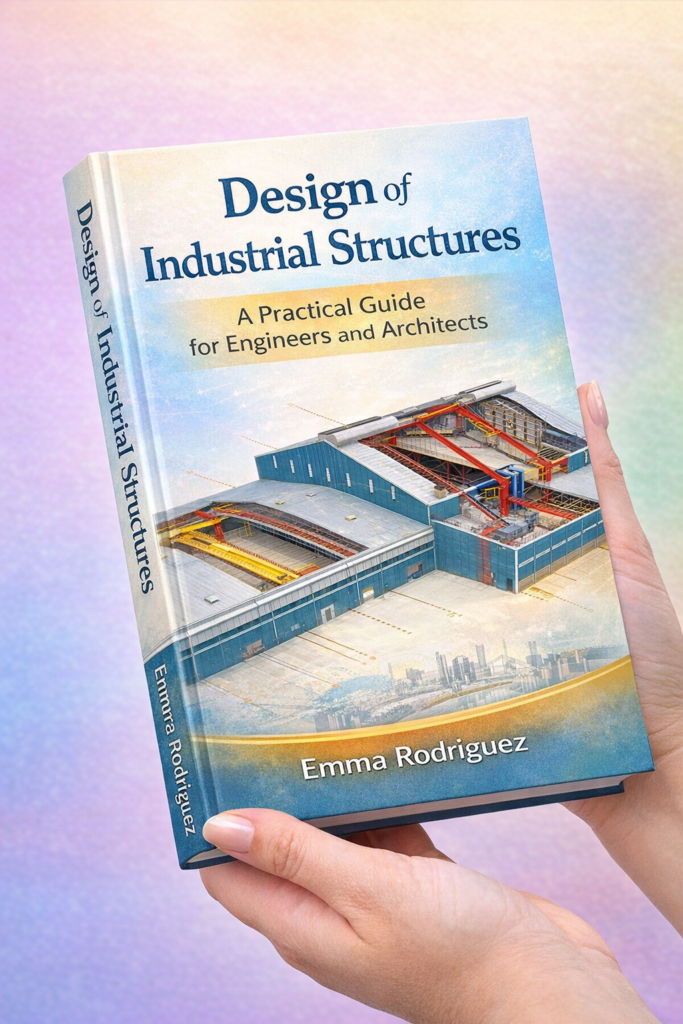
The design of industrial structures is a specialized branch of structural engineering that focuses on Reinforced Cement Concrete (RCC) and Steel structures. Unlike residential or commercial buildings, industrial structures face unique challenges such as vibration, fatigue loading, temperature variations, corrosive environments, and heavy moving loads.
This article is written for:
🎓 Engineering students (civil, structural, construction)
👷 Practicing engineers and designers
🏢 Industry professionals and consultants
It balances beginner-friendly explanations with advanced technical insights, making it useful for readers in the USA, UK, Canada, Australia, and Europe, where international codes and modern construction practices are widely adopted.
📚 Background Theory 🧠
Industrial structures evolved alongside industrialization. Early factories relied heavily on masonry and cast iron, which later proved insufficient due to brittleness and poor fire resistance.
🔹 Evolution of Materials
Reinforced Cement Concrete (RCC) emerged in the early 20th century, combining concrete’s compressive strength with steel’s tensile capacity.
Structural steel gained popularity due to its high strength-to-weight ratio, speed of construction, and adaptability.
🔹 Why Industrial Structures Are Different
Industrial buildings are designed to:
Carry heavy static and dynamic loads
Resist machine-induced vibrations
Allow large column-free spaces
Support cranes, conveyors, silos, and tanks
Operate safely under thermal and chemical exposure
⚙️ Technical Definition 🧩
🔸 What Is an Industrial Structure?
An industrial structure is a building or framework designed primarily to support industrial processes, machinery, storage, or production systems.
🔸 RCC Industrial Structures
Structures where reinforced concrete is used for:
Foundations
Columns
Beams
Slabs
Shear walls
🔸 Steel Industrial Structures
Structures composed mainly of:
Steel columns and beams
Trusses and frames
Crane girders
Bracing systems
Often, hybrid systems (RCC + Steel) are used to optimize cost, performance, and constructability.
🛠️ Step-by-Step Design Process 🔍
🧱 Step 1: Functional Planning
Define the industrial process
Identify machinery layout
Determine clear heights and spans
Plan future expansion
📊 Step 2: Load Assessment
Key loads include:
Dead load
Live load
Equipment load
Crane load
Wind load
Seismic load
Thermal load
📐 Step 3: Structural System Selection
RCC frame
Steel portal frame
Truss system
Composite structure
🧮 Step 4: Structural Analysis
Manual calculations (basic checks)
Software analysis (ETABS, SAP2000, STAAD)
Dynamic and vibration analysis (for machines)
🧾 Step 5: Member Design
RCC design: beams, columns, slabs, footings
Steel design: sections, connections, bracings
🧩 Step 6: Detailing and Drawings
Reinforcement detailing
Connection details
Fabrication drawings
🏗️ Step 7: Construction & Quality Control
Material testing
Site inspections
Compliance with codes
⚖️ Comparison: RCC vs Steel Industrial Structures 🆚
🧱 Reinforced Cement Concrete (RCC)
Advantages:
High fire resistance 🔥
Good durability
Lower maintenance
Suitable for corrosive environments
Disadvantages:
Heavier structure
Longer construction time
Larger foundation size
🔩 Steel Structures
Advantages:
Lightweight
Faster construction 🚀
Longer spans without columns
Easy modification and expansion
Disadvantages:
Corrosion risk
Fire protection required
Higher maintenance cost
🔄 Hybrid Systems
RCC foundations + steel superstructure
Best of both worlds ✔️
🧪 Detailed Examples 📘
Example 1: RCC Industrial Warehouse
Span: 15 m
Column spacing: 6 m
Loads: Storage racks + forklift movement
RCC slabs designed for heavy live load
Expansion joints provided
Example 2: Steel Manufacturing Shed
Span: 30 m
Steel portal frame
Overhead crane of 20 tons
Braced frame system
Bolted connections for faster erection
🌐 Real-World Applications in Modern Projects 🏭
Industrial structure design is widely applied in:
Automotive factories 🚗
Power plants ⚡
Oil & gas refineries 🛢️
Data centers 🖥️
Logistics and warehouses 📦
Pharmaceutical plants 💊
Modern projects integrate:
BIM (Building Information Modeling)
Sustainable materials
Performance-based seismic design
❌ Common Mistakes in Industrial Structure Design ⚠️
Ignoring dynamic machine loads
Underestimating crane impact forces
Poor expansion joint planning
Inadequate corrosion protection
Incorrect foundation assumptions
Overlooking future expansion
🧗 Challenges & Engineering Solutions 🔧
🔴 Challenge: Vibration Control
Solution:
Dynamic analysis
Isolation pads
Tuned mass dampers
🔴 Challenge: Corrosion
Solution:
Protective coatings
Use of high-performance concrete
Cathodic protection
🔴 Challenge: Fire Resistance
Solution:
Fireproofing steel members
RCC encasement
Fire-rated design as per codes
📊 Case Study: Design of an Industrial Plant 🏢
📍 Project Overview
Location: Europe
Facility: Heavy manufacturing plant
Structure: RCC foundations + steel superstructure
🧮 Design Highlights
25-ton overhead cranes
Steel portal frames with bracing
RCC pile foundation due to weak soil
Seismic design as per Eurocode
📈 Results
20% reduction in construction time
Improved future expandability
Excellent performance under operational loads
🎯 Practical Tips for Engineers 👷
Always coordinate with process engineers
Design for future expansion
Never ignore dynamic effects
Use code-compliant load combinations
Invest time in good detailing
Review constructability early
❓ FAQs – Frequently Asked Questions 🤔
1️⃣ Which is better for industrial buildings: RCC or steel?
It depends on span, load, environment, and project timeline. Steel is faster; RCC is more durable.
2️⃣ Are industrial structures designed differently from residential buildings?
Yes. Industrial structures handle heavier loads, vibrations, and operational stresses.
3️⃣ What software is commonly used?
ETABS, SAP2000, STAAD, SAFE, and Tekla Structures.
4️⃣ How important is seismic design?
Very important, especially in seismic zones. Industrial equipment adds complexity.
5️⃣ Can RCC and steel be used together?
Yes. Hybrid structures are common and cost-effective.
6️⃣ What codes are used internationally?
ACI, AISC, Eurocode, BS, AS, and CSA standards.
🏁 Conclusion 🎓
The design of industrial structures using Reinforced Cement Concrete and Steel is a critical engineering discipline that directly impacts safety, efficiency, and economic performance. With rapid industrial growth and technological advancement, engineers must adopt modern design approaches, advanced materials, and international best practices.
Whether you are a student learning fundamentals or a professional handling complex industrial projects, mastering RCC and steel industrial design opens doors to high-impact engineering careers across the globe.
🏗️ Strong design today builds safer industries tomorrow.