Deep Learning: Foundations and Concepts — A Practical Guide for Students and Engineers
Introduction
Deep learning has become one of the most influential technologies in modern engineering and computer science. From autonomous machines and medical imaging to predictive maintenance, robotics, natural-language systems, and intelligent design tools, deep learning enables computers to identify complex patterns from large amounts of data. 🤖🧠
Unlike traditional programming, where engineers explicitly define many rules, deep learning systems can learn useful representations from examples. This capability makes deep learning particularly valuable when the relationship between inputs and outputs is too complicated to describe manually.
For engineering students, understanding deep learning is no longer limited to studying artificial intelligence as a theoretical subject. It can provide a foundation for developing intelligent systems, analyzing sensor data, optimizing industrial processes, and building automation solutions.


This article presents the foundations of deep learning from both beginner and professional perspectives. It explains the underlying ideas, important components, training workflow, model comparisons, practical applications, common mistakes, and engineering challenges.
Background Theory
Deep learning is a specialized area within machine learning, which itself is a major branch of artificial intelligence.
A traditional software system generally follows a predefined sequence:
Input → Rules → Processing → Output
A machine-learning system changes this relationship:
Input Data → Learning Algorithm → Model → Prediction
Deep learning extends this approach by using neural networks containing multiple processing layers.
From Artificial Intelligence to Deep Learning
The development can be viewed as a progression:
Artificial Intelligence → Machine Learning → Neural Networks → Deep Learning
Artificial intelligence is the broadest concept. Machine learning focuses on systems that learn patterns from data. Neural networks are computational models inspired loosely by biological nervous systems. Deep learning uses neural networks with multiple layers to learn increasingly sophisticated representations.
Why Depth Matters
A shallow model may recognize relatively simple patterns. A deeper network can progressively transform information.
For example, an image-processing system could conceptually learn:
Pixels → Edges → Shapes → Objects → Scene
This hierarchical representation is one of the defining strengths of deep learning.
Representation Learning
One of the most important ideas behind deep learning is representation learning.
Instead of requiring an engineer to manually determine every useful feature, a neural network can learn representations directly from training examples.
This is especially powerful for:
- Images
- Audio
- Video
- Text
- Sensor measurements
- Time-series data
- Complex industrial signals
Definition
Deep learning can be defined as a machine-learning approach that uses multi-layer neural networks to automatically learn hierarchical representations from data.
The word deep refers primarily to the presence of multiple computational layers rather than simply the size of a dataset.
A typical deep-learning system contains:
- Input data
- Neural-network layers
- Learnable parameters
- Activation functions
- A training objective
- An optimization process
- Training data
- Validation data
- Evaluation procedures
Neural Network
A neural network consists of interconnected computational units commonly called neurons.
Each neuron receives information, processes it using learned parameters and an activation function, and passes the resulting representation to subsequent units.
A simplified structure is:
Input Layer → Hidden Layer → Hidden Layer → Output Layer
Parameters
Parameters are values learned during training.
They determine how strongly different pieces of information influence subsequent computations.
The training process continuously adjusts these parameters to improve model performance.
Activation Functions
Activation functions introduce nonlinear behavior into neural networks.
Common examples include:
- ReLU
- Sigmoid
- Tanh
- Softmax
Without useful nonlinear transformations, stacking many layers would provide much less expressive power.
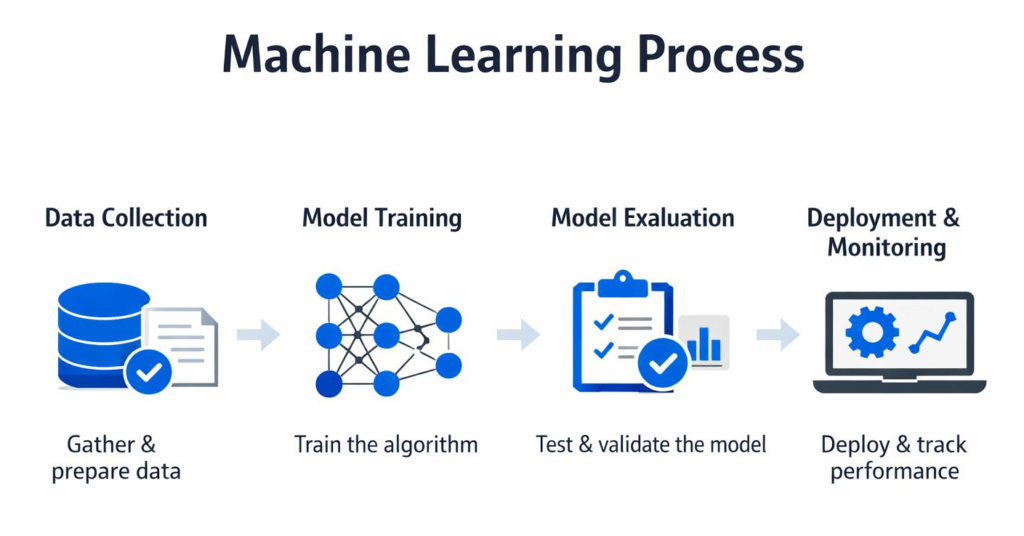
How Deep Learning Works Step by Step
Understanding the workflow is more important for beginners than memorizing terminology.


Step 1: Define the Engineering Problem
Start with the problem rather than the algorithm.
Examples include:
- Detecting defective components
- Predicting equipment failures
- Classifying satellite images
- Recognizing speech
- Estimating energy demand
- Detecting anomalies in sensors
A clearly defined objective determines what type of data and model will be appropriate.
Step 2: Collect Data
Deep-learning models require suitable training information.
Data can come from:
- Cameras
- Sensors
- Databases
- Simulations
- Industrial machines
- Public datasets
- Human-generated records
Data quality often has a larger impact on practical performance than simply selecting a more sophisticated architecture.
Step 3: Clean and Prepare the Data
Raw data frequently contains problems.
Engineers may need to address:
- Missing values
- Duplicate records
- Incorrect labels
- Sensor noise
- Corrupted images
- Inconsistent units
- Imbalanced classes
Data preprocessing creates a more reliable foundation for training.
Step 4: Divide the Dataset
A common workflow separates data into:
Training set → Validation set → Test set
The training set is used for learning.
The validation set helps engineers tune the development process.
The test set provides an independent evaluation of the final model.
Step 5: Select an Architecture
Different problems require different architectures.
Examples include:
- Feedforward neural networks
- Convolutional neural networks
- Recurrent neural networks
- Transformers
- Autoencoders
- Graph neural networks
Architecture selection should be driven by the structure of the problem.
Step 6: Train the Model
During training, the neural network produces predictions.
The predictions are compared with the desired outputs through a loss function.
An optimization algorithm then adjusts model parameters to reduce the loss.
This process repeats across many training iterations.
Step 7: Validate Performance
Training performance alone is not sufficient.
An engineer must determine whether the model also works on previously unseen examples.
This is where validation and testing become essential.
Step 8: Deploy the Model
After successful evaluation, the model can be integrated into a real application.
Deployment may occur on:
- Cloud servers
- Industrial computers
- Mobile devices
- Embedded systems
- Edge-AI hardware
- Autonomous machines
Step 9: Monitor the System
Deployment is not the end of the engineering process.
Real-world data can change over time.
Engineers should monitor:
- Accuracy
- Latency
- Reliability
- Input-data quality
- Hardware utilization
- Prediction distribution
- Model drift
Comparison of Deep Learning Approaches
Different neural-network families have different strengths.
| Architecture | Typical Strength | Example Application |
|---|---|---|
| Feedforward Network | General structured data | Engineering prediction |
| CNN | Spatial patterns | Image inspection |
| RNN | Sequential information | Time-series analysis |
| Transformer | Long-range relationships | Language and multimodal AI |
| Autoencoder | Representation learning | Anomaly detection |
| Graph Neural Network | Relationships between entities | Network and structural analysis |
Deep Learning vs Traditional Machine Learning
Traditional machine learning often depends heavily on engineered features.
Deep learning can learn useful representations directly from relatively raw inputs.
However, this does not mean deep learning is always superior.
For smaller structured datasets, classical methods can sometimes be easier, faster, and more reliable.
Deep Learning vs Traditional Programming
Traditional programming requires explicit rules.
Deep learning instead learns patterns from examples.
This makes deep learning attractive when the rules are difficult to define manually.
However, learned behavior can be harder to interpret and validate.
Diagrams and System Architecture
A basic deep-learning architecture can be represented conceptually as:
                 DATA
                   │
                   ▼
          ┌─────────────────┐
          │ Data Preparation│
          └────────┬────────┘
                   │
                   ▼
          ┌─────────────────┐
          │ Input Layer     │
          └────────┬────────┘
                   │
                   ▼
          ┌─────────────────┐
          │ Hidden Layer 1  │
          └────────┬────────┘
                   │
                   ▼
          ┌─────────────────┐
          │ Hidden Layer 2  │
          └────────┬────────┘
                   │
                   ▼
          ┌─────────────────┐
          │ Hidden Layer N  │
          └────────┬────────┘
                   │
                   ▼
          ┌─────────────────┐
          │ Output Layer    │
          └────────┬────────┘
                   │
                   ▼
              PREDICTION


Training Feedback Loop
Deep-learning training can also be understood as a feedback cycle:
        Input Data
            ↓
       Neural Network
            ↓
        Prediction
            ↓
      Loss Evaluation
            ↓
     Parameter Update
            ↓
       Improved Model
            ↺
This cycle continues until the model reaches an acceptable level of performance or the training process is stopped.
Important Engineering Components
| Component | Purpose |
|---|---|
| Dataset | Provides learning examples |
| Neural Network | Represents the learned relationship |
| Loss Function | Measures prediction error |
| Optimizer | Updates model parameters |
| Validation Set | Supports model selection |
| Test Set | Measures generalization |
| Hardware | Provides computational resources |
| Monitoring | Detects deployment problems |


Practical Examples
Example 1: Industrial Defect Detection
Imagine a manufacturing facility producing metal components.
A camera captures photographs of finished components.
Engineers provide examples labeled as acceptable or defective.
A deep-learning vision model can learn visual patterns associated with defects.
During production, new images are sent to the model.
The system can then flag components requiring human inspection.
Example 2: Predictive Maintenance
Industrial equipment generates vibration, temperature, pressure, and acoustic data.
Instead of waiting for a machine to fail, engineers can train a model using historical operating information.
The model can identify unusual patterns associated with developing faults.
Maintenance teams can then investigate the equipment before a major failure occurs.
Example 3: Engineering Document Analysis
A deep-learning language model can process large collections of technical documents.
It may assist engineers in:
- Finding relevant information
- Classifying documents
- Extracting technical terms
- Summarizing reports
- Searching maintenance records
The engineer should still verify important technical conclusions.
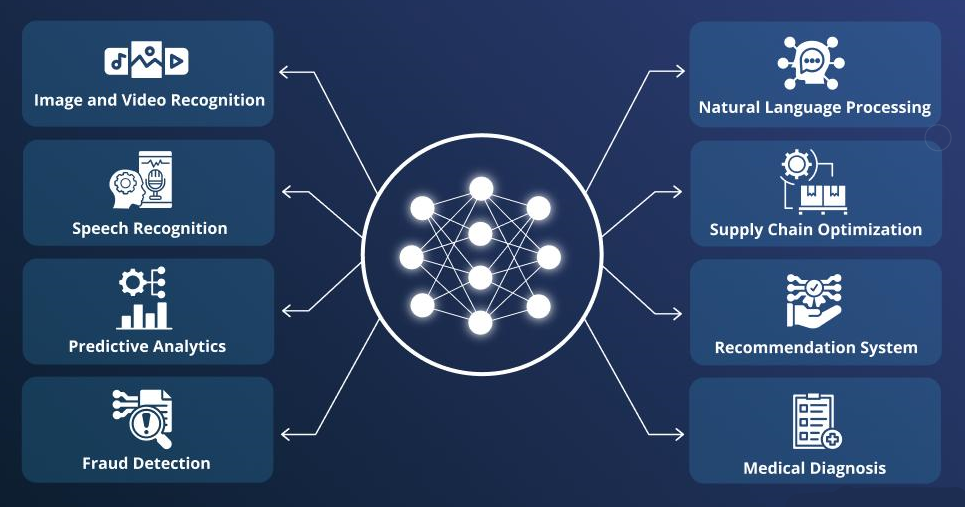
Real-World Applications
Deep learning has expanded across many engineering disciplines.
Mechanical Engineering
Applications include:
- Predictive maintenance
- Fault detection
- Quality inspection
- Digital twins
- Manufacturing optimization
- Robot control
Civil Engineering
Potential applications include:
- Structural-health monitoring
- Crack detection
- Construction-site analysis
- Traffic prediction
- Infrastructure inspection
- Material classification
Electrical Engineering
Deep learning can support:
- Load forecasting
- Fault classification
- Power-quality analysis
- Renewable-energy prediction
- Smart-grid optimization
Aerospace Engineering
Applications include:
- Aircraft inspection
- Sensor-data analysis
- Predictive maintenance
- Autonomous navigation
- Anomaly detection
Software and Computer Engineering
Deep learning supports:
- Computer vision
- Natural-language processing
- Speech recognition
- Recommendation systems
- Generative AI
- Intelligent cybersecurity analysis
Common Mistakes
Using Too Little or Poor-Quality Data
A sophisticated model cannot compensate for fundamentally unreliable training data.
Solution: Improve collection, labeling, cleaning, and validation procedures.
Choosing a Model Because It Is Popular
A transformer may be powerful, but that does not automatically make it the best choice for every engineering problem.
Solution: Match architecture complexity to the data and objective.
Ignoring Overfitting
A model can perform extremely well on training data while performing poorly on unseen examples.
Solution: Use appropriate validation procedures, regularization, augmentation, and careful model selection.
Data Leakage
Data leakage occurs when information unavailable during real operation accidentally enters the training process.
This can produce misleadingly impressive results.
Solution: Design data splitting and preprocessing pipelines carefully.
Measuring Only Accuracy
Accuracy can be misleading, particularly with imbalanced datasets.
Solution: Consider precision, recall, F1 score, confusion matrices, calibration, latency, and application-specific metrics.
Ignoring Deployment Constraints
A model may work well in a development environment but be too slow or computationally expensive for the target hardware.
Solution: Evaluate deployment requirements early.
Challenges and Solutions
| Challenge | Engineering Solution |
|---|---|
| Limited data | Transfer learning, augmentation, simulation |
| Noisy data | Filtering, cleaning, robust preprocessing |
| Overfitting | Regularization and better validation |
| High computation | GPUs, optimization, model compression |
| Poor interpretability | Explainability techniques and expert review |
| Model drift | Continuous monitoring |
| Deployment latency | Quantization and efficient architectures |
| Security concerns | Robust testing and secure deployment |
| Class imbalance | Appropriate sampling and evaluation metrics |
Explainability
Deep-learning systems can sometimes behave like black boxes.
For safety-critical engineering, simply obtaining a prediction may not be sufficient.
Engineers may need to understand why a system generated a particular output.
Interpretability techniques can provide additional insight into model behavior, although they do not automatically guarantee that a model is correct.
Case Study: Intelligent Machine Monitoring
Consider a factory operating hundreds of industrial motors.
Historically, technicians inspect machines according to fixed maintenance schedules.
The company begins collecting:
- Vibration readings
- Motor temperature
- Operating load
- Electrical measurements
- Maintenance history
Phase 1: Data Collection
Sensors continuously record operating conditions.
Historical maintenance records provide information about previous failures and repairs.
Phase 2: Data Preparation
Engineers synchronize sensor records and maintenance events.
They remove corrupted measurements and identify periods with known equipment problems.
Phase 3: Model Development
A deep-learning model is trained to identify patterns associated with abnormal machine behavior.
Several architectures are evaluated rather than assuming one model will automatically be optimal.
Phase 4: Testing
The model is evaluated using equipment and operating periods that were not used during training.
This provides a more realistic estimate of performance.
Phase 5: Deployment
The system generates alerts when sensor patterns significantly differ from expected operating behavior.
Importantly, the model does not automatically shut down machinery.
Instead, maintenance personnel receive an alert and investigate the equipment.
Engineering Lesson
The greatest value does not come simply from having a neural network.
It comes from combining:
Sensors + Data Engineering + Deep Learning + Domain Expertise + Human Decision-Making
This combination is fundamental to successful engineering AI.
Essential Tips for Learning Deep Learning
Build the Fundamentals First
Before studying advanced architectures, understand:
- Python programming
- Data structures
- Basic statistics
- Linear algebra concepts
- Machine-learning fundamentals
- Data preprocessing
Start With Small Projects
A small classification project can teach more practical lessons than immediately attempting to build an enormous AI system.
Visualize Your Data
Always investigate the data before training.
Visualization can reveal:
- Outliers
- Imbalance
- Missing values
- Unexpected patterns
- Incorrect labels
Learn the Training Process
Do not treat training as simply pressing a button.
Understand:
Data → Prediction → Loss → Optimization → Updated Model
Separate Training and Testing Carefully
A test dataset should represent unseen information.
Using the test set repeatedly during development can undermine its value as an independent evaluation.
Consider the Complete Engineering System
A production AI solution involves more than a model.
Think about:
Data → Model → Hardware → Software → Users → Monitoring → Maintenance
Keep Humans in the Loop
For safety-critical or high-impact applications, deep learning should generally support qualified human decision-making rather than blindly replacing it.
FAQs
What is deep learning in simple terms?
Deep learning is a machine-learning approach that uses neural networks with multiple layers to learn patterns from data. It is particularly effective for complex information such as images, language, audio, and sensor signals.
Is deep learning difficult for beginners?
The basic concepts can be learned progressively. Beginners should start with Python, basic mathematics, machine-learning concepts, and simple neural networks before moving to advanced architectures.
What is the difference between AI, machine learning, and deep learning?
Artificial intelligence is the broad field. Machine learning is a subset focused on learning from data. Deep learning is a machine-learning approach based primarily on multi-layer neural networks.
Do deep-learning models always require huge datasets?
Not always. Large datasets can be valuable, but transfer learning, data augmentation, simulation, and entrained models can make deep learning practical when labeled data is limited.
Which programming language is commonly used for deep learning?
Python is widely used because of its extensive ecosystem for numerical computing, machine learning, data processing, visualization, and neural-network development.
Is a GPU necessary for learning deep learning?
No. Small educational projects can run on CPUs. GPUs become increasingly useful as datasets, models, and training workloads become larger.
Can deep learning replace engineers?
Deep learning can automate specific analytical and repetitive tasks, but engineering judgment remains essential. Successful systems combine computational intelligence with domain expertise, validation, safety procedures, and human oversight.
What should I learn after understanding the foundations?
A practical progression is:
Python → Machine Learning → Neural Networks → Deep Learning → Computer Vision/NLP → Model Deployment → MLOps
Conclusion
Deep learning is more than a collection of neural-network architectures. It is an engineering methodology for extracting useful patterns and representations from complex data. 🧠⚙️
Its foundations include data preparation, neural-network architecture, activation functions, loss evaluation, optimization, validation, testing, deployment, and continuous monitoring.
For students, the best approach is to build understanding progressively rather than jumping immediately into highly complex models. For professionals, the most important lesson is that model performance is only one part of a successful AI system.
A reliable engineering solution requires high-quality data, an appropriate architecture, careful evaluation, suitable computing resources, robust deployment, and domain expertise.
The future of engineering will increasingly involve collaboration between humans and intelligent computational systems. Engineers who understand both the fundamentals of deep learning and the practical realities of engineering workflows will be better prepared to design reliable, efficient, and responsible intelligent systems. 🚀
Deep Learning = Data + Representation Learning + Optimization + Engineering Judgment.