Deep Learning Algorithms: A Complete Beginner-to-Advanced Guide to Neural Networks, AI Models, and Real-World Applications
Introduction 🚀
Deep Learning has become one of the most transformative technologies of the 21st century. From self-driving cars and medical diagnosis to virtual assistants and industrial automation, deep learning algorithms are changing the way computers solve complex problems.
Unlike traditional machine learning algorithms that often require handcrafted features, deep learning automatically learns patterns directly from data. This capability enables computers to recognize images, understand speech, translate languages, detect fraud, generate realistic images, and even create human-like text.
Today, companies such as Google, Microsoft, NVIDIA, Tesla, Amazon, Meta, and OpenAI invest billions of dollars in deep learning research because it powers many modern AI systems.
Whether you’re an engineering student, data scientist, software developer, or AI researcher, understanding deep learning algorithms has become an essential skill for modern engineering careers.
In this comprehensive guide, you’ll learn:
- 🤖 What deep learning algorithms are
- 🧠 How artificial neural networks work
- 📊 Popular deep learning architectures
- ⚙️ Training process step by step
- 📈 Engineering applications
- 💡 Best practices
- 🚀 Future trends


Background Theory 📚
Deep learning is a subset of Artificial Intelligence (AI).
The relationship between different fields can be illustrated as follows:
Artificial Intelligence
        │
        ▼
Machine Learning
        │
        ▼
Deep Learning
        │
        ▼
Neural Networks
Artificial Intelligence focuses on making machines intelligent.
Machine Learning allows computers to learn patterns from data instead of following manually programmed rules.
Deep Learning goes one step further by using multiple layers of artificial neurons that automatically discover increasingly complex features.
For example:
- Traditional programming:
- Input → Rules → Output
- Machine Learning:
- Input + Output → Learn Rules
- Deep Learning:
- Raw Data → Learn Features → Learn Rules → Output
This automation is why deep learning has surpassed many traditional algorithms in accuracy.
Definition 🧠
Deep Learning Algorithms are machine learning methods that use multi-layer artificial neural networks to automatically learn hierarchical representations from large datasets.
These algorithms imitate, in a simplified way, how neurons communicate inside the human brain.
The word “Deep” refers to having many hidden layers between the input and output.
A typical neural network consists of:
- Input Layer
- Hidden Layers
- Output Layer
Each neuron performs mathematical calculations before passing information to the next layer.
Understanding Artificial Neural Networks Step by Step ⚙️


Step 1 — Data Collection 📂
Everything begins with data.
Examples include:
- Medical images
- Financial transactions
- Satellite imagery
- Customer reviews
- Voice recordings
- Videos
Higher-quality datasets generally lead to better-performing models.
Step 2 — Data Preprocessing 🔧
Engineers clean and prepare the dataset.
Typical preprocessing includes:
- Removing duplicates
- Handling missing values
- Data normalization
- Image resizing
- Feature scaling
- Data augmentation
Example:
Original image
↓
Resize
↓
Normalize pixels
↓
Feed into network
Step 3 — Forward Propagation ➡️
The data enters the input layer.
Each neuron computes:
Output = Activation(Weights × Inputs + Bias)
Information flows through every hidden layer until reaching the output layer.
Step 4 — Loss Calculation 📉
The model compares its prediction with the correct answer.
Example:
Actual:
Cat
Prediction:
Dog
Error = High
The objective is minimizing this error.
Step 5 — Backpropagation 🔄
This is the heart of deep learning.
The algorithm calculates how much each weight contributed to the error.
Weights are updated using gradients.
Step 6 — Optimization 🚀
Optimization algorithms adjust weights.
Popular optimizers include:
- Gradient Descent
- SGD
- Adam
- RMSProp
- Adagrad
Adam is currently one of the most widely used optimizers.
Step 7 — Repeat Thousands of Times 🔁
The training process repeats for many epochs until the model reaches acceptable accuracy.
Types of Deep Learning Algorithms 🏗️
| Algorithm | Best For | Example |
|---|---|---|
| Feedforward Neural Network | Classification | Customer churn |
| CNN | Images | Face recognition |
| RNN | Sequential Data | Speech recognition |
| LSTM | Time Series | Stock prediction |
| GRU | NLP | Chatbots |
| Autoencoder | Compression | Noise removal |
| GAN | Image Generation | AI Art |
| Transformer | Language Models | ChatGPT-like systems |
| Diffusion Models | Image Generation | AI Images |
Popular Neural Network Architectures
Feedforward Neural Networks
The simplest architecture.
Information only moves forward.
Used for:
- Basic classification
- Regression
- Small datasets
Convolutional Neural Networks (CNN)
Designed specifically for images.
Key operations:
- Convolution
- Pooling
- Fully Connected Layers
Applications:
- Medical imaging
- Face recognition
- Self-driving cars
- Manufacturing inspection
Recurrent Neural Networks (RNN)
Designed for sequences.
Applications:
- Language processing
- Weather prediction
- Speech recognition
Long Short-Term Memory (LSTM)
An improved RNN capable of remembering long-term dependencies.
Applications include:
- Financial forecasting
- Energy demand prediction
- Traffic prediction
Transformer Networks
Modern AI systems mostly rely on transformers.
Advantages:
- Faster training
- Better scalability
- Superior language understanding
Applications:
- Chatbots
- Translation
- Code generation
- Scientific research
Deep Learning Workflow 📈
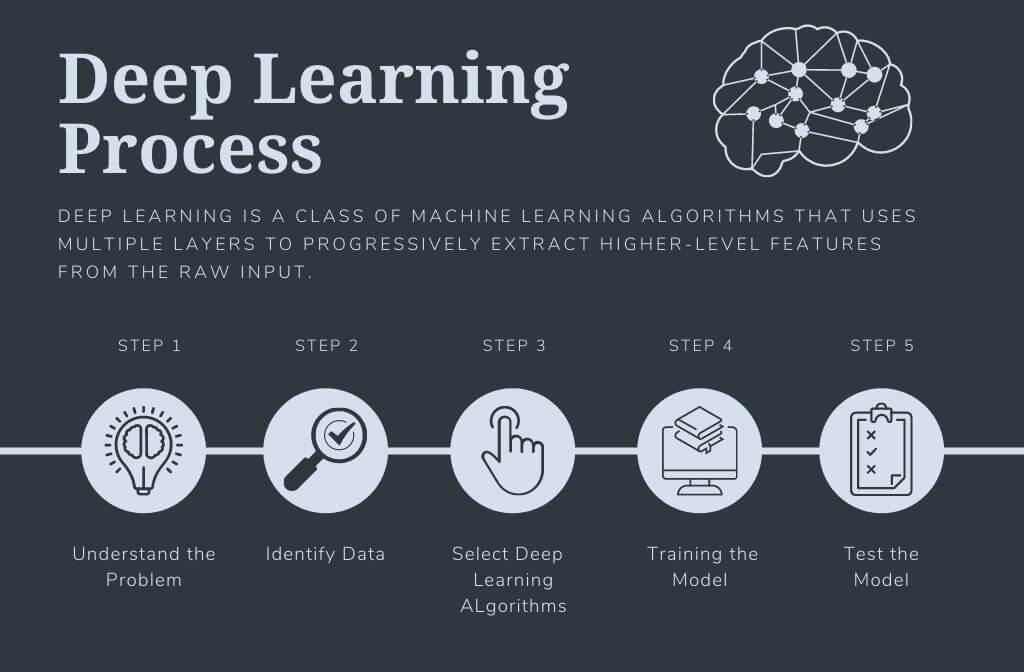


| Stage | Description |
|---|---|
| Data Collection | Gather raw data |
| Cleaning | Remove errors |
| Labeling | Add annotations |
| Training | Learn patterns |
| Validation | Tune parameters |
| Testing | Evaluate performance |
| Deployment | Use in production |
| Monitoring | Improve continuously |
Comparison of Popular Algorithms ⚖️
| Feature | CNN | RNN | LSTM | Transformer |
|---|---|---|---|---|
| Images | ⭐⭐⭐⭐⭐ | ⭐ | ⭐ | ⭐⭐⭐ |
| Text | ⭐⭐ | ⭐⭐⭐ | ⭐⭐⭐⭐ | ⭐⭐⭐⭐⭐ |
| Video | ⭐⭐⭐⭐ | ⭐⭐⭐ | ⭐⭐⭐ | ⭐⭐⭐⭐⭐ |
| Speech | ⭐⭐ | ⭐⭐⭐⭐ | ⭐⭐⭐⭐⭐ | ⭐⭐⭐⭐⭐ |
| Speed | Fast | Medium | Medium | Fast |
| Accuracy | High | Medium | High | Very High |
Examples 💻
Image Classification
Input:
Dog image
Output:
Dog
98.7% confidence
Medical Diagnosis
Input:
Chest X-ray
Output:
Pneumonia Detected
96% Confidence
Fraud Detection
Input:
Credit card transaction
Output:
Fraud Probability
0.91
Language Translation
Input:
Hello
↓
Output:
Bonjour
Voice Assistant
Input:
“Turn on the lights.”
↓
Output:
Smart home executes the command.
Real-World Applications 🌍
Deep learning powers solutions across nearly every engineering discipline.
Healthcare 🏥
- Cancer detection
- MRI analysis
- Drug discovery
- Medical imaging
- Disease prediction
Mechanical Engineering ⚙️
- Predictive maintenance
- Defect detection
- Robotics
- Quality inspection
Civil Engineering 🏗️
- Structural monitoring
- Crack detection
- Traffic forecasting
- Smart cities
Electrical Engineering ⚡
- Power forecasting
- Grid optimization
- Fault diagnosis
Aerospace Engineering ✈️
- Flight control
- Satellite image analysis
- Autonomous drones
Manufacturing 🏭
- Smart factories
- Automated inspection
- Process optimization
Finance 💳
- Fraud detection
- Risk prediction
- Algorithmic trading
Agriculture 🌾
- Crop monitoring
- Disease detection
- Yield prediction
Common Mistakes ❌
Many beginners encounter avoidable issues when training deep learning models.
| Mistake | Consequence | Solution |
|---|---|---|
| Too little data | Poor accuracy | Collect more data |
| Overfitting | Memorization | Use regularization |
| Ignoring preprocessing | Low performance | Clean data |
| Wrong learning rate | Slow or unstable training | Tune hyperparameters |
| Small batch size | Noisy updates | Experiment with batch sizes |
| No validation set | Misleading results | Split the dataset properly |
Challenges and Solutions 🛠️
| Challenge | Solution |
|---|---|
| Huge computational cost | Use GPUs or TPUs |
| Large datasets | Data augmentation |
| Long training time | Distributed computing |
| Model bias | Balanced datasets |
| Explainability | Explainable AI (XAI) |
| Memory limitations | Model pruning and quantization |
Case Study 📖
Predicting Equipment Failure in Manufacturing
A manufacturing company experienced frequent machine failures that caused costly downtime.
Problem
Unexpected equipment breakdowns reduced productivity.
Solution
Engineers installed sensors to collect:
- Temperature
- Pressure
- Vibration
- Current
- Rotation speed
An LSTM-based deep learning model analyzed time-series sensor data to predict failures before they occurred.
Results
| Metric | Before | After |
|---|---|---|
| Downtime | 18% | 6% |
| Maintenance Cost | High | Reduced |
| Production Efficiency | 82% | 95% |
| Failure Prediction Accuracy | N/A | 97% |
The project demonstrated how predictive maintenance with deep learning can improve operational efficiency and reduce costs.
Essential Tips 💡
- 🎯 Begin with simple neural networks before tackling complex architectures.
- 📊 Invest time in collecting and cleaning high-quality data.
- ⚙️ Normalize features to improve convergence.
- 📈 Monitor both training and validation metrics to detect overfitting.
- 💾 Save checkpoints during long training sessions.
- 🧪 Experiment with learning rates, optimizers, and batch sizes.
- 🧩 Use transfer learning when labeled data is limited.
- 🚀 Leverage GPUs or cloud platforms for faster experimentation.
- 📚 Stay updated with current research, as deep learning evolves rapidly.
- 🔍 Evaluate models using appropriate metrics, not just accuracy.
Frequently Asked Questions ❓
Is deep learning the same as machine learning?
No. Deep learning is a specialized branch of machine learning that relies on deep neural networks with multiple hidden layers.
How much mathematics is required?
A solid understanding of linear algebra, calculus, probability, and statistics is helpful, but beginners can start by learning the concepts while gradually building their mathematical foundation.
Why is deep learning so powerful?
Because it automatically learns useful features from raw data, reducing the need for manual feature engineering and enabling high performance on complex tasks.
Which programming language is most popular?
Python is the dominant language due to its rich ecosystem of AI libraries and frameworks.
What hardware is recommended?
For small projects, modern CPUs may be enough. For larger models, GPUs significantly reduce training time, while TPUs are often used in large-scale cloud environments.
What industries use deep learning?
Healthcare, finance, manufacturing, transportation, cybersecurity, agriculture, telecommunications, retail, aerospace, education, and many others.
Can beginners learn deep learning?
Yes. Starting with Python, basic machine learning concepts, and simple neural networks provides a strong foundation before exploring advanced architectures like CNNs and Transformers.
Conclusion 🎯
Deep learning algorithms have transformed modern engineering by enabling computers to learn directly from vast amounts of data and solve problems once considered beyond the reach of machines. From image recognition and language understanding to predictive maintenance and autonomous systems, these algorithms are driving innovation across industries worldwide.
For students, mastering deep learning opens doors to careers in artificial intelligence, robotics, data science, computer vision, and intelligent automation. For professionals, it offers powerful tools to optimize processes, improve decision-making, and develop next-generation products.
As computing power, data availability, and neural network architectures continue to advance, deep learning will remain at the forefront of technological progress. Building a strong foundation in neural networks, optimization techniques, and modern architectures such as Convolutional Neural Networks (CNNs), Long Short-Term Memory (LSTM) networks, and Transformers will prepare engineers to tackle increasingly complex real-world challenges and contribute to the future of intelligent systems.