Data Mining 3rd Edition: Concepts and Techniques – Complete Guide to Data Mining Methods, Algorithms, and Applications
Introduction
In the modern engineering and technology environment, organizations generate enormous quantities of data every day. Sensors, websites, databases, mobile applications, financial systems, industrial machines, and scientific instruments continuously produce information. The challenge is no longer simply collecting data—it is discovering useful knowledge hidden inside it. 🔍📊
This is where data mining becomes important. Data mining combines ideas from statistics, databases, machine learning, artificial intelligence, pattern recognition, and computational methods to discover meaningful structures and relationships within large datasets.
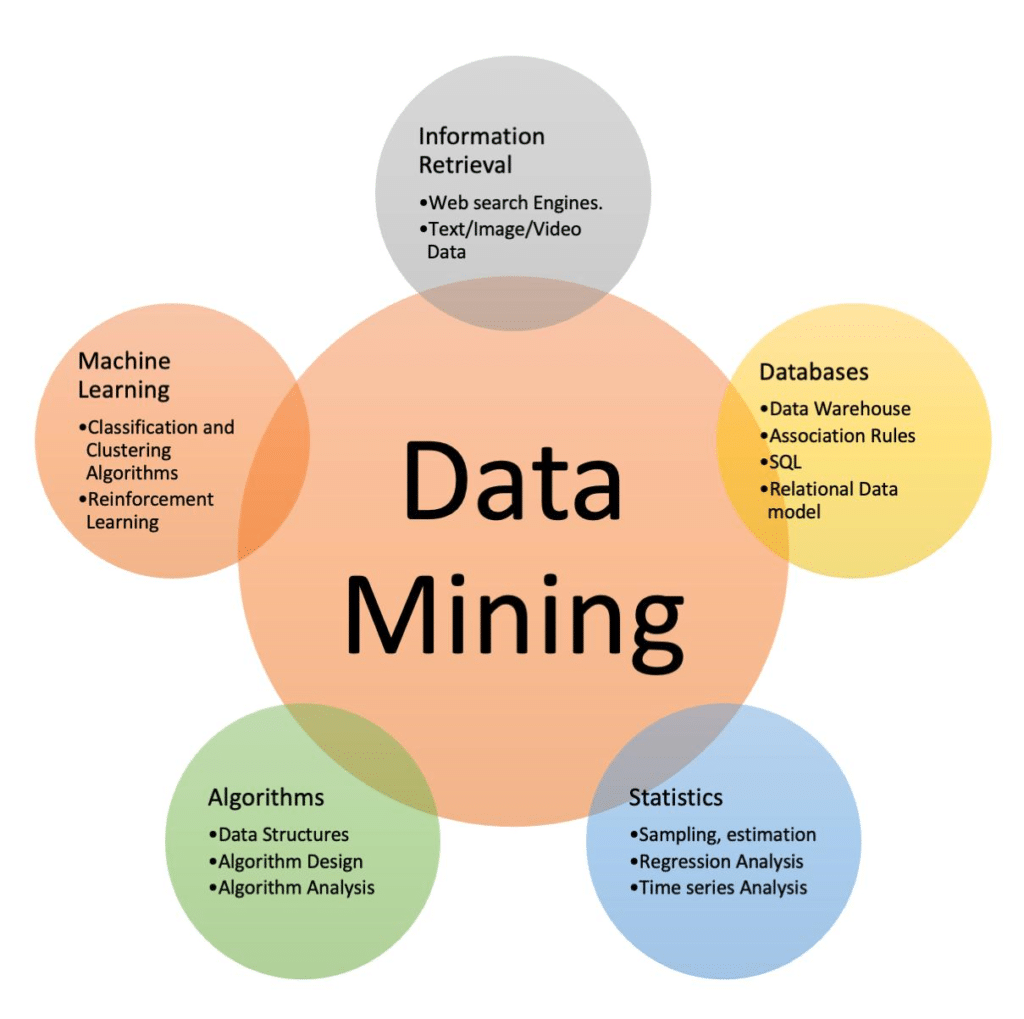
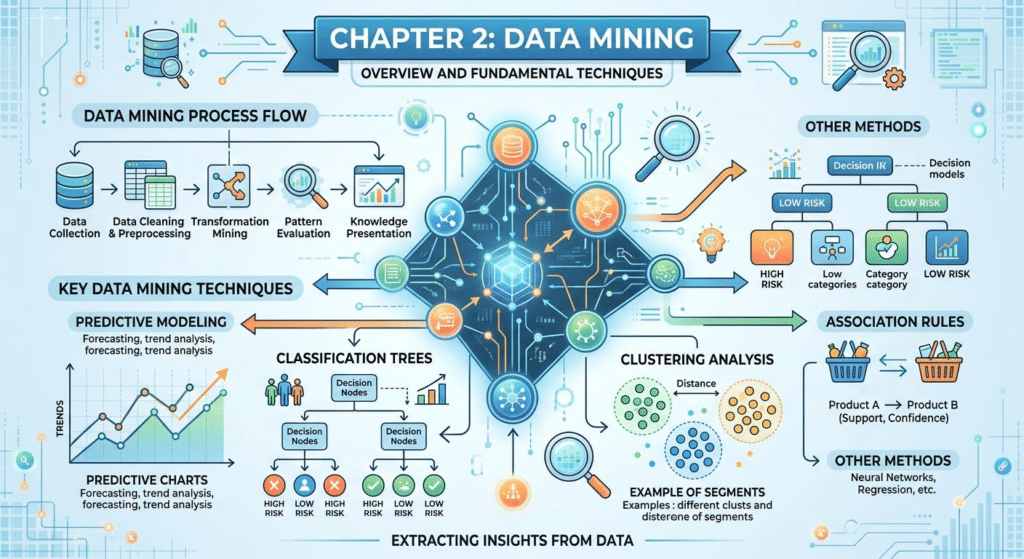


The third edition of Data Mining: Concepts and Techniques, by Jiawei Han, Micheline Kamber, and Jian Pei, provides a broad academic treatment of data mining, including data preprocessing, data warehousing, frequent-pattern mining, classification, prediction, clustering, outlier analysis, and advanced data-mining topics. The publisher describes the book as focusing on techniques for discovering knowledge from collected data, particularly with attention to usefulness, effectiveness, feasibility, and scalability.
This article provides an original educational overview inspired by the subject areas covered by the book, rather than reproducing its copyrighted text.
Background Theory
Data mining is closely connected with the broader concept of Knowledge Discovery from Data (KDD).
A simplified KDD workflow can be represented as:
Raw Data → Preparation → Transformation → Mining → Evaluation → Knowledge → Decision
The important point is that data mining is not simply “running an algorithm.”
A sophisticated project normally involves several stages:
- Understanding the problem
- Collecting appropriate data
- Cleaning inaccurate records
- Transforming variables
- Selecting useful features
- Applying mining algorithms
- Evaluating discovered patterns
- Communicating the results
- Deploying useful models
For engineers and data professionals, this distinction is extremely important. A technically sophisticated algorithm can still produce useless results if the original dataset is incomplete, biased, poorly structured, or unrelated to the engineering question.
Why Data Mining Matters
Consider an industrial facility containing thousands of sensors.
Every sensor might record:
where the variables could represent temperature, pressure, vibration, current, flow rate, humidity, and machine status.
A data-mining system can investigate relationships among these variables and potentially identify conditions associated with equipment failures.
Therefore:
Relationship With Machine Learning
Data mining and machine learning overlap significantly, but they are not identical.
Machine learning often emphasizes learning predictive or descriptive models from data.
Data mining has a broader emphasis on discovering useful patterns and knowledge from potentially large and complex datasets.
Modern engineering projects frequently combine both.
Definition
Data mining can be defined as the systematic process of discovering useful, previously unknown, or actionable patterns, relationships, structures, and anomalies in data.
Common data-mining tasks include:
| Task | Main Objective | Example |
|---|---|---|
| Classification | Assign data to known categories | Fault / No Fault |
| Regression | Predict a numerical value | Predict energy consumption |
| Clustering | Discover natural groups | Group similar customers |
| Association Mining | Discover relationships | Products frequently purchased together |
| Outlier Detection | Identify unusual observations | Detect abnormal sensor readings |
| Sequential Mining | Discover ordered patterns | Analyze machine-event sequences |
The third edition covers these broad areas while also discussing data preparation, data warehousing, OLAP, frequent patterns, advanced classification, clustering, outlier detection, complex data types, applications, and research trends.
Step-by-Step Data Mining Process
A practical data-mining project can be understood as a cycle rather than a one-way pipeline.


Step 1: Define the Engineering or Business Problem
Start with a precise question.
For example:
Can machine sensor measurements be used to predict equipment failure 24 hours in advance?
This is much better than simply saying:
“Analyze the machine data.”
A good problem definition establishes the target, available data, constraints, and success criteria.
Step 2: Collect the Data
Potential sources include:
- SQL databases
- Data warehouses
- IoT sensors
- Manufacturing systems
- Web logs
- Transaction records
- Scientific experiments
- Customer databases
- Engineering simulations
The quality and relevance of the data determine much of the eventual quality of the analysis.
Step 3: Clean the Dataset
Real datasets are rarely perfect.
Typical problems include:
Cleaning may involve removing duplicate records, correcting invalid values, handling missing observations, and identifying suspicious measurements.
Step 4: Transform the Data
Algorithms often work better when variables are represented appropriately.
For example, an engineer may convert:
or:
This stage can reveal useful features that were not directly available in the original dataset.
Step 5: Select a Mining Method
The appropriate algorithm depends on the question.
📊 For known target categories, classification may be appropriate.
📊 For discovering unknown groups, clustering may be more suitable.
For predicting numerical values, regression can be useful.
For discovering relationships between events or products, association analysis may be appropriate.
Step 6: Build and Test the Model
The dataset is generally divided into development and evaluation portions.
A simplified concept is:
The model learns from , while provides an independent indication of how well the model performs on unseen observations.
Step 7: Evaluate the Results
Evaluation should not rely on a single number.
For classification, engineers may examine:
For regression:
For clustering, measures such as cohesion, separation, or silhouette-based evaluation can be considered.
Step 8: Deploy and Monitor
A successful model must eventually produce value.
Deployment could mean:
- An engineering dashboard
- An automated alert
- A recommendation engine
- A predictive-maintenance system
- A quality-control application
- A forecasting service
The process is iterative: new data can reveal weaknesses that require additional preparation or modeling.
Comparison of Major Data Mining Techniques
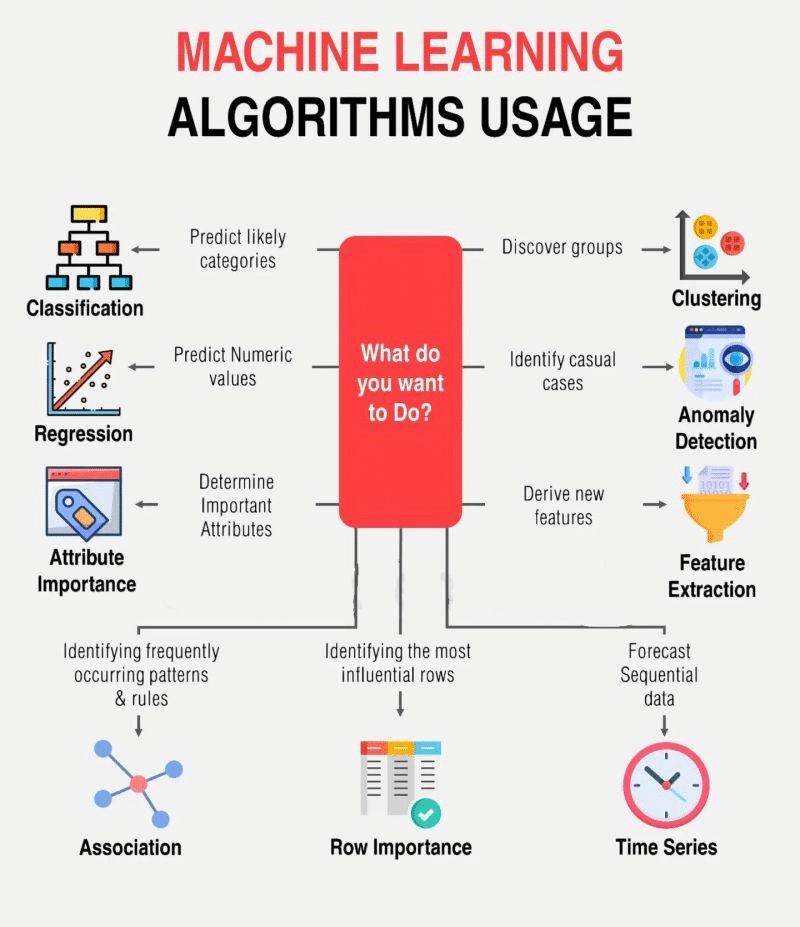


| Technique | Data Requirement | Output | Engineering Example |
|---|---|---|---|
| Classification | Labeled data | Category | Detect defective components |
| Regression | Numerical target | Number | Predict temperature |
| Clustering | Usually unlabeled data | Groups | Segment operating conditions |
| Association Rules | Transaction/event data | Relationships | Discover co-occurring failures |
| Outlier Detection | Normal/abnormal patterns | Anomalies | Detect unusual vibration |
| Sequential Mining | Ordered events | Sequences | Analyze failure progression |
Classification vs. Clustering
Classification asks:
“Which known category does this observation belong to?”
Clustering asks:
“What natural groups exist in this dataset?”
For example, suppose a factory has historical records labeled Normal, Warning, and Failure.
A classification model can learn these categories.
If the labels do not exist, clustering can instead search for groups of machines or operating conditions with similar characteristics.
Diagrams and Data-Mining Architecture
A simplified architecture can be represented as:
             ┌─────────────────────┐
             │   Data Sources      │
             │ DB | IoT | Logs | ERP│
             └──────────┬──────────┘
                        ↓
             ┌─────────────────────┐
             │ Data Preparation    │
             │ Clean + Transform   │
             └──────────┬──────────┘
                        ↓
             ┌─────────────────────┐
             │ Data Warehouse /    │
             │ Analytical Dataset  │
             └──────────┬──────────┘
                        ↓
             ┌─────────────────────┐
             │ Data Mining         │
             │ ML + Statistics     │
             └──────────┬──────────┘
                        ↓
             ┌─────────────────────┐
             │ Pattern Evaluation  │
             └──────────┬──────────┘
                        ↓
             ┌─────────────────────┐
             │ Engineering Decision│
             └─────────────────────┘
This architecture highlights an important engineering principle: the mining algorithm is only one component of the overall system.
Examples
Example 1: Predictive Maintenance
Imagine a pump equipped with vibration, temperature, and pressure sensors.
Suppose the historical dataset contains:
| Temperature | Vibration | Pressure | Failure |
|---|---|---|---|
| 62°C | 2.1 mm/s | 5.2 bar | No |
| 65°C | 2.5 mm/s | 5.1 bar | No |
| 73°C | 4.8 mm/s | 4.7 bar | Yes |
| 76°C | 5.4 mm/s | 4.5 bar | Yes |
A classification model could learn relationships between sensor behavior and failure conditions.
The engineering objective is not merely obtaining a high accuracy score. The real objective is reducing unexpected downtime and maintenance costs.
Example 2: Customer Segmentation
An online retailer can represent customers using:
A clustering algorithm can identify groups such as:
- High-value frequent customers
- Occasional customers
- New customers
- Low-engagement customers
Marketing teams can then design different strategies for each group.
Example 3: Association Rules
Suppose transaction data shows that several products repeatedly occur together.
A simplified rule is:
Three important concepts are:
Support — how frequently the combination occurs.
Confidence — how often occurs when occurs.
Lift — how strongly the relationship exceeds what might be expected by chance.
These concepts are useful for recommendation systems, inventory planning, and operational analysis.
Real-World Applications
Data mining has applications across numerous engineering and commercial sectors.
Manufacturing ⚙️
Engineers can mine machine histories to identify:
- Failure patterns
- Quality problems
- Production bottlenecks
- Energy inefficiencies
- Abnormal operating conditions
Civil Engineering 🏗️
Data from structural monitoring systems can be analyzed to investigate:
- Vibration behavior
- Structural anomalies
- Traffic patterns
- Construction productivity
- Infrastructure deterioration
Electrical Engineering ⚡
Power-system data can support:
- Load forecasting
- Fault detection
- Energy-demand analysis
- Grid anomaly detection
- Renewable-energy prediction
Healthcare Technology
Data mining can help researchers analyze large datasets for patterns associated with outcomes, provided privacy, validation, and appropriate governance requirements are respected.
Finance 💳
Financial organizations can investigate:
- Transaction anomalies
- Customer behavior
- Risk patterns
- Fraud indicators
- Market-related datasets
Transportation 🚗
Mining vehicle and traffic datasets can support:
- Route analysis
- Congestion prediction
- Fleet optimization
- Predictive maintenance
- Driver-behavior analysis
Common Mistakes
Mistake 1: Starting With an Algorithm
Choosing a sophisticated algorithm before understanding the problem is a common error.
Solution: Define the engineering objective first.
Mistake 2: Ignoring Data Quality
A model cannot automatically transform poor-quality measurements into reliable engineering knowledge.
Solution: Perform systematic data profiling and validation.
Mistake 3: Data Leakage
Data leakage occurs when information that would not realistically be available at prediction time accidentally enters the model.
Solution: Design the training process around the actual deployment scenario.
Mistake 4: Focusing Only on Accuracy
A model with excellent accuracy can still be unsuitable if it misses the most important failure cases.
Solution: Select evaluation metrics according to engineering consequences.
Mistake 5: Ignoring Domain Knowledge
Algorithms identify mathematical patterns, but engineers understand physical systems.
Solution: Combine computational analysis with subject-matter expertise.
Challenges and Solutions
| Challenge | Why It Matters | Practical Solution |
|---|---|---|
| Missing data | Can distort patterns | Imputation or appropriate removal |
| High dimensionality | Makes modeling harder | Feature selection/reduction |
| Imbalanced classes | Minority events may be missed | Resampling and suitable metrics |
| Noisy measurements | Creates false patterns | Filtering and robust analysis |
| Large datasets | Increases computational cost | Scalable architectures |
| Privacy concerns | Can create legal/ethical risks | Governance and data minimization |
| Model drift | Patterns change over time | Continuous monitoring |
The third edition particularly emphasizes the feasibility, usefulness, effectiveness, and scalability of mining techniques for large datasets.
Case Study: Predictive Maintenance for an Industrial Motor
Consider an industrial motor monitored continuously for six months.
Sensors record:
Historical maintenance records identify whether a failure occurred.
Data Preparation
Engineers first remove impossible readings and synchronize measurements.
Next, they create additional features:
Modeling
Several classification approaches can be tested.
The objective is to predict:
Evaluation
Suppose the model detects most historical failures but generates some false alarms.
The engineering team should evaluate the economic consequences of both outcomes.
A missed failure might cause:
while a false alarm might cause:
Therefore, the best model is not necessarily the model with the highest generic accuracy. It is the model that provides an appropriate balance between technical performance and operational consequences.
Essential Tips
🔹 Start with the question, not the algorithm.
🔹 Understand your variables before modeling.
📊 Visualize data whenever possible.
🔹 Check missing values and outliers.
🔹 Separate training and evaluation data correctly.
📊 Use multiple evaluation metrics.
🔹 Keep a record of preprocessing decisions.
🔹 Use domain knowledge to interpret patterns.
📊 Prefer interpretable results when engineering safety is important.
🔹 Monitor deployed models because real-world data changes.
For students, a strong learning path is:
For professionals, the emphasis should shift toward scalable systems, reliable validation, explainability, governance, deployment, and measurable business or engineering value.
FAQs
What is Data Mining: Concepts and Techniques, 3rd Edition?
It is a comprehensive textbook by Jiawei Han, Micheline Kamber, and Jian Pei covering major concepts and techniques for discovering knowledge from data. The third edition was published by Morgan Kaufmann/Elsevier and covers areas including data preparation, data warehousing, frequent-pattern mining, classification, clustering, outlier analysis, and advanced data-mining topics.
Is data mining the same as machine learning?
No. They overlap substantially, but data mining has a broader emphasis on discovering useful patterns and knowledge from data, while machine learning frequently focuses on algorithms that learn predictive or descriptive models.
Is data mining useful for engineering students?
Yes. It is particularly useful for students working with sensor data, manufacturing, structural monitoring, energy systems, automation, robotics, transportation, and scientific datasets.
What programming languages are useful for data mining?
Python and R are popular choices. SQL is also extremely important because much practical data mining begins with extracting and preparing information from databases.
What is the difference between classification and clustering?
Classification uses predefined categories and learns how to assign new observations to them. Clustering attempts to discover groups without requiring predefined labels.
Why is data preprocessing important?
Because real-world datasets often contain missing values, noise, inconsistent formats, duplicate records, and irrelevant variables. Poor preprocessing can significantly reduce the reliability of mining results.
Can data mining be used with very large datasets?
Yes. Scalability is a major consideration in modern data mining. Large datasets may require distributed storage, parallel algorithms, optimized databases, or cloud-based processing architectures.
Is data mining only used by businesses?
No. It is used in engineering, science, healthcare research, manufacturing, transportation, energy, finance, cybersecurity, environmental monitoring, and many other areas.
Conclusion
Data Mining: Concepts and Techniques 3rd Edition provides a strong conceptual foundation for understanding how large datasets can be transformed into useful knowledge. Its subject areas span the complete journey from understanding and preparing data to discovering patterns through classification, clustering, association analysis, and outlier detection.
For beginners, data mining can initially appear to be a collection of complicated algorithms. For experienced engineers, however, its real value becomes clearer: data mining is a systematic engineering approach to extracting evidence from data. 📊⚙️
The most effective projects combine:
The result is not simply a prediction or a graph. The ultimate objective is better knowledge, better decisions, and measurable real-world value.
For students and professionals in the USA, UK, Canada, Australia, and Europe, learning these principles creates a useful bridge between traditional engineering analysis and modern data-driven engineering. As sensors, connected devices, cloud platforms, and AI systems continue to expand, the ability to transform massive datasets into reliable engineering insight will remain an increasingly valuable technical skill. 🚀📈