Computational Algebra: Theory and Applications with Python
Introduction 🔬🐍
Computational algebra is the meeting point between abstract algebra, symbolic computation, algorithms, and computer programming. Instead of treating algebra as a purely theoretical subject, computational algebra asks an additional question:
How can algebraic ideas be represented, manipulated, and solved efficiently by a computer?
This perspective is particularly valuable in engineering because many practical systems contain mathematical relationships that are difficult to analyze manually. Engineers may need to simplify symbolic expressions, solve systems of equations, analyze polynomial models, manipulate matrices, investigate transformations, or construct algorithms for numerical and symbolic computation.
Python provides an accessible environment for these tasks. Libraries such as SymPy allow engineers and students to work with mathematical objects symbolically while still benefiting from Python’s programming ecosystem.


Computational algebra is not simply about asking a computer to calculate an answer. It is about understanding how mathematical structures can become computational objects and how algorithms can operate on them.
This makes the subject useful for beginners learning algebraic programming as well as professionals developing engineering, scientific, optimization, simulation, and data-analysis workflows.


Background Theory 📚
Traditional algebra studies structures and relationships involving mathematical objects such as numbers, polynomials, vectors, matrices, groups, rings, and fields.
Computational algebra adds an algorithmic layer.
From Algebra to Algorithms
Consider a polynomial expression. On paper, an engineer might simplify it by applying algebraic rules manually. A computer algebra system instead represents the expression internally as a structured object.
The system can then perform operations such as:
- Simplification
- Expansion
- Factorization
- Substitution
- Differentiation
- Integration
- Polynomial manipulation
- Equation solving
- Matrix operations
- Expression comparison
The important idea is that the computer is not merely storing a string of characters. It is working with a representation of a mathematical structure.
Symbolic Versus Numerical Computation
Numerical computation focuses primarily on approximate values.
For example, a numerical program might evaluate an expression for a particular engineering parameter.
Symbolic computation works differently. It attempts to preserve mathematical relationships.
Instead of immediately converting everything into decimal values, symbolic software can retain variables such as:
xytθab
This distinction is extremely important.
A numerical result may tell an engineer what value occurs.
A symbolic result can help explain why that value occurs.
Why Algebra Becomes Computational
Large algebraic problems can involve thousands or millions of operations. Human reasoning remains essential, but computers can automate repetitive symbolic transformations.
This creates a powerful combination:
Mathematical theory + Algorithms + Data structures + Programming = Computational algebra
Definition 🧠
Computational algebra can be defined as the study and implementation of algorithms that manipulate algebraic objects and solve algebraic problems using computers.
These objects can include:
- Polynomials
- Rational expressions
- Matrices
- Vectors
- Algebraic numbers
- Equations
- Systems of equations
- Groups
- Rings
- Fields
- Boolean expressions
- Symbolic functions
Computational Algebra in Python
Python is particularly useful because its syntax is relatively readable while supporting powerful mathematical libraries.
One of the most important libraries for symbolic mathematics is SymPy.
A basic symbolic workflow can look conceptually like:
import sympy as sp

x = sp.symbols('x')
expression = (x + 2)**2

expanded = sp.expand(expression)

print(expanded)
The important feature is that x remains a symbolic variable.
Python therefore becomes a bridge between mathematical reasoning and software implementation.
Step-by-Step Explanation ⚙️
A practical computational-algebra workflow can be divided into several stages.


Step 1: Identify the Mathematical Structure
Before writing Python code, determine what kind of mathematical object you are working with.
Is it:
- A polynomial?
- A matrix?
- A system of equations?
- A transformation?
- A symbolic function?
- A group operation?
Correct classification makes the computational approach much easier.
Step 2: Define Symbols
Variables should be represented explicitly.
For example:
import sympy as sp

x, y = sp.symbols('x y')
The computer can now distinguish these symbols from ordinary numerical values.
Step 3: Construct the Expression
The mathematical structure is represented using Python syntax.
expression = (x + y)**2This object can then be manipulated symbolically.
Step 4: Transform the Expression
Different algebraic operations can be applied.
expanded = sp.expand(expression)
factored = sp.factor(expanded)
This creates a computational sequence:
Expression → Transformation → Result
Step 5: Substitute Values
Once symbolic manipulation is complete, numerical values can be introduced.
result = expression.subs({x: 3, y: 2})This allows the same symbolic model to support multiple scenarios.
Step 6: Validate the Result
Never assume that a computer-generated result is automatically correct.
Engineers should check:
- Dimensions
- Physical meaning
- Boundary conditions
- Expected behavior
- Special cases
- Numerical consistency
Step 7: Integrate the Result
The final symbolic or numerical output can then become part of a larger engineering workflow.
For example:
Symbolic model → Python algorithm → Simulation → Visualization → Engineering decision
Comparison ⚖️
Computational algebra is related to several other mathematical approaches, but they are not identical.
| Approach | Primary Focus | Typical Output | Engineering Use |
|---|---|---|---|
| Traditional algebra | Mathematical reasoning | Exact relationships | Derivations |
| Numerical computation | Approximate values | Numbers | Simulation |
| Computational algebra | Algebraic manipulation | Symbolic structures | Modeling |
| Numerical linear algebra | Matrix calculations | Numerical vectors/matrices | Structural and control analysis |
| Computer algebra systems | Automated symbolic manipulation | Exact or symbolic results | Analysis and research |
| Scientific programming | Computational workflows | Data and models | Engineering applications |
Symbolic and Numerical Methods
Symbolic methods are excellent when the structure of a problem matters.
Numerical methods are often better when the problem is too large or complex for exact symbolic manipulation.
In many engineering projects, the strongest solution is a hybrid workflow.
For example:
Symbolic preprocessing → Numerical solution → Visualization → Validation
Python Versus Specialized Systems
Python’s greatest advantage is flexibility.
A Python project can combine symbolic algebra with:
- NumPy
- SciPy
- Matplotlib
- pandas
- Optimization tools
- Machine-learning frameworks
- Engineering simulation packages
This makes Python especially attractive for interdisciplinary projects.
Diagrams and Tables 📊
A useful conceptual diagram is:
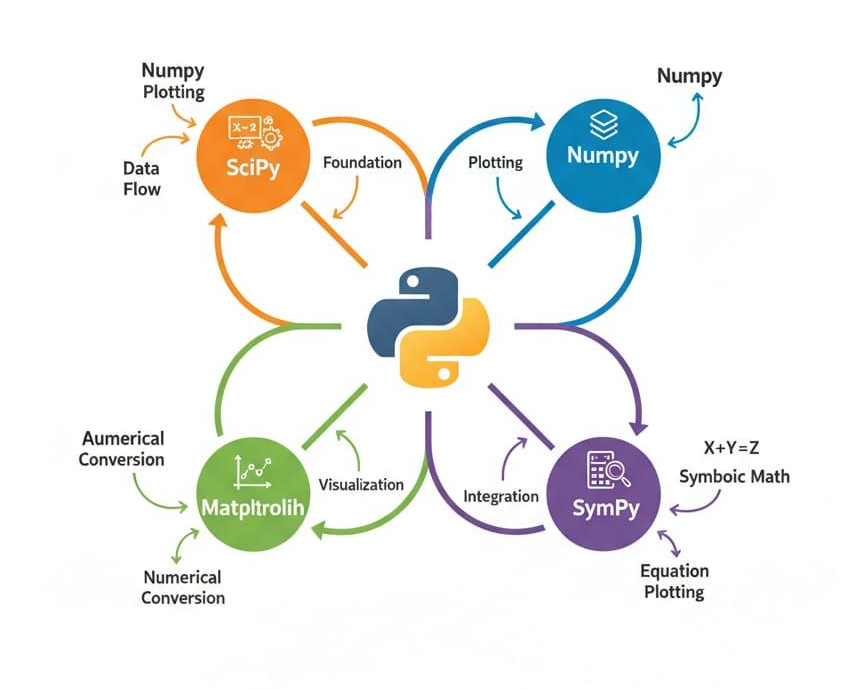


Computational Algebra Pipeline
Engineering Problem
        ↓
Mathematical Model
        ↓
Algebraic Representation
        ↓
Symbolic Manipulation
        ↓
Algorithmic Processing
        ↓
Numerical Evaluation
        ↓
Visualization
        ↓
Engineering Decision
This pipeline demonstrates why computational algebra is more than symbolic calculation.
Important Python Tools
| Tool | Main Purpose |
|---|---|
| SymPy | Symbolic mathematics |
| NumPy | Numerical arrays and computation |
| SciPy | Scientific and engineering algorithms |
| Matplotlib | Visualization |
| pandas | Data organization |
| Jupyter | Interactive computational workflows |
Core Computational Operations
| Operation | Purpose |
|---|---|
| Expand | Reveals polynomial terms |
| Factor | Identifies multiplicative structure |
| Simplify | Reduces expression complexity |
| Substitute | Inserts specific parameter values |
| Solve | Searches for solutions |
| Differentiate | Analyzes rates of change |
| Integrate | Accumulates quantities |
| Matrix manipulation | Handles linear systems |
Examples Without Equations 💡
Example 1: Polynomial Simplification
Imagine an engineer has a complicated polynomial produced by a symbolic modeling process.
Instead of manually expanding every term, Python can represent the expression and perform the expansion automatically.
The engineer can then factor the result to investigate its underlying structure.
Example 2: Engineering Parameter Study
Suppose a symbolic model contains several design parameters.
The same symbolic expression can be reused while different parameter values are substituted.
This is useful for exploring:
- Design alternatives
- Material properties
- Operating conditions
- Geometric parameters
- Safety margins
Example 3: Matrix-Based Engineering Model
A structural engineering problem may involve matrices representing relationships between components.
Python can construct and manipulate these matrices, allowing engineers to automate repetitive algebraic operations.
Example 4: Symbolic Differentiation
A model describing system behavior may need derivatives.
Instead of manually deriving a complicated expression, a symbolic engine can perform differentiation and return another symbolic expression.
This can support optimization, sensitivity analysis, and system modeling.
Real-World Applications 🌍
Computational algebra has applications across many engineering disciplines.
Mechanical Engineering
Mechanical engineers can use symbolic computation for:
- Kinematic analysis
- Dynamic modeling
- Control systems
- Vibration analysis
- Mechanism design
- Sensitivity studies
Symbolic models can expose relationships between physical parameters before numerical simulation begins.
Electrical Engineering
Applications include:
- Circuit analysis
- Signal processing
- Control theory
- Power-system modeling
- Filter design
- System transfer analysis
Symbolic manipulation can help engineers investigate how component parameters influence system behavior.
Civil Engineering
Civil engineers can apply computational algebra to:
- Structural analysis
- Matrix-based models
- Load relationships
- Optimization
- Geometric modeling
- Numerical simulation preparation
Aerospace Engineering ✈️
Aerospace systems often involve complex mathematical relationships.
Computational algebra can assist with:
- Flight dynamics
- Control systems
- Trajectory analysis
- Stability studies
- Parameter sensitivity
- Model reduction
Computer Engineering
Computational algebra is also relevant to:
- Cryptography
- Error-correcting codes
- Computer graphics
- Robotics
- Algorithms
- Formal verification
Common Mistakes ⚠️
Treating Symbolic Computation as a Black Box
A computer can manipulate expressions, but it does not replace mathematical understanding.
Always understand the assumptions behind the model.
Mixing Symbols and Numbers Carelessly
A symbolic variable and a numerical value behave differently.
Unexpected automatic conversions can lead to confusing results.
Ignoring Expression Complexity
Symbolic expressions can grow dramatically during certain operations.
A mathematically valid transformation may produce an expression that is computationally expensive to process.
Assuming Every Problem Has an Exact Solution
Some engineering problems are naturally numerical.
Trying to force a complete symbolic solution can be inefficient.
Skipping Validation
A symbolic result still needs engineering verification.
Check whether it makes sense in the physical context.
Challenges and Solutions 🚧
Challenge: Expression Explosion
Some symbolic operations dramatically increase expression size.
Solution: Simplify strategically and avoid unnecessary expansion.
Challenge: Slow Computation
Large symbolic systems may require substantial processing time.
Solution: Reduce the problem, exploit mathematical structure, and switch to numerical methods when appropriate.
Challenge: Numerical Instability
A symbolic expression may become problematic when evaluated numerically under certain conditions.
Solution: Investigate conditioning, precision, and alternative formulations.
Challenge: Difficult Debugging
A symbolic object can look correct while containing unexpected assumptions.
Solution: Inspect intermediate expressions and test small examples.
Challenge: Learning Curve
Computational algebra requires knowledge of both mathematics and programming.
Solution: Learn progressively:
Algebra → Python → Symbolic Python → Algorithms → Engineering applications
Case Study: Symbolic Analysis of an Engineering Design 🔧
Consider a hypothetical mechanical engineering team developing a compact rotating mechanism.
The team has several design parameters and wants to understand how changes in geometry influence system behavior.
Stage 1: Modeling
Engineers describe the mechanism using symbolic variables.
Instead of immediately inserting measurements, they maintain a general symbolic model.
Stage 2: Computational Representation
Python and SymPy are used to represent the symbolic relationships.
The engineering team can manipulate the model programmatically.
Stage 3: Simplification
The model initially contains several redundant terms.
Symbolic simplification makes the structure easier to inspect.
Stage 4: Parameter Exploration
Different design configurations are substituted into the symbolic model.
The team can compare multiple scenarios without rewriting the underlying mathematical model.
Stage 5: Numerical Integration
After symbolic processing, numerical tools are used for large-scale evaluation.
This hybrid strategy avoids performing every computational task symbolically.
Stage 6: Engineering Validation
The results are compared against expected physical behavior and independent calculations.
The team discovers that one parameter has a much stronger influence than initially expected.
Result
Computational algebra does not replace engineering judgment. Instead, it helps the team understand the model faster, automate repetitive analysis, and explore more design possibilities.
Essential Tips ⭐
Build Mathematical Understanding First
Do not begin with Python commands alone.
Understand what the mathematical object represents.
Keep Symbolic and Numerical Workflows Separate
Use symbolic computation when structure matters and numerical computation when large-scale evaluation is required.
Use Small Test Cases
Before processing a large engineering model, verify your workflow with a simple example.
Document Assumptions
Record assumptions about:
- Variables
- Domains
- Units
- Boundary conditions
- Physical constraints
Visualize Results
A symbolic expression can be difficult to interpret.
Graphs, diagrams, and numerical experiments often make the result much clearer.
Learn the Underlying Algorithms
Advanced users should investigate algorithms behind:
- Polynomial factorization
- Gröbner bases
- Polynomial reduction
- Matrix algorithms
- Algebraic number computation
- Symbolic integration
- Equation solving
Understanding these methods helps explain why some problems are computationally easy while others are extremely expensive.
FAQs ❓
What is computational algebra?
Computational algebra is the use of algorithms and computers to represent, manipulate, and solve algebraic structures and problems.
Is computational algebra only for mathematicians?
No. It is useful in engineering, physics, computer science, robotics, control, cryptography, and scientific computing.
Why is Python useful for computational algebra?
Python provides readable programming syntax and access to libraries such as SymPy, while also connecting symbolic mathematics with numerical and scientific tools.
What is SymPy?
SymPy is a Python library designed for symbolic mathematics. It can represent mathematical expressions and perform operations such as simplification, expansion, factorization, differentiation, integration, and equation solving.
Is symbolic computation better than numerical computation?
Neither is universally better. Symbolic computation preserves mathematical structure, while numerical computation is often more efficient for large practical problems. Hybrid workflows are frequently the best choice.
Can computational algebra be used in engineering?
Yes. It can support structural analysis, mechanical modeling, circuit analysis, control systems, optimization, robotics, aerospace modeling, and many other engineering applications.
Is computational algebra difficult to learn?
The fundamentals can be learned progressively. Beginners can start with Python and basic symbolic manipulation, while advanced learners can move toward algebraic algorithms and computational structures.
What should I learn before computational algebra?
A useful foundation includes basic algebra, functions, matrices, programming fundamentals, and introductory Python. Advanced topics benefit from knowledge of linear algebra and abstract algebra.
Conclusion 🚀
Computational algebra transforms algebra from a purely manual activity into an algorithmic and programmable discipline.
For engineering students, it provides a practical way to connect mathematical theory with Python programming. For professionals, it offers a powerful method for automating symbolic manipulation, investigating engineering models, performing parameter studies, and preparing complex systems for numerical analysis.
The most effective approach is not to choose between mathematics and programming. Instead, combine them:
Mathematical theory 🧠 + Computational algorithms ⚙️ + Python 🐍 + Engineering judgment 🔧 = Powerful technical workflows
As engineering models become increasingly complex, computational algebra provides an important foundation for turning mathematical relationships into reusable computational systems. Its greatest value comes not from replacing human reasoning, but from allowing engineers to spend less time on repetitive algebra and more time understanding, designing, validating, and improving real-world systems.