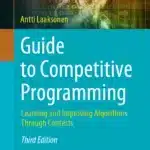
The Ultimate Guide to Antti Laaksonen’s Competitive Programmer’s Handbook
Introduction
Competitive programming is a mental sport where programmers solve algorithmic problems under strict time constraints. It sharpens logical thinking, coding speed, and analytical ability. Among the most highly recommended resources for mastering this field is Antti Laaksonen’s Competitive Programmer’s Handbook. This book has become a cornerstone for students, professionals, and coding enthusiasts preparing for contests like ICPC, Codeforces, AtCoder, LeetCode, and Google Code Jam.
This guide provides a comprehensive 3,000-word analysis of the Competitive Programmer’s Handbook—its purpose, structure, benefits, challenges, applications, and how you can leverage it to become a skilled competitive programmer.
Background: The Origin of the Handbook
The Competitive Programmer’s Handbook was written by Antti Laaksonen, a Finnish computer scientist and competitive programmer. His goal was to create a concise, accessible, and structured manual for anyone looking to improve their problem-solving skills.
Unlike bulky textbooks on algorithms, this handbook distills complex topics into a practical, problem-solver friendly format. It covers everything from time complexity analysis to advanced graph algorithms, making it a go-to resource for both beginners and advanced programmers.
Key Highlights
- Written in clear and concise language.
- Covers both theoretical concepts and real-world applications.
- Free to access under an open license.
- Contains a systematic structure, making it easy to progress step by step.
Importance of Competitive Programming
Why should anyone care about competitive programming in the first place? The benefits go far beyond winning medals in contests.
1. Enhances Problem-Solving Skills
Competitive programming trains your brain to analyze problems, break them into subproblems, and devise efficient solutions. This mirrors the kind of thinking required in real-world engineering and software design.
2. Builds Speed and Accuracy
In contests, programmers must solve problems under time pressure. This trains them to write clean, bug-free, and optimized code quickly.
3. Boosts Interview Performance
Top tech companies like Google, Meta, Microsoft, and Amazon use algorithmic problems in interviews. Competitive programming experience gives candidates an edge in solving these efficiently.
4. Encourages Logical and Mathematical Thinking
Many problems require knowledge of number theory, combinatorics, and probability. Practicing them develops logical precision and mathematical intuition.
5. Creates Career Opportunities
Beyond contests, skills gained from competitive programming often translate into better coding efficiency, faster debugging, and innovative problem-solving in software development roles.
Structure of the Competitive Programmer’s Handbook
The book is organized to help readers gradually build their knowledge. Each chapter adds new tools to your problem-solving arsenal.
1. Basics
- Time complexity and Big-O notation.
- Recursion and divide-and-conquer strategies.
- Essential mathematics for programmers.
2. Data Structures
- Arrays and linked lists.
- Stacks, queues, and deques.
- Trees and heaps.
- Hash maps and sets.
3. Algorithms
- Sorting (quick sort, merge sort, counting sort).
- Searching algorithms.
- Greedy methods.
- Dynamic programming fundamentals.
4. Graph Theory
- Breadth-First Search (BFS) and Depth-First Search (DFS).
- Shortest path algorithms (Dijkstra, Bellman-Ford).
- Minimum spanning trees (Kruskal, Prim).
5. Advanced Topics
- Segment trees and Fenwick trees.
- Flow algorithms.
- String algorithms (KMP, Z-algorithm).
- Bit manipulation techniques.
This structured flow ensures that a reader can start from scratch and progress to highly advanced concepts.
Practical Learning Approach
The Competitive Programmer’s Handbook emphasizes learning by doing. Each theoretical explanation is paired with exercises and problem sets, making the knowledge stick.
Learn, Apply, Repeat
- Read the theory.
- Implement code from scratch.
- Solve related practice problems.
- Review mistakes and optimize.
Benefits of Hands-On Learning
- Reinforces long-term memory.
- Builds intuition for selecting the right algorithm.
- Improves debugging and optimization skills.
Examples and Real-World Applications
To illustrate the practicality of the book, here are a few example use cases:
Binary Search Example
Used for finding elements in a sorted array, binary search reduces complexity from O(n) to O(log n). In real-world terms, this technique powers search functions in databases and e-commerce websites.
Graph Applications
- BFS is used in social networks to measure degrees of separation.
- Dijkstra’s Algorithm is used in GPS navigation to find the shortest path.
Dynamic Programming Example
Problems like the knapsack problem mirror real-world scenarios in resource allocation and financial planning.
String Algorithms in Action
Pattern matching algorithms are widely used in search engines, DNA sequencing, and plagiarism detection software.
Challenges of Using the Handbook
Despite its strengths, the handbook has some limitations.
1. Steep Learning Curve
Beginners may find it overwhelming, especially in advanced graph algorithms and dynamic programming.
2. Lack of Step-by-Step Solutions
The book emphasizes self-learning. It provides problems but not always detailed solutions, requiring additional effort from learners.
3. Requires Strong Mathematical Foundation
Topics such as number theory, modular arithmetic, and probability can intimidate students without prior mathematical exposure.
Solutions to Challenges
Fortunately, these challenges can be overcome with the right approach.
Supplement with Online Judges
Pair learning with Codeforces, LeetCode, AtCoder, and HackerRank to gain practical experience.
Progress Gradually
Start with basics like arrays and recursion before jumping into segment trees or flows.
Use Additional Resources
- GeeksforGeeks for explanations.
- CLRS (Introduction to Algorithms) for in-depth theory.
- YouTube tutorials for visual learners.
Case Study: A Student’s Success with the Handbook
Consider the journey of Ravi, a computer science undergraduate.
Ravi’s Struggle
Ravi found technical interviews challenging. He could write code but struggled with algorithms.
Discovering the Handbook
He started using Antti Laaksonen’s handbook and followed its systematic approach:
- Learned complexity analysis and recursion.
- Practiced graph algorithms daily.
- Applied dynamic programming to competitive problems.
The Transformation
Within six months, Ravi’s rankings improved on Codeforces, and he secured an internship at a top tech company. The handbook gave him not just skills, but confidence.
Tips for Maximizing the Handbook
To get the most out of the Competitive Programmer’s Handbook, follow these strategies:
1. Set Goals
Define your objective: Are you aiming for contests like ICPC, or preparing for job interviews?
2. Practice Daily
Even solving one or two problems daily builds consistency.
3. Join Communities
Platforms like Codeforces forums, Reddit’s r/CompetitiveProgramming, and Discord servers help you exchange knowledge.
4. Track Progress
Maintain a problem log: what you solved, what you struggled with, and how you improved.
5. Mix Theory with Practice
Never skip exercises—applying theory is the key to mastery.
FAQs About the Competitive Programmer’s Handbook
Q1. Is the Competitive Programmer’s Handbook free?
Yes, it is available online under an open license.
Q2. Is it suitable for beginners?
Yes, but beginners should start slowly and supplement with tutorials.
Q3. Does it cover all topics for coding interviews?
It covers most essential algorithms and data structures, but pairing with interview prep books is recommended.
Q4. How long does it take to finish the book?
Anywhere from 2–6 months, depending on practice time and pace.
Q5. Is it better than CLRS?
CLRS is more theoretical and academic. The handbook is concise, practical, and contest-focused.
Conclusion
The Competitive Programmer’s Handbook is more than just a book—it’s a roadmap for mastering algorithmic problem-solving. Whether you’re a student, job seeker, or coding enthusiast, this resource equips you with the skills needed to excel in contests and technical interviews.
By combining structured learning, practical examples, and consistent practice, you can unlock your potential as a competitive programmer. For anyone serious about coding challenges, the Competitive Programmer’s Handbook PDF should be a constant companion.
In short: If you want to sharpen your problem-solving edge, make this handbook part of your daily routine.