Big Data and Social Science: A Practical Guide to Methods and Tools for Modern Research 📊🌍
Introduction 📚
The digital revolution has transformed how researchers understand human behavior. Every second, millions of social media posts, online purchases, GPS locations, mobile interactions, government records, healthcare transactions, and digital communications generate enormous volumes of information known as Big Data.
Unlike traditional research methods that relied on relatively small surveys or interviews, modern social scientists can analyze billions of observations collected in real time. This transformation has opened new opportunities for engineers, data scientists, economists, sociologists, psychologists, political scientists, urban planners, and public policy experts.
Big Data allows researchers to answer questions that were previously impossible:
- 📈 How do people respond to economic crises?
- 🌍 How do pandemics affect social behavior?
- 🏙️ How can cities improve transportation?
- ❤️ How do online communities influence mental health?
- 🗳️ What factors influence elections?
- 🛒 How do consumers make purchasing decisions?
This practical guide explains the engineering foundations, computational methods, analytical tools, ethical considerations, and real-world applications of Big Data in social science for both beginners and experienced professionals.


Background Theory 🧠
The concept of Big Data emerged as digital technologies dramatically increased information generation.
Traditional social science research generally depended on:
- Questionnaires
- Interviews
- Focus groups
- Census reports
- Laboratory experiments
Although valuable, these approaches often suffer from:
- Small sample sizes
- Human bias
- Long collection periods
- High costs
- Limited geographic coverage
Modern digital infrastructure continuously produces data from:
- Smartphones
- IoT devices
- Social media
- Government databases
- Financial systems
- Healthcare systems
- Satellite observations
- Web browsing activity
Engineers developed distributed computing technologies capable of processing these massive datasets efficiently.
The integration of engineering, computer science, statistics, artificial intelligence, and behavioral sciences has created an entirely new interdisciplinary research field.
Definition 📖
Big Data in Social Science refers to the collection, storage, processing, and analysis of extremely large, complex, and rapidly changing datasets to study human behavior, societies, economies, institutions, and public systems.
Its primary objective is transforming raw digital information into actionable knowledge that supports scientific discovery and evidence-based decision-making.
The Five Vs of Big Data ⚡
The engineering community commonly describes Big Data using five characteristics.
| Characteristic | Description | Example |
|---|---|---|
| Volume | Massive quantities of information | Billions of tweets |
| Velocity | Continuous data generation | Live GPS tracking |
| Variety | Multiple data formats | Images, videos, text |
| Veracity | Data reliability | Removing fake accounts |
| Value | Useful insights | Predicting disease outbreaks |
How Big Data Works in Social Science 🔄


Step 1 — Data Collection 📥
Researchers gather information from multiple sources.
Common sources include:
- Social media
- Census databases
- Smartphones
- Sensors
- Financial records
- Government portals
- Health databases
- Online surveys
Step 2 — Data Storage 💾
Large datasets require scalable infrastructure.
Popular technologies include:
- Distributed databases
- Cloud storage
- Data lakes
- Hadoop Distributed File System (HDFS)
Step 3 — Data Cleaning 🧹
Raw data often contains:
- Missing values
- Duplicate records
- Typographical errors
- Spam
- Fake accounts
- Corrupted observations
Cleaning improves analysis accuracy.
Step 4 — Data Processing ⚙️
Engineers transform raw information into structured datasets through:
- Filtering
- Aggregation
- Feature engineering
- Data normalization
Step 5 — Data Analysis 📊
Researchers apply analytical techniques such as:
- Machine Learning
- Statistical modeling
- Network analysis
- Natural Language Processing
- Time-series analysis
- Spatial analysis
Step 6 — Visualization 📈
Interactive dashboards and visualizations communicate insights effectively.
Popular visualization formats include:
- Heat maps
- Scatter plots
- Network graphs
- Histograms
- Geographic maps
- Time-series charts
Major Methods Used in Social Science Research 🔬
Machine Learning 🤖
Machine learning discovers hidden patterns automatically.
Applications include:
- Crime prediction
- Recommendation systems
- Public opinion analysis
- Consumer behavior
Natural Language Processing (NLP) 💬
NLP extracts meaning from textual information.
Examples include:
- Sentiment analysis
- Topic modeling
- Emotion detection
- Language translation
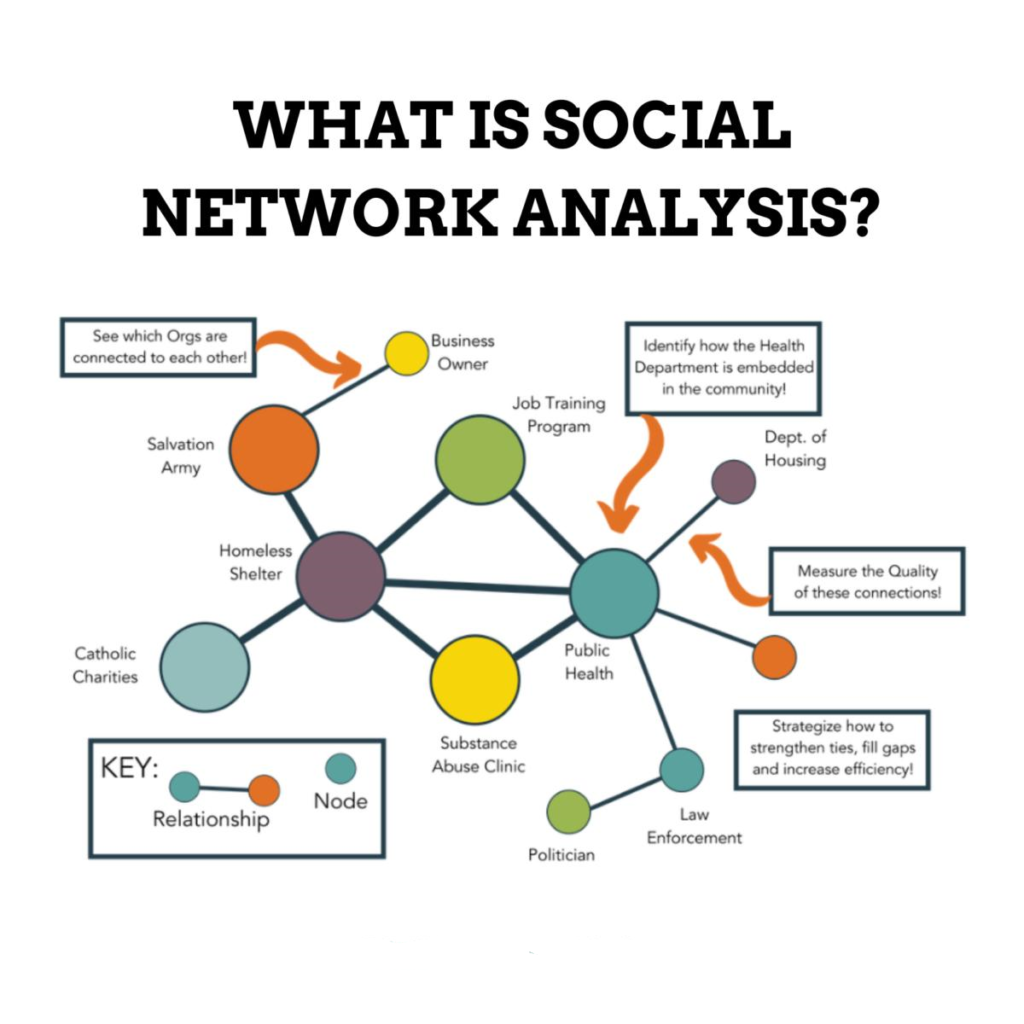
Social Network Analysis 🌐
Researchers examine relationships among individuals.
Metrics include:
- Centrality
- Influence
- Communities
- Connectivity
Geospatial Analytics 🛰️
Location data reveals mobility patterns.
Applications include:
- Smart cities
- Traffic optimization
- Disease spread
- Emergency response
Predictive Analytics 🔮
Predictive models forecast future events using historical data.
Applications include:
- Economic forecasting
- Population growth
- Healthcare planning
- Disaster management
Common Engineering Tools 🛠️
| Tool | Primary Use | Difficulty |
|---|---|---|
| Python | Data analysis & AI | Medium |
| R | Statistical modeling | Medium |
| SQL | Database querying | Beginner |
| Apache Hadoop | Distributed storage | Advanced |
| Apache Spark | Fast data processing | Advanced |
| Tableau | Dashboards | Beginner |
| Power BI | Business analytics | Beginner |
| Jupyter Notebook | Interactive analysis | Beginner |
| TensorFlow | Deep learning | Advanced |
| PyTorch | AI research | Advanced |
Traditional Research vs Big Data Research ⚖️
| Feature | Traditional Research | Big Data Research |
|---|---|---|
| Sample Size | Hundreds | Millions to Billions |
| Speed | Weeks or Months | Seconds or Minutes |
| Cost | High | Moderate |
| Automation | Low | High |
| Real-Time Analysis | Rare | Common |
| Geographic Coverage | Limited | Global |
Big Data Architecture 🏗️


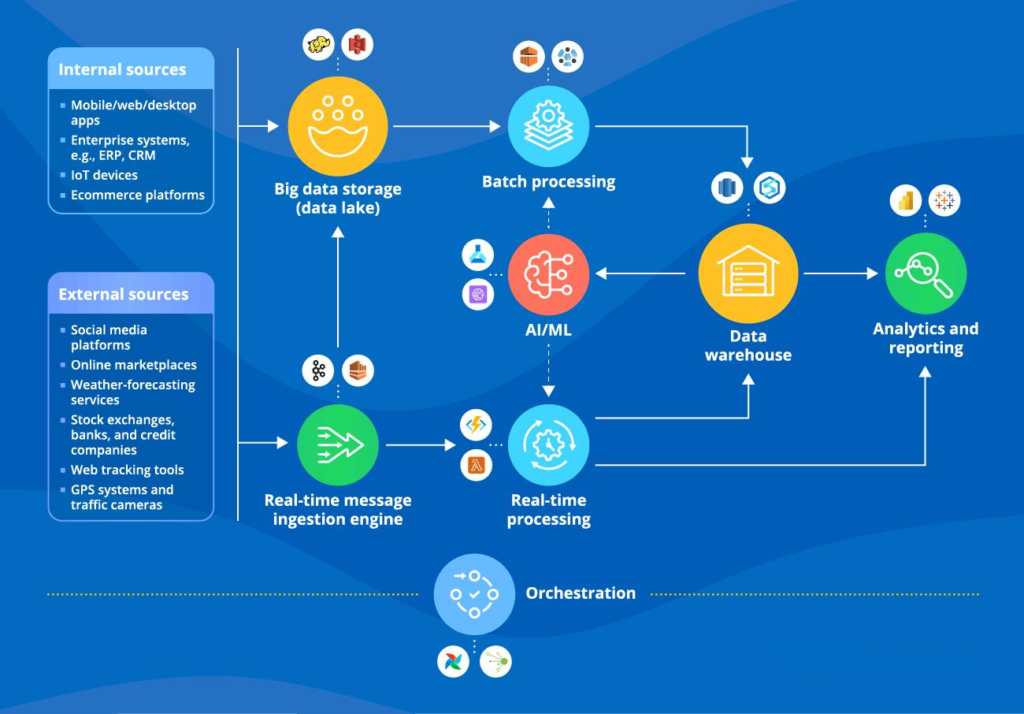

A simplified engineering workflow follows this sequence:
Data Sources
      │
      ▼
 Data Collection
      │
      ▼
 Data Storage
      │
      ▼
 Data Cleaning
      │
      ▼
 Data Processing
      │
      ▼
 Machine Learning
      │
      ▼
 Visualization
      │
      ▼
 Decision Making
Practical Examples 💡
Example 1 — Public Health
Researchers analyze millions of mobility records during pandemics.
Results:
- Track disease spread
- Optimize hospital resources
- Predict outbreaks
Example 2 — Election Analysis
Millions of social media posts reveal:
- Political trends
- Public opinion
- Candidate popularity
Example 3 — Transportation Engineering
GPS datasets help engineers:
- Reduce congestion
- Improve road safety
- Optimize public transit
Example 4 — Education
Universities analyze learning platforms to:
- Predict student performance
- Reduce dropout rates
- Personalize learning
Example 5 — Marketing
Companies analyze customer behavior for:
- Product recommendations
- Demand forecasting
- Customer segmentation
Real-World Applications 🌎
Big Data now supports nearly every sector.
Smart Cities 🏙️
City governments optimize:
- Traffic signals
- Energy consumption
- Waste management
- Public transportation
Healthcare 🏥
Hospitals analyze:
- Electronic medical records
- Disease outbreaks
- Treatment effectiveness
Financial Engineering 💰
Banks detect:
- Fraud
- Credit risk
- Customer behavior
Environmental Science 🌱
Researchers monitor:
- Climate change
- Air pollution
- Water quality
- Wildlife migration
Social Media Analytics 📱
Organizations measure:
- Brand reputation
- Consumer engagement
- Public sentiment
- Viral trends
Common Mistakes ❌
Many beginners encounter avoidable problems.
Ignoring Data Quality
Poor-quality data produces misleading conclusions.
Using Too Many Variables
More features do not always improve model performance.
Confusing Correlation with Causation
Two variables moving together do not necessarily indicate one causes the other.
Overfitting Models
Highly complex models may perform poorly on new data.
Ignoring Ethics
Researchers must respect:
- Privacy
- Consent
- Transparency
- Fairness
Challenges and Solutions ⚙️
| Challenge | Solution |
|---|---|
| Massive datasets | Cloud computing |
| Slow processing | Apache Spark |
| Missing values | Data imputation |
| Privacy concerns | Data anonymization |
| Data bias | Balanced datasets |
| High storage costs | Distributed storage |
| Cybersecurity | Encryption |
Case Study 📘
Predicting Urban Mobility Using Mobile Phone Data
A metropolitan transportation authority sought to reduce traffic congestion in a rapidly growing city. Engineers partnered with social scientists to analyze anonymized mobile phone location data collected over one year.
Objective
Understand commuting behavior and identify bottlenecks.
Data Sources
- Mobile phone location records
- GPS-enabled buses
- Public transit schedules
- Road traffic sensors
- Weather reports
Engineering Workflow
- Data ingestion into a cloud platform.
- Cleaning duplicate and incomplete records.
- Aggregating trips by time and location.
- Applying clustering algorithms to identify commuting corridors.
- Visualizing congestion hotspots on interactive maps.
Results
- Peak-hour congestion zones were identified with high precision.
- Bus routes were redesigned to better match commuter demand.
- Average travel times decreased after route optimization.
- City planners used the insights to prioritize future infrastructure investments.
Lessons Learned
Combining engineering techniques with social science methodologies enabled evidence-based decisions that improved mobility while protecting user privacy through anonymization.
Tips for Engineers 🚀
- 📚 Learn statistics before diving into advanced AI.
- 🐍 Master Python and SQL—they are foundational skills.
- ☁️ Become familiar with cloud platforms and distributed computing.
- 📊 Practice data visualization to communicate findings effectively.
- 🔒 Prioritize data security and privacy from the start.
- 🤝 Collaborate with domain experts in sociology, economics, psychology, and public policy.
- 🧪 Validate models using independent datasets.
- ♻️ Continuously monitor and update analytical models as new data becomes available.
Frequently Asked Questions ❓
What is Big Data in social science?
It is the use of very large and complex datasets to understand human behavior, societies, institutions, and public systems through computational and statistical methods.
Do I need programming skills?
Basic programming is highly recommended. Python, SQL, and R are among the most widely used languages for data analysis and research.
Which industries use Big Data?
Healthcare, finance, education, transportation, government, retail, cybersecurity, environmental science, marketing, and urban planning all rely on Big Data analytics.
Is Big Data only for engineers?
No. Social scientists, economists, psychologists, policy analysts, journalists, and business professionals also use Big Data. Interdisciplinary collaboration often leads to the strongest outcomes.
What are the biggest ethical concerns?
Key concerns include protecting privacy, reducing algorithmic bias, ensuring transparency, obtaining appropriate consent where required, and using data responsibly.
Which tools should beginners learn first?
A practical starting path is:
- SQL for querying data.
- Python for analysis.
- Jupyter Notebook for experimentation.
- Power BI or Tableau for visualization.
Can Big Data replace traditional surveys?
Not entirely. Big Data provides scale and speed, while surveys and interviews offer context, motivations, and perspectives that digital traces alone may not capture. Combining both approaches often yields the best results.
Conclusion 🎯
Big Data has fundamentally reshaped social science by enabling researchers to analyze human behavior at an unprecedented scale and speed. Through distributed computing, machine learning, statistical modeling, natural language processing, and advanced visualization, engineers and social scientists can extract meaningful insights from billions of digital records.
Success in this field depends not only on mastering powerful tools such as Python, SQL, Apache Spark, and cloud computing platforms but also on maintaining rigorous data quality standards, protecting privacy, addressing bias, and interpreting results responsibly. The most impactful projects combine technical excellence with domain expertise, allowing organizations and governments to make informed, evidence-based decisions.
As digital information continues to grow exponentially, professionals who develop strong skills in Big Data engineering, analytics, and ethical research practices will be well positioned to solve complex societal challenges, improve public services, drive innovation, and contribute to smarter, more resilient communities across the USA, UK, Canada, Australia, Europe, and beyond. 🚀