Big Data Analytics in Digital Marketing and Decision-Making: The Complete Engineering Guide for Smarter Business Intelligence 📊🚀
Introduction 🌍📈
The digital economy generates quintillions of bytes of data every day from websites, social media platforms, mobile applications, IoT devices, customer interactions, online purchases, search engines, and cloud services. Businesses that successfully transform this raw information into meaningful insights gain a powerful competitive advantage.
This is where Big Data Analytics becomes one of the most valuable technologies in modern engineering and business. Instead of relying on intuition or small datasets, organizations can now analyze millions—or even billions—of records in real time to predict customer behavior, optimize advertising campaigns, improve operational efficiency, and support strategic decision-making.
From global retailers and financial institutions to healthcare providers and manufacturing companies, Big Data Analytics has become the foundation of intelligent decision-making.
For engineering students and professionals, understanding how data flows through modern analytics systems is just as important as understanding programming, databases, or cloud computing. Whether you specialize in software engineering, computer science, data science, industrial engineering, or business analytics, Big Data Analytics is a core technology shaping the future.
Throughout this guide, you’ll discover the engineering concepts behind Big Data Analytics, its role in digital marketing, practical workflows, comparisons, diagrams, examples, challenges, and best practices.


Background Theory 📚
Evolution of Data Analytics
Data analysis has evolved through several generations:
| Era | Characteristics |
|---|---|
| Traditional Databases | Small structured datasets |
| Data Warehouses | Historical reporting |
| Business Intelligence | Dashboards and KPIs |
| Big Data | Massive structured & unstructured datasets |
| AI-Powered Analytics | Predictive and automated decisions |
The explosion of smartphones, cloud computing, IoT devices, and social media has made traditional databases insufficient for handling today’s data volumes.
The Five Vs of Big Data
Big Data is commonly described by five important characteristics:
Volume 📦
Organizations collect terabytes or petabytes of information.
Examples include:
- Customer purchases
- Website visits
- Clickstreams
- Images
- Videos
Velocity ⚡
Data arrives continuously in real time.
Examples:
- Live transactions
- Sensor readings
- Stock market prices
- Social media posts
Variety 🌐
Modern data exists in many formats:
- Text
- Images
- Audio
- Video
- Database tables
- Emails
- PDFs
Veracity ✔️
Data quality determines analysis accuracy.
Poor-quality data often leads to incorrect business decisions.
Value 💰
Raw data has little value until analyzed into actionable insights.
Definition 📖
Big Data Analytics is the engineering process of collecting, storing, processing, cleaning, analyzing, and visualizing extremely large datasets to identify patterns, trends, relationships, and predictions that improve business and technical decision-making.
Unlike traditional analytics, Big Data systems use distributed computing technologies capable of processing millions of records simultaneously.
Step-by-Step Explanation 🔄
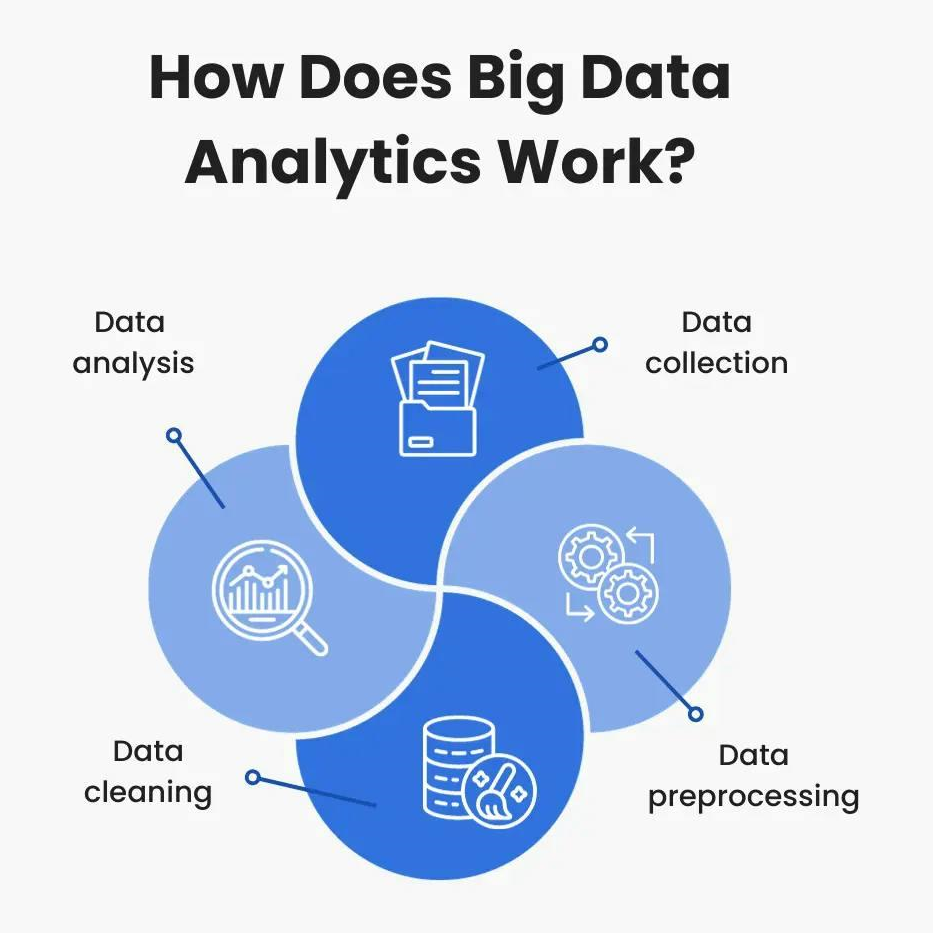


Step 1 — Data Collection 📥
Businesses gather information from multiple sources:
- Websites
- Mobile Apps
- CRM Systems
- ERP Systems
- Social Media
- Online Stores
- IoT Sensors
- Email Campaigns
Step 2 — Data Storage 🗄️
Collected information is stored using:
- Data Lakes
- Data Warehouses
- Cloud Storage
- Distributed File Systems
Common technologies include Hadoop Distributed File System (HDFS) and cloud object storage.
Step 3 — Data Cleaning 🧹
Raw data often contains:
- Missing values
- Duplicate records
- Incorrect entries
- Formatting errors
Cleaning improves reliability.
Step 4 — Data Processing ⚙️
Processing frameworks divide enormous datasets into smaller tasks running across many servers simultaneously.
This dramatically reduces computation time.
Step 5 — Data Analysis 📊
Data scientists perform:
- Descriptive Analytics
- Diagnostic Analytics
- Predictive Analytics
- Prescriptive Analytics
Each level provides deeper business intelligence.
Step 6 — Visualization 📈
Results appear in dashboards using:
- Charts
- Heat Maps
- KPI Panels
- Interactive Reports
Decision-makers understand trends much faster visually than through raw spreadsheets.
Step 7 — Business Decisions 🎯
Insights drive actions such as:
- Increasing advertising budgets
- Launching products
- Improving customer experience
- Reducing costs
- Forecasting sales
Comparison ⚖️
| Feature | Traditional Analytics | Big Data Analytics |
|---|---|---|
| Dataset Size | Small | Massive |
| Speed | Slow | Near Real-Time |
| Storage | Relational Databases | Distributed Storage |
| Scalability | Limited | Extremely High |
| Data Types | Structured | Structured + Unstructured |
| Cost Efficiency | Moderate | Higher Initial Investment |
| AI Integration | Limited | Extensive |
| Marketing Optimization | Basic | Advanced |
Diagrams & Tables 🖥️


Big Data Processing Pipeline
| Stage | Purpose |
|---|---|
| Data Sources | Generate Information |
| Data Ingestion | Collect Data |
| Storage | Save Data |
| Processing | Analyze Data |
| Machine Learning | Build Predictions |
| Dashboard | Present Insights |
| Decision | Improve Business |
Marketing Analytics Metrics
| Metric | Purpose |
|---|---|
| CTR | Advertisement Performance |
| CPC | Advertising Cost |
| Conversion Rate | Sales Efficiency |
| Bounce Rate | Website Quality |
| Customer Lifetime Value | Revenue Prediction |
| ROI | Investment Success |
Decision-Making Workflow
| Input | Processing | Output |
|---|---|---|
| Customer Data | Analytics | Personalized Marketing |
| Sales Data | Forecasting | Inventory Planning |
| Website Traffic | Behavior Analysis | UX Improvements |
| Campaign Results | Optimization | Higher ROI |
Examples 💡
Example 1 — E-commerce
A retailer analyzes:
- 50 million purchases
- Customer demographics
- Product searches
- Shopping carts
The recommendation engine increases sales by suggesting relevant products.
Example 2 — Email Marketing
Analytics identifies:
- Best sending times
- Preferred products
- Customer interests
Email campaigns achieve higher open and conversion rates.
Example 3 — Social Media
Companies analyze:
- Likes
- Shares
- Comments
- Trending hashtags
Marketing teams create content that better matches audience interests.
Example 4 — Website Analytics
Visitor behavior reveals:
- Most viewed pages
- Exit pages
- Device usage
- Geographic locations
Website owners redesign pages to improve conversions.
Real-World Applications 🌎
Big Data Analytics powers countless industries.
Digital Marketing
- Audience segmentation
- Customer personalization
- Campaign optimization
- Conversion tracking
Healthcare
Hospitals predict disease outbreaks and improve patient care using clinical data.
Banking
Banks detect fraud in real time through transaction analysis.
Manufacturing
Factories use predictive maintenance to reduce equipment failures.
Transportation
Logistics companies optimize delivery routes using GPS and traffic data.
Smart Cities
Governments monitor:
- Traffic
- Pollution
- Energy consumption
- Public transportation
Education
Universities analyze student performance to improve learning outcomes.
Common Mistakes ❌
Many organizations struggle because of avoidable errors.
Collecting Too Much Data
More data does not always produce better insights.
Ignoring Data Quality
Incorrect or incomplete records generate misleading conclusions.
Poor Visualization
Complex dashboards confuse decision-makers.
No Business Objectives
Analytics should solve business problems rather than simply produce reports.
Neglecting Privacy
Organizations must comply with regulations such as GDPR and other applicable privacy laws when handling personal data.
Challenges & Solutions 🛠️
| Challenge | Solution |
|---|---|
| Massive Data Volume | Cloud Computing |
| Slow Processing | Distributed Computing |
| Poor Data Quality | Data Cleaning Pipelines |
| Security Risks | Encryption & Access Control |
| Skill Shortages | Employee Training |
| High Costs | Scalable Cloud Services |
| Integration Issues | APIs & ETL Pipelines |
Case Study 🏢
Improving Marketing Performance with Big Data
A global online retailer noticed declining advertising performance despite increasing marketing expenditures.
Initial Situation
Problems included:
- High advertising costs
- Low conversion rates
- Weak customer engagement
- Poor campaign targeting
Big Data Strategy
The engineering team collected information from:
- Website logs
- Mobile applications
- CRM systems
- Email campaigns
- Social media interactions
- Purchase histories
They cleaned the data, built customer segments, and developed predictive models to estimate purchase likelihood. Marketing campaigns were then personalized based on browsing behavior, previous purchases, geographic location, and device type.
Results
Within several months, the company observed:
- Higher conversion rates
- Lower customer acquisition costs
- Improved campaign return on investment
- Better customer retention
- Faster business decision-making
The project demonstrated how integrating data engineering, analytics, and marketing strategy can create measurable business value.
Essential Tips ⭐
Build Strong Data Foundations
High-quality data consistently produces more reliable insights.
Focus on Business Goals
Always define measurable objectives before beginning analysis.
Automate Repetitive Tasks
Automation reduces manual work and speeds up reporting.
Monitor KPIs Continuously
Track metrics regularly instead of relying only on monthly reports.
Use Predictive Models
Forecast future trends instead of analyzing only historical data.
Protect Customer Privacy
Implement encryption, role-based access controls, and compliance practices to safeguard sensitive information.
Keep Learning
Big Data technologies evolve rapidly. Engineers should continuously improve their skills in cloud computing, AI, machine learning, and modern analytics platforms.
Frequently Asked Questions ❓
1. What is Big Data Analytics?
It is the process of analyzing massive datasets to discover patterns, trends, and insights that support better business and engineering decisions.
2. Why is Big Data important in digital marketing?
It helps marketers understand customer behavior, personalize campaigns, optimize advertising budgets, and improve return on investment.
3. What types of data are analyzed?
Organizations analyze structured, semi-structured, and unstructured data, including transactions, logs, images, videos, text, and sensor information.
4. What skills are required for Big Data Analytics?
Useful skills include statistics, SQL, Python, data visualization, cloud computing, machine learning, distributed systems, and communication.
5. How does Big Data improve decision-making?
It enables evidence-based decisions using historical trends, real-time monitoring, predictive models, and performance analytics instead of relying solely on intuition.
6. Is Big Data only useful for large companies?
No. Small and medium-sized businesses can also benefit through cloud-based analytics services that scale according to their needs.
7. What is the difference between Big Data and Business Intelligence?
Business Intelligence primarily focuses on reporting and historical performance, while Big Data Analytics handles much larger and more diverse datasets and often includes predictive and AI-driven techniques.
8. What are the biggest future trends?
Key trends include AI-powered analytics, edge computing, real-time data streaming, automated machine learning (AutoML), privacy-enhancing technologies, and increasingly intelligent decision-support systems.
Conclusion 🎯
Big Data Analytics has transformed the way organizations understand customers, optimize digital marketing, and make strategic decisions. By collecting information from diverse sources, processing it through scalable engineering systems, and turning it into actionable insights, businesses can improve efficiency, reduce costs, increase revenue, and deliver more personalized customer experiences.
For students, mastering Big Data concepts provides a strong foundation for careers in data engineering, software development, artificial intelligence, cloud computing, and business intelligence. For professionals, investing in modern analytics capabilities enables faster, more accurate, and data-driven decisions in an increasingly competitive marketplace.
As data volumes continue to grow, organizations that combine robust engineering practices, high-quality data governance, advanced analytics, and ethical AI will be best positioned to innovate, adapt, and lead in the digital era. 🚀📊