Bayesian Data Analysis 3rd Edition: A Complete Engineering Guide to Modern Bayesian Statistics, Modeling, and Decision-Making 📊🔬🚀
Introduction 🌍📈
In today’s data-driven world, engineers, scientists, analysts, and researchers are constantly faced with uncertainty. Whether predicting equipment failures, estimating structural loads, analyzing sensor measurements, or building machine learning systems, uncertainty is an unavoidable part of engineering practice.
Bayesian Data Analysis 3rd Edition is one of the most influential books in modern statistics and data science. Written by Andrew Gelman, John B. Carlin, Hal S. Stern, David B. Dunson, Aki Vehtari, and Donald B. Rubin, the book provides a comprehensive framework for understanding probability, uncertainty, statistical inference, and predictive modeling.
Unlike traditional statistical approaches that often focus solely on observed data, Bayesian analysis combines:
💡 Prior knowledge
✅ Observed evidence
✅ Mathematical probability theory
to create updated beliefs and predictions.
This methodology has transformed fields such as:
- Engineering
- Artificial Intelligence
- Data Science
- Finance
- Medicine
- Manufacturing
- Reliability Engineering
- Robotics
- Aerospace Systems
For both beginners and experienced engineers, Bayesian Data Analysis offers a powerful toolkit for making better decisions under uncertainty.
Background Theory 🧠📚
The Evolution of Statistical Thinking
Statistics has evolved through two major schools of thought:
Frequentist Statistics
The frequentist approach assumes that parameters are fixed but unknown.
Examples include:
- Hypothesis testing
- Confidence intervals
- ANOVA
- Classical regression
This methodology dominated the twentieth century because calculations were simpler before modern computers.
The Rise of Bayesian Statistics
Bayesian statistics originated from the work of:
Thomas Bayes
His fundamental insight was that probabilities could represent degrees of belief rather than merely frequencies of events.
Modern computing enabled Bayesian methods to flourish because complex probability calculations became computationally feasible.
Today Bayesian techniques are heavily used in:
- Machine Learning
- Neural Networks
- Quality Control
- Signal Processing
- Predictive Maintenance
- Risk Assessment
Bayes’ Theorem Foundation
The entire field is built upon Bayes’ Theorem.
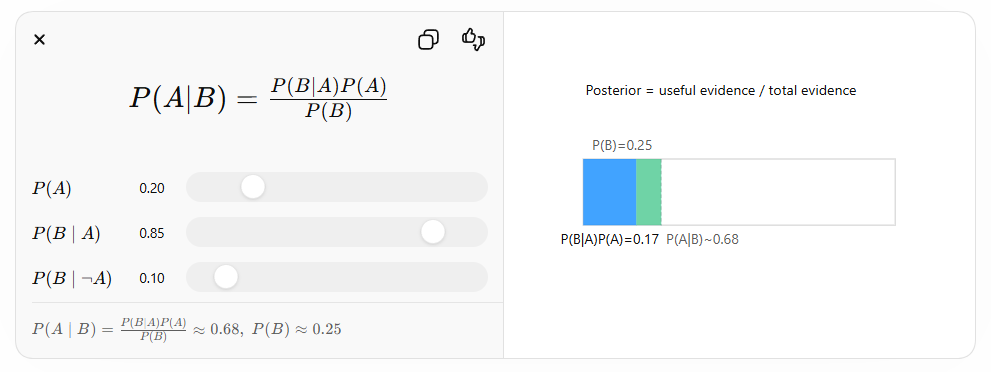
Where:
- P(A) = Prior probability
- P(B|A) = Likelihood
- P(B) = Evidence
- P(A|B) = Posterior probability
The theorem updates our belief after observing new information.
Technical Definition ⚙️
What is Bayesian Data Analysis?
Bayesian Data Analysis is a statistical methodology that updates probability distributions for unknown quantities by combining:
- Prior Information
- Observed Data
- Probabilistic Models
The result is a posterior distribution that quantifies uncertainty and provides a complete picture of possible parameter values.
Rather than producing a single estimate, Bayesian analysis generates a distribution of plausible outcomes.
Core Components
Prior Distribution
Represents knowledge before observing data.
Examples:
- Historical measurements
- Engineering specifications
- Expert judgment
- Previous experiments
Likelihood Function
Represents how likely the observed data are given a parameter value.
Examples:
- Sensor observations
- Production measurements
- Test results
Posterior Distribution
The updated belief after combining prior information and evidence.
This posterior becomes the basis for:
- Prediction
- Decision making
- Risk analysis
Posterior Predictive Distribution
Allows engineers to forecast future observations while accounting for uncertainty.
Step-by-Step Explanation 🔍⚙️
Step 1: Define the Problem
Suppose an engineer wants to estimate the failure probability of a mechanical component.
Question:
What is the true failure rate?
Step 2: Select Prior Knowledge
Historical records suggest:
- Average failure rate = 2%
This information becomes the prior distribution.
Step 3: Collect Data
A new test is performed.
Results:
- Components tested = 100
- Failures observed = 5
Step 4: Construct Likelihood
The likelihood describes the probability of observing five failures under different failure rates.
Step 5: Apply Bayes’ Rule
The prior and likelihood are combined mathematically.
Result:
Posterior Distribution
This reflects both historical experience and current evidence.
Step 6: Interpret Results
Instead of saying:
“Failure rate equals 5%”
Bayesian analysis says:
“There is a probability distribution describing all plausible failure rates.”
This provides richer engineering information.
Step 7: Predict Future Performance
The posterior can predict:
- Future failures
- Maintenance schedules
- Replacement intervals
- Warranty costs
Comparison ⚖️
Bayesian vs Frequentist Statistics
| Feature | Bayesian | Frequentist |
|---|---|---|
| Uses Prior Information | Yes ✅ | No ❌ |
| Probability of Parameters | Yes ✅ | No ❌ |
| Handles Uncertainty | Excellent ⭐ | Good |
| Decision Making | Strong ⭐ | Moderate |
| Computational Cost | Higher | Lower |
| Interpretability | Intuitive | Sometimes Difficult |
Bayesian vs Machine Learning Only
| Feature | Bayesian Analysis | Traditional ML |
|---|---|---|
| Uncertainty Quantification | Excellent | Limited |
| Small Datasets | Strong | Often Weak |
| Explainability | High | Variable |
| Risk Assessment | Excellent | Moderate |
| Prior Knowledge | Supported | Often Ignored |
Diagrams & Tables 📊
Bayesian Workflow Diagram
Prior Knowledge
       │
       ▼
Likelihood Function
       │
       ▼
Bayes' Theorem
       │
       ▼
Posterior Distribution
       │
       ▼
Predictions & Decisions
Bayesian Modeling Pipeline
| Stage | Purpose |
|---|---|
| Prior | Existing Knowledge |
| Data | Evidence Collection |
| Model | Statistical Representation |
| Inference | Posterior Computation |
| Validation | Model Checking |
| Prediction | Future Estimates |
Examples 💡
Example 1: Quality Control
A factory produces bearings.
Historical defect rate:
1%
After inspection:
20 defects found among 1000 bearings.
Bayesian analysis updates the defect probability and predicts future quality levels.
Example 2: Structural Engineering
An engineer estimates bridge load capacity.
Information sources:
- Design calculations
- Sensor data
- Inspection reports
Bayesian methods combine all evidence into a unified reliability estimate.
Example 3: Machine Learning
An AI system predicts equipment failures.
Bayesian inference:
- Learns from historical data
- Updates predictions continuously
- Quantifies uncertainty
This produces more reliable predictions than many traditional approaches.
Example 4: Environmental Engineering
Air pollution sensors provide noisy measurements.
Bayesian models help estimate:
- True pollution levels
- Measurement uncertainty
- Future trends
Real World Applications 🌎🏭
Aerospace Engineering ✈️
Used for:
- Flight safety assessment
- Sensor fusion
- Failure prediction
- Space mission reliability
Mechanical Engineering ⚙️
Applications include:
- Fatigue analysis
- Predictive maintenance
- Reliability engineering
- Equipment monitoring
Civil Engineering 🏗️
Used in:
- Structural health monitoring
- Earthquake risk assessment
- Traffic modeling
- Infrastructure planning
Electrical Engineering ⚡
Important for:
- Signal processing
- Fault detection
- Communication systems
- Control systems
Artificial Intelligence 🤖
Bayesian methods power:
- Probabilistic neural networks
- Recommendation systems
- Natural language processing
- Autonomous vehicles
Medical Engineering 🏥
Applications:
- Clinical trials
- Disease prediction
- Medical imaging
- Treatment optimization
Common Mistakes ❌
Ignoring Prior Selection
Poor priors can distort results.
Always justify prior assumptions.
Using Overly Complex Models
Complexity does not guarantee accuracy.
Simpler models often perform better.
Misinterpreting Posterior Probabilities
Posterior probabilities represent updated beliefs, not absolute truths.
Neglecting Model Validation
Posterior estimates must be checked against real observations.
Insufficient Data Quality
Bayesian methods cannot fully compensate for poor-quality measurements.
Challenges & Solutions 🛠️
Challenge 1: Computational Complexity
Large models require intensive computation.
Solution
Use:
- Markov Chain Monte Carlo (MCMC)
- Hamiltonian Monte Carlo
- Variational Inference
Challenge 2: Prior Selection
Choosing priors can be controversial.
Solution
Perform sensitivity analysis.
Compare multiple prior assumptions.
Challenge 3: High-Dimensional Data
Thousands of variables create difficulties.
Solution
Use hierarchical Bayesian models.
Challenge 4: Convergence Issues
Sampling algorithms may fail to converge.
Solution
Monitor:
- Trace plots
- Effective sample size
- R-hat statistics
Case Study 🏭📉➡️📈
Predictive Maintenance in a Manufacturing Plant
A manufacturing company experiences unexpected motor failures.
Initial Situation
Problems included:
- Downtime costs
- Production delays
- Maintenance uncertainty
Data Available
Engineers collected:
- Temperature readings
- Vibration measurements
- Operating hours
- Historical failures
Bayesian Model Development
A Bayesian reliability model was created.
Inputs:
- Historical failure records
- Real-time sensor streams
- Expert maintenance knowledge
Results
Benefits achieved:
✅ Improved failure prediction
✅ Reduced downtime
💡 Better maintenance scheduling
✅ Lower operational costs
✅ Increased equipment lifespan
Business Impact
The company shifted from reactive maintenance to predictive maintenance, significantly improving operational efficiency.
This is one of the most common industrial applications of Bayesian Data Analysis today.
Tips for Engineers 🎯
Learn Probability First
Strong probability fundamentals make Bayesian methods easier to understand.
Focus on Interpretation
Understanding posterior distributions is more important than memorizing formulas.
Use Modern Software
Popular tools include:
- Stan
- PyMC
- JAGS
- BUGS
- R
- Python
Start with Simple Models
Build intuition before tackling large hierarchical systems.
Visualize Results
Graphs often reveal insights that tables cannot.
Validate Continuously
Always compare predictions against actual outcomes.
Frequently Asked Questions (FAQs) ❓
1. Is Bayesian Data Analysis difficult for beginners?
It can be challenging initially because it combines probability theory, statistics, and computation. However, many learners find Bayesian reasoning intuitive once they understand the concept of updating beliefs with evidence.
2. Why is Bayesian Data Analysis 3rd Edition so popular?
The book balances theory and practical application while covering modern Bayesian techniques used in research, engineering, and data science.
3. Is Bayesian analysis better than frequentist statistics?
Neither approach is universally superior. Bayesian methods excel when prior knowledge and uncertainty quantification are important.
4. Do engineers use Bayesian methods in industry?
Yes. Industries including aerospace, manufacturing, energy, automotive, healthcare, and AI use Bayesian techniques extensively.
5. What programming language is best for Bayesian modeling?
Python and R are the most commonly used languages due to their strong ecosystem of Bayesian libraries.
6. What is the biggest advantage of Bayesian statistics?
Its ability to quantify uncertainty and continuously update predictions as new data become available.
7. Can Bayesian analysis work with small datasets?
Yes. One of its strongest advantages is incorporating prior knowledge when limited data are available.
8. Is Bayesian Data Analysis useful for machine learning?
Absolutely. Many advanced AI systems rely on Bayesian principles for probabilistic reasoning and uncertainty estimation.
Conclusion 🎓🚀
Bayesian Data Analysis 3rd Edition stands as one of the most important references in modern statistics, engineering analytics, and data science. Its central philosophy—updating knowledge through evidence—provides a mathematically rigorous framework for dealing with uncertainty in complex systems.
For engineers, the book offers far more than statistical formulas. It teaches a way of thinking that integrates prior knowledge, observational data, and probabilistic reasoning into a coherent decision-making process.
From predictive maintenance and structural reliability to artificial intelligence and risk assessment, Bayesian methods continue to shape the future of engineering and technology. 🌟
As industries generate larger volumes of data and increasingly rely on intelligent systems, the principles presented in Bayesian Data Analysis 3rd Edition remain essential tools for students, researchers, and professionals seeking deeper insight, better predictions, and more informed engineering decisions. 📊⚙️🤖🌍📈