Basic Math for AI: A Beginner’s Quickstart Guide to the Mathematical Foundations of Artificial Intelligence 🤖📐
Introduction: Why Mathematics Matters in Artificial Intelligence 🧠
Artificial intelligence can look mysterious from the outside. A modern AI system can recognize an image, understand language, recommend a product, predict equipment failures, or generate code in seconds. Behind these impressive capabilities, however, are mathematical ideas that are surprisingly understandable.
You do not need to become a mathematician before learning AI. Instead, you need to understand the small set of mathematical concepts that repeatedly appear in machine learning, neural networks, data analysis, computer vision, robotics, and optimization.
The most important foundations are:
- Basic algebra 🔢
- Functions and graphs 📈
- Vectors and matrices
- Probability 🎲
- Statistics
- Calculus
- Optimization
- Logic and mathematical notation
The goal of this guide is to build an intuitive foundation. Rather than overwhelming beginners with complicated equations, we will focus on what each mathematical concept means, why AI uses it, and where you will encounter it in practice.


Whether you are a university student, engineer, programmer, data analyst, or professional transitioning into AI, these foundations can make machine-learning concepts much easier to understand.
Background Theory: The Mathematics Behind AI
AI systems learn patterns from information. Mathematics provides the language for representing those patterns and manipulating them.
Consider a simple machine-learning system designed to predict whether an industrial machine may require maintenance. The system might receive information such as:
- Operating temperature
- Vibration level
- Operating hours
- Pressure
- Previous maintenance history
A computer cannot directly reason about these concepts in their everyday form. They must be represented numerically.
This is where mathematics enters the picture.
The temperature might become a number. Several measurements can be organized into a vector. Thousands of vectors can form a matrix. Probability can describe uncertainty. Statistics can help identify patterns in historical observations. Calculus can help determine how a model should change during training.
In other words:
Real-world information → mathematical representation → AI model → prediction or decision
The Mathematical Layers of AI
Different areas of mathematics serve different purposes.
| Mathematical Area | Main Purpose in AI | Typical AI Use |
|---|---|---|
| Algebra | Manipulating relationships | Model calculations |
| Functions | Representing input-output relationships | Predictions |
| Vectors | Representing features | Machine learning |
| Matrices | Handling large datasets | Neural networks |
| Probability | Managing uncertainty | Classification |
| Statistics | Understanding data | Data analysis |
| Calculus | Understanding change | Model training |
| Optimization | Improving models | Loss minimization |
| Logic | Making structured decisions | Rule-based AI |
The important point is that these areas are connected, not isolated subjects.
Definition: What Is “Basic Math for AI”? 🔍
Basic math for AI refers to the fundamental mathematical concepts required to understand how artificial-intelligence and machine-learning algorithms represent data, discover patterns, make predictions, and improve their performance.
It does not necessarily mean advanced mathematics.
For a beginner, the essential foundation can be viewed as five major building blocks:
- Algebra — relationships between quantities.
- Linear algebra — vectors, matrices, and transformations.
- Probability and statistics — uncertainty and patterns in data.
- Calculus — rates of change.
- Optimization — finding better model parameters.
Algebra: The Starting Point
Algebra is one of the most useful foundations because AI models contain relationships between inputs and outputs.
For example, imagine a model receiving the number of hours a machine has operated and producing a maintenance-risk prediction.
The model needs a mechanism for connecting the input with the prediction.
You do not need to memorize complicated formulas initially. Instead, understand the basic idea:
Inputs are transformed through mathematical relationships to produce outputs.
That simple concept appears everywhere in AI.
Functions: Turning Inputs Into Outputs
A function can be viewed as a mathematical machine.
You provide an input, the function processes it, and you receive an output.
In AI:
Input data → function/model → prediction
For example:
Machine temperature → AI model → probability of overheating
Neural networks are essentially collections of mathematical transformations arranged in layers.
Step-by-Step: The Mathematical Journey From Data to AI 🤖


Understanding the following sequence provides a useful mental model for almost every machine-learning project.
Step 1: Represent the Real World as Data
The first challenge is converting real-world information into numerical features.
Imagine an engineer wants an AI system to identify abnormal behavior in a pump.
Possible features include:
- Temperature
- Pressure
- Vibration
- Flow rate
- Operating duration
Each observation becomes a collection of numerical values.
Step 2: Organize the Information
Individual measurements can be represented as vectors.
A complete collection of observations can be organized into matrices or larger data structures.
This is where linear algebra becomes extremely important.
Step 3: Normalize or Transform the Data
Different features can have very different scales.
For example, operating hours might be measured in thousands while vibration measurements might be relatively small.
Data preprocessing can transform these values into more useful ranges.
This helps many machine-learning algorithms train more efficiently.
Step 4: Feed Data Into a Model
The model receives numerical information and processes it through mathematical operations.
A simple model may be easy to interpret.
A deep neural network can contain many layers of transformations.
Each layer extracts or transforms information.
Step 5: Generate a Prediction
The model produces an output.
For example:
Normal operation → 0.15 risk
Potential fault → 0.85 risk
The numbers can represent confidence or probability depending on the model.
Step 6: Measure the Error
The model’s prediction is compared with the desired result.
The difference is represented using a loss function or another evaluation method.
A better model generally produces lower error on appropriate evaluation data.
Step 7: Improve the Model
Optimization techniques adjust model parameters so that future predictions become better.
This is one of the areas where calculus becomes particularly useful.
Step 8: Evaluate With New Data
Finally, the model must be tested on information it did not use during training.
This helps determine whether it learned useful patterns rather than simply memorizing its training examples.
Linear Algebra: The Language of Machine Learning 📊
Linear algebra is arguably the most important mathematical area for modern AI.
Vectors
A vector is a collection of values that can represent an object or observation.
For example, a machine could be represented through a feature vector containing:
- Temperature
- Pressure
- Vibration
- Speed
A customer profile, image, text embedding, or sensor observation can also be represented as a vector.
Matrices
A matrix is essentially a structured collection of numbers arranged into rows and columns.
Imagine a spreadsheet containing thousands of machine observations.
That dataset can naturally be represented mathematically as a matrix.
Matrices are heavily used in:
- Neural networks
- Computer vision
- Recommendation systems
- Natural-language processing
- Data transformations
- Scientific computing
Transformations
One powerful way to understand linear algebra in AI is to think about transformations.
A model can transform an input representation into another representation.
For example:
Raw image → numerical representation → feature representation → classification
This mathematical transformation is fundamental to computer vision.
Probability and Statistics 🎲
AI rarely operates with perfect certainty.
A medical-image classifier, spam detector, fraud detector, or autonomous system may need to make decisions when information is incomplete.
Probability provides a framework for representing uncertainty.
Probability
Probability answers questions such as:
- How likely is an event?
- How confident is the model?
- How should uncertain information be represented?
For example, an AI classifier might determine that an image has a high likelihood of containing a particular object.
The important beginner concept is not the calculation itself but the meaning of uncertainty.
Statistics
Statistics focuses on collecting, analyzing, describing, and interpreting data.
AI depends heavily on statistics because models learn from datasets.
Important statistical concepts include:
- Mean
- Median
- Variance
- Standard deviation
- Distribution
- Correlation
- Sampling
- Outliers
Statistics can help engineers understand whether a dataset is representative and whether a model’s performance is meaningful.
Calculus: Understanding Change 📈
At first, calculus may seem unrelated to AI.
In reality, it plays an important role in model training.
A machine-learning model contains parameters. During training, those parameters are adjusted.
The central question becomes:
How should the parameters change to make the model perform better?
Calculus provides tools for analyzing change.
Derivatives
A derivative describes how rapidly something changes.
In machine learning, derivatives can indicate how a small change in a model parameter affects the model’s error.
This information helps optimization algorithms decide which direction to move.
Gradients
When a model has many parameters, we need information about change across multiple dimensions.
A gradient provides that directional information.
Deep-learning systems can contain millions or even billions of parameters, so efficient gradient-based optimization becomes extremely important.
Optimization: Teaching Models to Improve ⚙️
Optimization is the process of finding better values for model parameters according to a defined objective.
Imagine adjusting thousands of controls on an engineering system while trying to minimize an unwanted effect.
Machine learning has a similar problem.
The model begins with parameter values. Training repeatedly adjusts them.
One famous approach is gradient descent.
Conceptually:
Measure error → determine direction of improvement → adjust parameters → repeat
This process can occur many times during training.
Optimization is therefore the bridge between mathematical theory and practical model learning.
Comparison: Which Mathematics Should You Learn First?
| Topic | Difficulty for Beginners | Importance | Learn First? |
|---|---|---|---|
| Basic Algebra | ⭐ | Very High | ✅ Yes |
| Functions | ⭐⭐ | Very High | ✅ Yes |
| Vectors | ⭐⭐ | Very High | ✅ Yes |
| Matrices | ⭐⭐⭐ | Very High | ✅ Yes |
| Probability | ⭐⭐ | Very High | ✅ Yes |
| Statistics | ⭐⭐ | Very High | ✅ Yes |
| Calculus | ⭐⭐⭐ | High | After fundamentals |
| Optimization | ⭐⭐⭐ | Very High | After calculus basics |
Beginner-Friendly Learning Order
A practical progression is:
Algebra → Functions → Vectors → Matrices → Probability → Statistics → Calculus → Optimization
You do not need to completely master one topic before moving to the next.
AI becomes easier when you gradually connect the concepts.
Diagrams, Tables, and Mathematical Relationships 🧩


A useful conceptual map is:
                    Artificial Intelligence
                             │
             ┌───────────────┼───────────────┐
             │               │               │
          Data           Algorithms         Models
             │               │               │
             ▼               ▼               ▼
        Statistics       Linear Algebra    Functions
             │               │               │
             └───────────────┼───────────────┘
                             │
                         Optimization
                             │
                             ▼
                         Prediction
How the Concepts Connect
| AI Activity | Mathematical Foundation |
|---|---|
| Representing features | Vectors |
| Handling datasets | Matrices |
| Understanding uncertainty | Probability |
| Measuring data behavior | Statistics |
| Building relationships | Functions |
| Measuring change | Calculus |
| Improving parameters | Optimization |
| Evaluating predictions | Statistics and probability |
Practical Examples 💡
Example 1: Email Spam Detection
An email can be converted into numerical features based on its text and metadata.
A machine-learning model examines these features and predicts whether the message is likely to be spam.
Mathematics helps represent the email, calculate relationships between features, estimate probabilities, and optimize the model.
Example 2: Predictive Maintenance
A factory collects sensor data from motors.
The AI system analyzes historical measurements and learns patterns associated with equipment failures.
When a new sensor observation arrives, the model estimates whether abnormal behavior is occurring.
Example 3: Image Recognition
A computer sees an image as numerical information.
Linear algebra provides ways to organize and transform that information.
A neural network processes increasingly sophisticated representations until the system can classify what appears in the image.
Example 4: Recommendation Systems
A streaming platform may analyze viewing behavior.
Mathematical representations allow the system to compare users, content, and preferences.
The model can then identify patterns and generate recommendations.
Real-World Applications of AI Mathematics 🌍
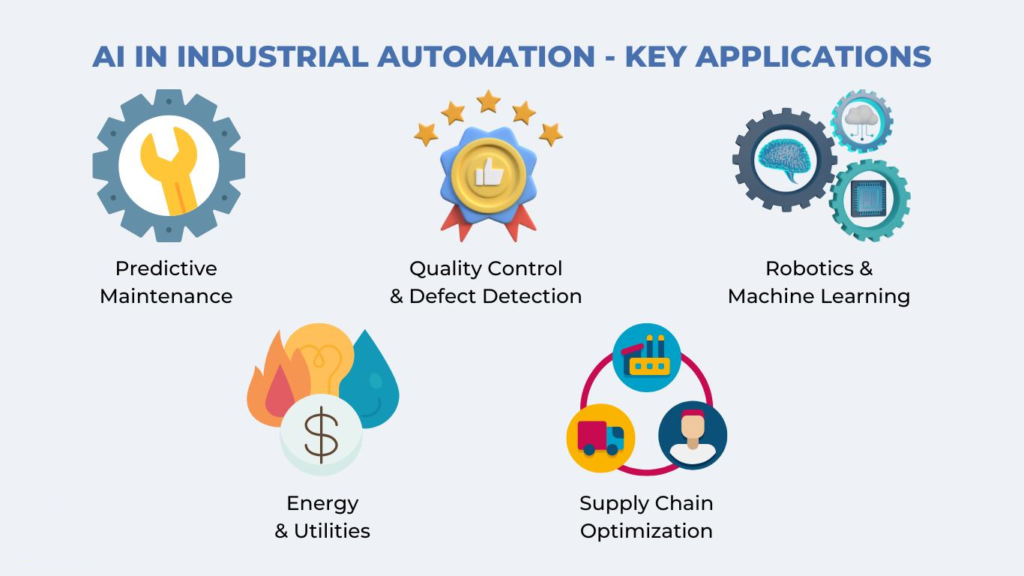
Mathematical foundations appear across almost every engineering and technology discipline.
Engineering
Engineers use AI for:
- Predictive maintenance
- Structural monitoring
- Fault detection
- Energy optimization
- Process control
- Digital twins
Robotics
Robotics combines mathematics with:
- Computer vision
- Motion planning
- Sensor fusion
- Localization
- Control systems
- Reinforcement learning
Computer Vision
Mathematical representations allow computers to process images and video for:
- Object detection
- Quality inspection
- Medical imaging
- Autonomous vehicles
- Security systems
Natural-Language Processing
Language models transform words and tokens into numerical representations.
Vectors, probability, statistics, optimization, and matrix operations are central to these systems.
Finance and Business
AI models can support:
- Fraud detection
- Demand forecasting
- Risk analysis
- Customer segmentation
- Automated decision support
Common Mistakes Beginners Make ⚠️
Trying to Learn All Mathematics Before AI
You do not need a mathematics degree before writing your first machine-learning program.
Learn the mathematics alongside AI concepts.
Memorizing Instead of Understanding
Memorizing terminology without understanding its purpose creates problems later.
Ask:
What problem does this mathematical concept solve?
Ignoring Statistics
Some beginners focus heavily on algebra and calculus while overlooking statistics.
However, real-world AI depends enormously on data quality, distributions, uncertainty, sampling, and evaluation.
Being Afraid of Matrices
Matrices may initially look intimidating.
Start with simple tables of numbers and gradually learn operations and transformations.
Jumping Directly Into Advanced Calculus
You usually need only an intuitive understanding of derivatives and gradients at first.
Build gradually.
Challenges & Solutions 🛠️
| Challenge | Practical Solution |
|---|---|
| Mathematics feels abstract | Connect every concept to an AI example |
| Matrix notation looks confusing | Begin with small datasets |
| Probability seems theoretical | Use classification examples |
| Calculus feels difficult | Focus initially on change and direction |
| Too many formulas | Prioritize intuition before memorization |
| Forgetting concepts | Implement them with small Python experiments |
| Difficulty connecting topics | Build complete mini-projects |
A Better Learning Strategy
Instead of studying mathematics for months without touching AI, use a cycle:
Learn → visualize → implement → experiment → review
For example, after learning vectors, create a tiny Python program that stores and compares feature vectors.
This creates a connection between theory and engineering practice.
Case Study: AI-Based Machine Fault Detection 🏭
Imagine a manufacturing facility operating hundreds of electric motors.
The engineering team wants to detect potential failures before they cause production interruptions.
Stage 1: Data Collection
Sensors continuously record:
- Temperature
- Vibration
- Motor speed
- Electrical measurements
- Operating duration
Stage 2: Mathematical Representation
Each sensor observation is represented numerically.
The measurements form feature vectors, while many observations form a structured dataset.
Stage 3: Statistical Analysis
Engineers examine normal operating behavior.
They identify unusual observations and investigate relationships between different sensor measurements.
Stage 4: Model Training
A machine-learning model receives historical observations.
Its parameters are repeatedly adjusted during training.
Optimization techniques help reduce prediction error.
Stage 5: Deployment
The trained model receives new sensor data.
If the incoming pattern resembles historical failure conditions, the system can generate an alert.
Stage 6: Engineering Decision
The AI does not necessarily replace the engineer.
Instead, it provides an additional source of information that can support maintenance planning.
This example demonstrates how algebra, linear algebra, statistics, probability, calculus, and optimization can work together inside a single engineering application.
Essential Tips for Learning AI Mathematics 🚀
Start With Intuition
Before asking how something is calculated, understand why it exists.
Practice With Small Numbers
Large datasets can hide the underlying idea.
Small examples make mathematical operations much easier to visualize.
Use Python as a Laboratory
Python can turn mathematical concepts into experiments.
Libraries such as NumPy, pandas, and visualization tools make it possible to connect theory with practical AI workflows.
Study Visualizations
Graphs can make functions, distributions, vectors, and optimization concepts much easier to understand.
Learn Mathematics Through AI Projects
Build simple projects involving:
- Classification
- Regression
- Recommendation
- Sensor analysis
- Image recognition
Projects provide context for otherwise abstract mathematics.
Don’t Chase Every Advanced Topic
You do not need advanced mathematical theory to begin.
Focus first on concepts that repeatedly appear in machine learning.
Build a Mathematical Vocabulary
Become comfortable with terms such as:
vector • matrix • feature • function • probability • distribution • derivative • gradient • parameter • loss • optimization
Once these words become familiar, AI research papers and technical documentation become much easier to read.
FAQs: Basic Math for AI ❓
Do I need advanced mathematics to start learning AI?
No. Basic algebra, functions, vectors, matrices, probability, and statistics are enough to begin. You can learn calculus and optimization progressively as your AI knowledge grows.
Is linear algebra more important than calculus for AI?
For many beginner machine-learning applications, linear algebra is encountered more frequently at the implementation level. However, calculus becomes extremely important for understanding neural-network training and optimization.
Should I learn Python before mathematics?
You can learn both together. Python gives you a practical environment where mathematical concepts can be tested rather than studied only theoretically.
How much probability do I need for machine learning?
Start with basic probability, conditional probability, distributions, expected values, and uncertainty. More advanced AI applications may require deeper probability theory.
Is statistics necessary for artificial intelligence?
Yes. Statistics is especially important for understanding datasets, distributions, sampling, correlations, model evaluation, uncertainty, and experimental results.
Can I learn AI if I am weak at mathematics?
Absolutely. Start with fundamentals and use practical examples. Mathematical ability improves through repeated application, just like programming ability.
Do neural networks require calculus?
Neural-network training relies heavily on derivatives, gradients, and optimization. You can use neural-network libraries without understanding all of the underlying calculus, but understanding the mathematics becomes valuable as you progress.
What should I learn first?
A strong beginner sequence is:
Algebra → Functions → Vectors → Matrices → Probability → Statistics → Calculus → Optimization
Then reinforce these topics through machine-learning projects.
Conclusion: Build the Foundation, Then Build the AI 🚀🤖
Mathematics is not a barrier standing between you and artificial intelligence. It is the language that explains what AI systems are doing underneath the software.
Algebra helps describe relationships. Functions transform inputs into outputs. Vectors and matrices provide efficient ways to represent data. Probability handles uncertainty. Statistics helps us understand datasets and evaluate results. Calculus explains change, while optimization helps models improve.
The most important lesson is that you do not need to master everything at once.
Start with simple algebra and functions. Move into vectors and matrices. Learn the statistical ideas needed to understand data. Then explore probability, calculus, and optimization as your AI projects become more advanced.
For students and professionals, the strongest approach is practical:
Learn the concept → connect it to AI → experiment with it → apply it to an engineering problem.
Once these mathematical building blocks become familiar, machine-learning algorithms stop looking like mysterious collections of formulas and start looking like what they really are: structured mathematical tools for finding patterns, making predictions, and solving real-world problems. 🔬📊🤖