Applied Natural Language Processing with Python: Building Modern Machine Learning and Deep Learning NLP Systems
Introduction
Natural Language Processing (NLP) sits at the intersection of engineering, computer science, linguistics, and artificial intelligence. Its goal is simple to describe but challenging to implement: enable computers to process, understand, classify, generate, and interact with human language.
Today, NLP systems are everywhere. Search engines interpret queries, customer-support platforms classify messages, recommendation systems analyze reviews, and intelligent assistants transform natural-language instructions into useful actions. Behind these applications are carefully designed pipelines that combine text processing, machine learning, deep learning, and increasingly transformer-based architectures. 🧠💻
Python has become one of the most practical languages for building these systems because it provides a rich ecosystem for data processing, experimentation, model development, and deployment.


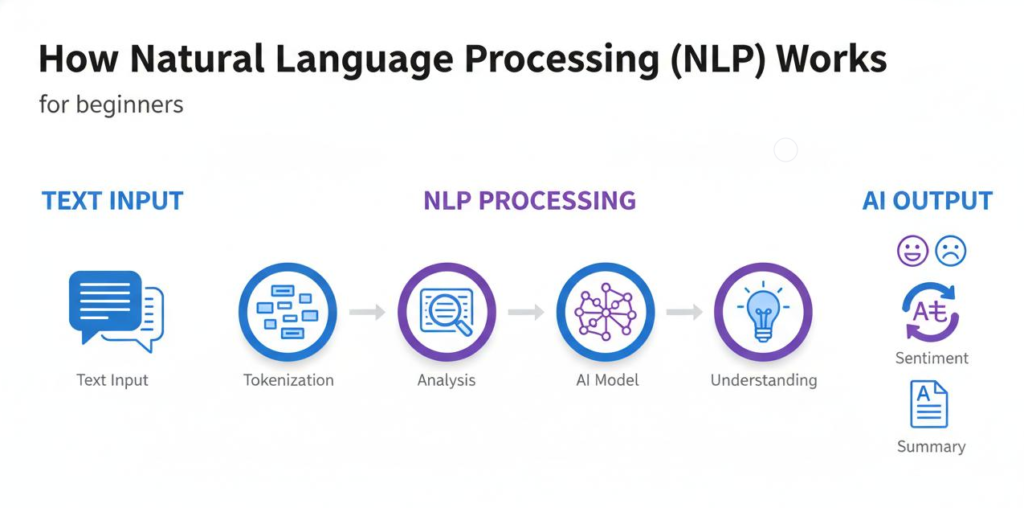
An applied NLP engineer does not simply train a model. The complete engineering workflow may involve collecting text, cleaning noisy data, selecting representations, training algorithms, evaluating performance, optimizing inference, and deploying the final system.
This article presents a practical engineering view of Applied Natural Language Processing with Python, suitable for students beginning their NLP journey as well as professionals developing production-oriented language applications.
Background Theory
What makes human language difficult for computers?
Human language is highly flexible.
The same idea can be expressed using completely different words. A sentence may also have multiple interpretations depending on context.
For example:
“The system detected a fault.”
The word fault might refer to an electrical problem, mechanical failure, software defect, or another engineering issue.
A computer therefore cannot rely only on individual words. Modern NLP systems need to consider context, relationships, syntax, semantics, and sometimes world knowledge.
From rules to machine learning
Early NLP systems frequently depended on manually designed linguistic rules.
An engineer might create rules for:
- identifying specific words
- detecting sentence patterns
- extracting dates
- recognizing technical terminology
- classifying predefined phrases
Rule-based approaches can still be useful, particularly when requirements are highly deterministic.
However, manually writing rules becomes difficult when the vocabulary and language patterns become large.
Machine learning changed this process.
Instead of manually specifying every pattern, engineers can provide examples and allow algorithms to learn useful relationships from data.
The rise of deep learning
Deep learning introduced another major change.
Neural networks can learn increasingly sophisticated representations of language from large datasets. Recurrent neural networks, convolutional architectures, attention mechanisms, and transformer models have all contributed to modern NLP.
Transformers are particularly important because attention allows models to examine relationships between different parts of a sequence efficiently.
This architecture supports many modern tasks, including:
- text classification
- translation
- summarization
- question answering
- information extraction
- semantic search
- conversational AI
- text generation
Definition
What is Applied Natural Language Processing?
Applied Natural Language Processing is the engineering discipline of designing computational systems that process and derive useful information from human language.
The word applied is important.
The objective is not merely to understand NLP theory. The objective is to transform language data into a working engineering solution.
A typical applied NLP system contains several stages:
Raw Text → Preprocessing → Representation → Model → Evaluation → Deployment → Monitoring
Each stage can influence the final quality of the system.
NLP versus traditional text processing
Traditional text processing often focuses on operations such as:
- searching
- replacing
- splitting
- counting
- matching
NLP goes further by attempting to extract meaning or useful structure from language.
For example, a keyword search can find the word “battery.”
An NLP system might determine whether the surrounding text describes:
- battery failure
- battery charging
- battery capacity
- battery replacement
- battery safety
That distinction is critical in engineering applications.
Step-by-Step NLP Workflow
Step 1: Define the engineering problem
Before selecting a model, clearly define the objective.
Possible goals include:
Input: Customer message
Output: Technical support category
Or:
Input: Engineering document
Output: Important technical entities
Or:
Input: Product review
Output: Sentiment classification
A vague problem produces vague evaluation criteria.
Step 2: Collect text data
Data may originate from:
- documents
- databases
- support tickets
- websites
- reports
- surveys
- product reviews
- research datasets
- application logs
The quality of this data often matters more than adding another sophisticated algorithm.
Step 3: Clean the data
Real-world text is rarely perfect.
It may contain:
- HTML fragments
- duplicated records
- unnecessary whitespace
- encoding problems
- spelling variations
- incomplete sentences
- irrelevant metadata
Python can be used to automate many preprocessing tasks.


Step 4: Tokenize the text
Tokenization converts text into smaller units.
Depending on the application, tokens may represent:
- words
- subwords
- sentences
- characters
Modern NLP systems often use subword tokenization because it handles unknown and uncommon words more effectively.
Step 5: Convert language into numerical representations
Machine learning algorithms cannot directly process ordinary sentences.
Text therefore needs a numerical representation.
Common approaches include:
- Bag-of-Words
- TF-IDF
- word embeddings
- contextual embeddings
- transformer representations
Step 6: Select a model
For simpler classification problems, classical machine learning can perform extremely well.
Possible algorithms include:
- Logistic Regression
- Naive Bayes
- Support Vector Machines
- Decision Trees
- Random Forests
For more complex language tasks, neural networks and transformer architectures may be appropriate.
Step 7: Train and evaluate
Split the dataset into suitable subsets for training and evaluation.
Evaluation should reflect the actual business or engineering objective.
For classification, useful metrics include:
- accuracy
- precision
- recall
- F1-score
- confusion matrix
For retrieval systems, ranking-oriented metrics may be more appropriate.
Step 8: Deploy the system
A successful NLP model must work outside the development environment.
Deployment may involve:
- REST APIs
- cloud services
- containers
- batch-processing systems
- embedded applications
- enterprise platforms
Step 9: Monitor performance
Language changes.
Users introduce new terminology, products evolve, and communication patterns shift.
Therefore, an NLP system should be monitored continuously.


Machine Learning Approaches for NLP
Bag-of-Words
Bag-of-Words represents text according to word occurrence.
It is relatively simple and useful for:
- document classification
- spam detection
- basic sentiment analysis
- keyword-oriented systems
Its main weakness is that it does not naturally capture deeper context.
TF-IDF
TF-IDF improves upon simple word counting by emphasizing terms that are important within a document but less common across the overall collection.
This can be highly effective for:
- document search
- document classification
- technical knowledge bases
- information retrieval
Classical classifiers
A surprisingly strong baseline can often be built using TF-IDF combined with Logistic Regression or a Support Vector Machine.
This approach has several advantages:
- fast training
- low computational requirements
- relatively easy debugging
- interpretable features
- straightforward deployment
For many business applications, a simple model is preferable if it satisfies the required performance.
Deep Learning for NLP
Neural network representations
Deep learning models can learn representations directly from data.
Instead of manually defining every useful language feature, the model can discover patterns during training.
This is particularly useful when language relationships are complex.
Recurrent neural networks
RNN-based architectures process sequences while maintaining information from previous positions.
Variants such as LSTM and GRU were historically important for:
- sequence classification
- language modeling
- speech-related applications
- sequence generation
However, their sequential processing can make large-scale training less efficient than modern transformer architectures.
Convolutional neural networks
CNNs can identify local patterns in text.
They can be useful for:
- sentence classification
- sentiment analysis
- short-text categorization
They are particularly effective when local word patterns contain strong predictive information.
Transformers
Transformers changed modern NLP by making attention a central component of language processing.
Instead of treating every word independently, attention mechanisms help models examine relationships between tokens.
This enables models to understand that the meaning of a word can depend heavily on surrounding content.
Comparison
| Approach | Main Strength | Main Limitation | Typical Use |
|---|---|---|---|
| Rule-based NLP | Predictable behavior | Difficult to scale | Controlled text |
| Bag-of-Words | Very simple | Weak contextual understanding | Basic classification |
| TF-IDF + ML | Fast and practical | Limited semantic understanding | Search and classification |
| RNN/LSTM | Sequence awareness | Slower sequential processing | Historical sequence tasks |
| CNN | Good local pattern detection | Limited long-range context | Text classification |
| Transformer | Strong contextual representation | Higher computational requirements | Modern NLP |
| Retrieval + LLM | Combines knowledge with generation | More system complexity | Enterprise assistants |
Choosing the right approach
The most advanced model is not automatically the best model.
A small organization processing a few thousand technical documents might obtain excellent results from TF-IDF and a classical classifier.
A multilingual conversational assistant operating across millions of documents may require transformer-based infrastructure.
The correct choice depends on:
Accuracy + latency + cost + data availability + maintainability + security
NLP Architecture and Data Flow
A production NLP system can be visualized as a sequence of engineering components:
                ┌───────────────────┐
                │    Text Sources   │
                └─────────┬─────────┘
                          ↓
                ┌───────────────────┐
                │ Data Preparation  │
                └─────────┬─────────┘
                          ↓
                ┌───────────────────┐
                │ Tokenization /    │
                │ Normalization     │
                └─────────┬─────────┘
                          ↓
                ┌───────────────────┐
                │ Text Representation│
                └─────────┬─────────┘
                          ↓
                ┌───────────────────┐
                │ NLP Model         │
                └─────────┬─────────┘
                          ↓
                ┌───────────────────┐
                │ Evaluation        │
                └─────────┬─────────┘
                          ↓
                ┌───────────────────┐
                │ Production System │
                └───────────────────┘
Core Python ecosystem
A practical Python NLP environment may include libraries for:
| Component | Example Technology |
|---|---|
| Data processing | pandas |
| Numerical computing | NumPy |
| Classical ML | scikit-learn |
| NLP processing | spaCy / NLTK |
| Deep learning | PyTorch / TensorFlow |
| Transformer models | Hugging Face ecosystem |
| Visualization | Matplotlib |
| API deployment | FastAPI |
| Experiment tracking | ML-focused tooling |


Examples
Example 1: Engineering document classification
Imagine an organization has thousands of engineering reports.
The system receives each report and assigns it to categories such as:
- structural
- electrical
- mechanical
- environmental
- software
A classical NLP classifier could provide an efficient first implementation.
Example 2: Customer-support classification
A company receives thousands of support requests.
The NLP system can identify whether a message concerns:
- account access
- software failure
- hardware failure
- billing
- installation
The resulting category can automatically route the request to the appropriate department.
Example 3: Sentiment analysis
A manufacturer collects product reviews.
An NLP model analyzes the text and identifies whether customers express:
- positive sentiment
- negative sentiment
- neutral sentiment
Engineers can then examine recurring complaints.
Example 4: Semantic document search
A traditional search engine may depend heavily on matching keywords.
A semantic search system attempts to identify documents that are conceptually related to a query, even when they use different terminology.
This is particularly useful for technical knowledge bases.
Real-World Applications
Engineering knowledge management
Large engineering organizations accumulate enormous quantities of documentation.
NLP can help engineers locate:
- specifications
- maintenance reports
- failure descriptions
- technical requirements
- safety documentation
Healthcare and scientific research
NLP can assist with extracting information from large collections of scientific literature and structured or unstructured documents.
Because these domains can be sensitive, systems require strong privacy, validation, and governance practices.
Financial technology
NLP can process:
- financial reports
- market commentary
- customer communications
- regulatory documents
The technology can help organize information and identify relevant passages.
Manufacturing
Manufacturers can analyze maintenance logs and operator reports.
An NLP system may identify recurring descriptions associated with equipment problems.
Software engineering
NLP techniques can be applied to:
- issue classification
- documentation search
- developer assistance
- code-related natural-language interfaces
- requirements analysis
Common Mistakes
Choosing a complex model too early
A transformer may look impressive, but it is not always necessary.
Start with a strong baseline.
Ignoring data quality
A sophisticated algorithm cannot reliably compensate for badly labeled or duplicated data.
Data leakage
Information from the evaluation dataset can accidentally influence training.
This produces unrealistically high results.
Using only accuracy
Accuracy can hide poor performance on minority classes.
A model that performs well overall may completely fail on an important category.
Ignoring latency
A model that performs beautifully in a notebook may be unsuitable for an application requiring near-instant responses.
Forgetting model monitoring
Deployment is not the final stage.
Language and user behavior evolve continuously.
Challenges & Solutions
Challenge: Ambiguous language
Solution: Use contextual representations and domain-specific data.
Challenge: Limited training data
Solution: Consider transfer learning, carefully selected entrained models, augmentation, or weak supervision where appropriate.
Challenge: Domain-specific terminology
Solution: Build domain-aware preprocessing and evaluation datasets.
Challenge: High inference cost
Solution: Consider smaller models, quantization, caching, batching, or selective model invocation.
Challenge: Multilingual content
Solution: Select models and tokenization strategies that support the required languages and validate performance separately for each language.
Challenge: Hallucinated information
Generative systems may produce plausible but incorrect content.
Solution: Use retrieval mechanisms, source grounding, validation, structured outputs, and human review for high-impact tasks.
Case Study: Intelligent Technical Support System
The problem
Consider a hypothetical electronics manufacturer receiving thousands of support messages every month.
The messages describe issues using inconsistent language.
For example, customers might describe the same underlying problem using completely different expressions.
The organization wants to automatically classify incoming messages.
Stage 1: Data preparation
Historical support tickets are collected and labeled according to technical categories.
Duplicate records are removed and obvious data-quality problems are corrected.
Stage 2: Baseline model
The engineering team creates a TF-IDF representation and trains a classical classifier.
This establishes a performance baseline.
Stage 3: Deep learning experiment
The team then evaluates a transformer-based classifier.
The newer system understands contextual relationships more effectively and performs better on ambiguous messages.
Stage 4: Deployment
The model is exposed through an API.
Incoming messages pass through:
Customer Message
       ↓
Validation
       ↓
Preprocessing
       ↓
NLP Model
       ↓
Category
       ↓
Support Routing
Stage 5: Continuous improvement
Engineers monitor incorrect classifications.
New examples are periodically added to the training dataset.
The result is not merely a machine-learning model but a continuously improved NLP engineering system.
Essential Tips
Start with a baseline 🚀
Always establish a simple reference model before introducing complex architectures.
Keep preprocessing consistent
Training and production pipelines should process text in compatible ways.
Evaluate real user behavior
Offline metrics are useful, but production performance can reveal problems that laboratory testing misses.
Keep humans in the loop
For high-impact decisions, automatic NLP predictions should not necessarily be treated as unquestionable truth.
Optimize for the actual requirement
If the application needs fast responses, latency matters.
If the application handles sensitive information, security matters.
If the application serves multiple countries, multilingual performance matters.
Build reusable pipelines
A clean architecture makes it easier to replace the model without rebuilding the entire application.
Track model versions
Record:
- training data version
- preprocessing version
- model version
- evaluation results
- deployment version
This improves reproducibility and debugging.
FAQs
What is NLP in Python?
NLP in Python refers to using Python libraries, algorithms, and frameworks to process and analyze human language. It can range from basic text classification to advanced transformer-based systems.
Is Python good for NLP?
Yes. Python has a broad ecosystem covering data processing, classical machine learning, deep learning, linguistic processing, transformer models, experimentation, and deployment.
Should beginners start with deep learning?
Not necessarily. Beginners can learn NLP fundamentals through preprocessing, TF-IDF, classical classifiers, and evaluation before moving to neural networks and transformers.
What is the difference between NLP and machine learning?
NLP is a field concerned with computational processing of human language. Machine learning is one of the major approaches used to build NLP systems.
Are transformers always better than traditional machine learning?
No. Transformers can provide powerful contextual representations, but traditional models may be faster, cheaper, easier to interpret, and entirely sufficient for smaller problems.
What Python libraries are useful for NLP?
Common choices include pandas, NumPy, scikit-learn, spaCy, NLTK, PyTorch, TensorFlow, and transformer-focused libraries.
How can NLP models be used in engineering?
They can classify technical reports, search documentation, analyze maintenance records, extract requirements, organize support tickets, and assist with engineering knowledge management.
What should I learn after basic NLP?
A useful progression is:
Python → Data Processing → NLP Fundamentals → Machine Learning → Deep Learning → Transformers → Deployment → MLOps
Conclusion
Applied Natural Language Processing is much more than converting sentences into numbers. It is a complete engineering discipline that combines data preparation, linguistic processing, machine learning, deep learning, software engineering, evaluation, and deployment. 🧠⚙️
Python provides an excellent environment for exploring this entire workflow.
For beginners, the best path is to understand the fundamentals first: text preprocessing, tokenization, representations, classification, evaluation, and data quality. From there, deep learning introduces more powerful methods for learning language representations, while transformers provide the foundation for many modern NLP applications.
For professionals, the key lesson is different: model sophistication should serve the application rather than replace good engineering.
A production NLP solution needs reliable data, measurable objectives, appropriate models, efficient infrastructure, monitoring, security, and continuous improvement.
The future of NLP will increasingly combine language models with retrieval, structured data, domain knowledge, specialized models, and traditional machine-learning techniques. The engineers who understand how these components work together will be better positioned to build reliable and scalable intelligent systems.
In practical NLP, the winning architecture is rarely the most complicated one—it is the one that solves the real problem reliably, efficiently, and responsibly. 🚀🤖