Algorithms for Data Science: A Complete Beginner-to-Advanced Engineering Guide with Practical Examples, Diagrams, and Real-World Applications 🚀
Introduction 📊✨
Data Science has transformed nearly every industry—from healthcare and finance to manufacturing, robotics, cybersecurity, and autonomous vehicles. At the center of this revolution lies one essential concept:
Algorithms.
Algorithms are the engines that enable computers to learn from data, discover patterns, make predictions, and automate intelligent decisions.
Whether you’re building a recommendation system for Netflix, detecting fraud in banking, predicting equipment failures in manufacturing, or analyzing satellite images, algorithms make these solutions possible.
For engineers, understanding data science algorithms is no longer optional. Mechanical engineers analyze sensor data, electrical engineers optimize smart grids, civil engineers predict infrastructure failures, and software engineers create AI-powered applications using these powerful techniques.
This comprehensive guide explains the most important algorithms used in Data Science, how they work, where they are applied, and how to choose the right algorithm for your engineering project.


Background Theory 📚
The Evolution of Algorithms
Algorithms have existed for thousands of years.
Some important milestones include:
| Year | Development | Impact |
|---|---|---|
| Ancient Era | Mathematical procedures | Foundation of algorithms |
| 1940s | Digital computers | Automated calculations |
| 1950s | Artificial Intelligence | Intelligent decision-making |
| 1980s | Machine Learning | Data-driven learning |
| 2000s | Big Data | Massive-scale analytics |
| Today | Deep Learning & Generative AI | Human-like intelligence |
Modern data science combines mathematics, statistics, optimization, programming, and computer science.
The Role of Mathematics 🧮
Almost every algorithm depends on mathematics, including:
- Linear Algebra
- Calculus
- Probability
- Statistics
- Optimization
- Graph Theory
Without mathematical foundations, algorithms cannot effectively learn from data.
The Data Science Pipeline
Most algorithms operate within this workflow:
Collect Data
      ↓
Clean Data
      ↓
Feature Engineering
      ↓
Select Algorithm
      ↓
Train Model
      ↓
Evaluate
      ↓
Deploy
      ↓
Monitor
Definition 🧠
Algorithms for Data Science are computational procedures that analyze data to discover patterns, classify information, predict future outcomes, optimize decisions, or automatically learn from experience.
Unlike traditional programs that follow fixed instructions, many modern data science algorithms improve their performance by learning from data.
Their objectives include:
- Prediction
- Classification
- Clustering
- Optimization
- Recommendation
- Pattern recognition
- Decision-making
Types of Data Science Algorithms 🔍
Algorithms generally fall into four categories.
Supervised Learning
Uses labeled data.
Examples:
- Linear Regression
- Logistic Regression
- Decision Trees
- Random Forest
- Support Vector Machine
Applications:
- House price prediction
- Medical diagnosis
- Email spam detection
Unsupervised Learning
Uses unlabeled data.
Examples:
- K-Means
- Hierarchical Clustering
- DBSCAN
- PCA
Applications:
- Customer segmentation
- Image grouping
- Market analysis
Reinforcement Learning
Learns through rewards and penalties.
Applications include:
- Robotics
- Autonomous vehicles
- Industrial automation
- Game AI
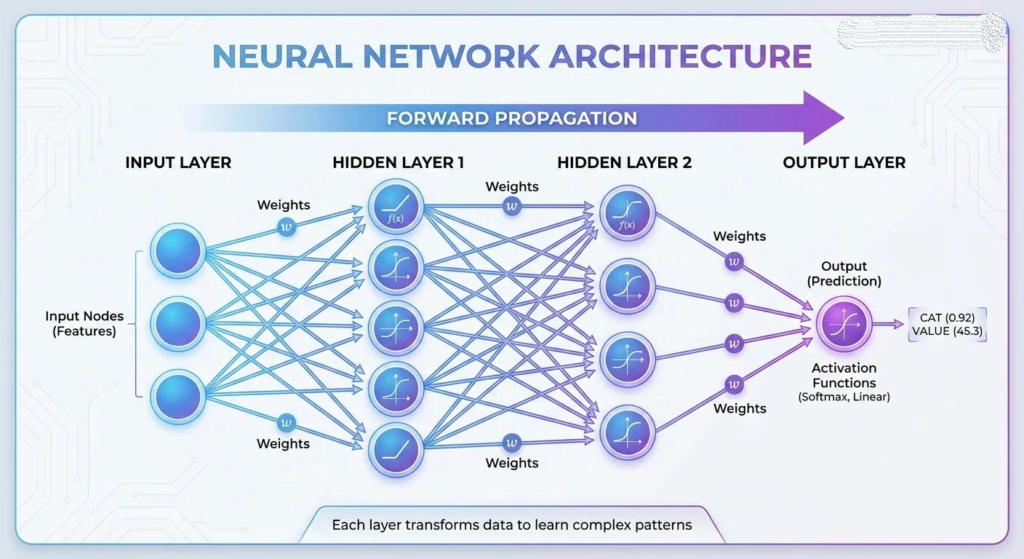
Deep Learning
Uses neural networks with many hidden layers.
Examples:
- CNN
- RNN
- Transformers
Applications:
- Chatbots
- Computer Vision
- Speech Recognition
- Generative AI
Step-by-Step Explanation ⚙️
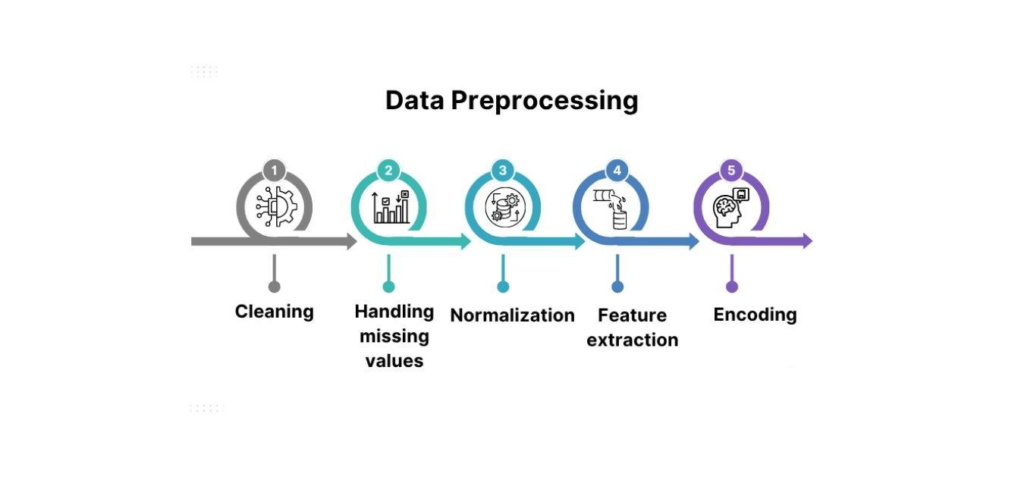


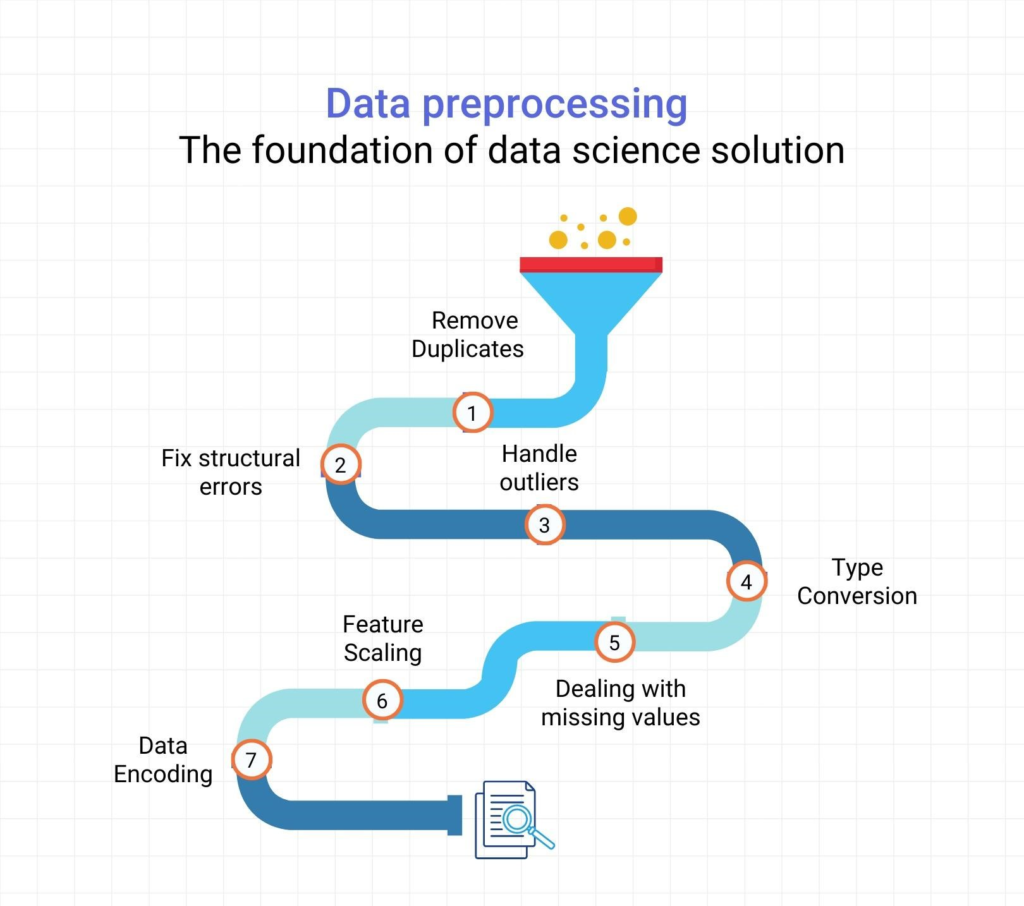


Step 1 — Collect Data 📥
Data sources include:
- Databases
- Sensors
- APIs
- Excel files
- IoT devices
- Websites
Quality data always produces better models.
Step 2 — Clean Data 🧹
Tasks include:
- Remove duplicates
- Handle missing values
- Remove noise
- Standardize formats
- Correct errors
Clean datasets significantly improve algorithm accuracy.
Step 3 — Feature Engineering ⚡
Features are variables used by algorithms.
Example:
Raw Data:
- Date
- Temperature
Engineered Features:
- Day of week
- Month
- Average temperature
- Temperature difference
Better features usually outperform more complex algorithms.
Step 4 — Choose the Algorithm 🎯
Selection depends on:
- Data size
- Number of features
- Prediction type
- Speed requirements
- Accuracy requirements
Step 5 — Train the Model 🏋️
The algorithm learns relationships between variables.
Example:
Hours Studied
        ↓
Machine Learning
        ↓
Predicted Exam Score
Step 6 — Evaluate Performance 📈
Common metrics:
- Accuracy
- Precision
- Recall
- F1 Score
- Mean Squared Error
- R² Score
Step 7 — Deployment 🚀
Models are integrated into:
- Websites
- Mobile apps
- Industrial systems
- Cloud platforms
- Embedded devices
Comparison 📊
| Algorithm | Learning Type | Speed | Accuracy | Best Use |
|---|---|---|---|---|
| Linear Regression | Supervised | Very Fast | Medium | Prediction |
| Logistic Regression | Supervised | Fast | High | Classification |
| Decision Tree | Supervised | Fast | High | Explainable AI |
| Random Forest | Supervised | Medium | Very High | General-purpose |
| SVM | Supervised | Slow | Very High | Small datasets |
| K-Means | Unsupervised | Very Fast | High | Clustering |
| DBSCAN | Unsupervised | Medium | High | Irregular clusters |
| Neural Networks | Deep Learning | Slow | Excellent | Complex AI |
| Gradient Boosting | Supervised | Medium | Excellent | Competitions |
Diagrams and Tables 🖼️


Machine Learning Family
Machine Learning
│
├── Supervised
│     ├── Regression
│     └── Classification
│
├── Unsupervised
│     ├── Clustering
│     └── Dimensionality Reduction
│
└── Reinforcement Learning
Engineering Workflow
| Phase | Algorithm Role |
|---|---|
| Data Collection | Input |
| Cleaning | Preparation |
| Feature Engineering | Improvement |
| Training | Learning |
| Validation | Testing |
| Deployment | Production |
Complexity Comparison
| Algorithm | Complexity |
|---|---|
| Linear Regression | Low |
| Logistic Regression | Low |
| Decision Tree | Medium |
| Random Forest | High |
| XGBoost | High |
| Deep Learning | Very High |
Examples 💡
Example 1 — Predicting House Prices
Input:
- Area
- Bedrooms
- Location
- Age
Algorithm:
Linear Regression
Output:
Estimated selling price
Example 2 — Fraud Detection
Input:
- Transaction history
- Card usage
- Purchase location
Algorithm:
Random Forest
Output:
Fraud probability
Example 3 — Customer Segmentation
Input:
- Purchase history
- Age
- Income
Algorithm:
K-Means
Output:
Customer groups
Example 4 — Medical Diagnosis
Input:
- Blood tests
- MRI scans
- Patient history
Algorithm:
Deep Neural Networks
Output:
Disease prediction
Real-World Applications 🌍
Algorithms power many engineering systems.
Manufacturing
- Predictive maintenance
- Defect detection
- Robotics
- Quality control
Healthcare
- Cancer detection
- Drug discovery
- Medical imaging
- Personalized medicine
Transportation
- Autonomous vehicles
- Traffic prediction
- Route optimization
Finance
- Credit scoring
- Fraud detection
- Risk management
- Algorithmic trading
Civil Engineering
- Bridge monitoring
- Structural health prediction
- Smart cities
Energy
- Smart grids
- Renewable energy forecasting
- Load balancing
Agriculture
- Crop prediction
- Soil analysis
- Precision farming
Common Mistakes ❌
Many beginners make similar errors.
Using Dirty Data
Poor-quality data creates poor models.
Choosing Complex Algorithms Too Early
Simple models often outperform complicated ones.
Ignoring Feature Engineering
Better features usually increase accuracy more than changing algorithms.
Overfitting
The model memorizes training data instead of learning patterns.
Ignoring Evaluation Metrics
Accuracy alone may be misleading.
Using Too Little Data
Small datasets often lead to unstable models.
Challenges & Solutions 🛠️
| Challenge | Solution |
|---|---|
| Missing values | Data imputation |
| Noise | Data cleaning |
| Imbalanced data | Resampling |
| High dimensions | PCA |
| Slow training | Parallel computing |
| Overfitting | Cross-validation |
| Underfitting | Better features |
| Limited data | Data augmentation |
Case Study 🏭
Predictive Maintenance in a Smart Factory
A manufacturing company installed vibration and temperature sensors on industrial machines.
Problem:
Unexpected equipment failures caused production losses.
Solution:
Data scientists collected sensor readings over two years.
Algorithms tested:
- Decision Tree
- Random Forest
- Gradient Boosting
Random Forest achieved the highest prediction accuracy.
Results:
- Maintenance costs reduced by 28%
- Downtime reduced by 40%
- Equipment lifetime increased by 18%
- Production efficiency improved significantly
This demonstrates how selecting the right algorithm can directly improve engineering performance and operational efficiency.
Tips for Engineers 🚀
Build Strong Mathematical Skills
Focus on:
- Statistics
- Probability
- Linear Algebra
Learn Python
Essential libraries include:
- NumPy
- Pandas
- Matplotlib
- Scikit-learn
- TensorFlow
- PyTorch
Start with Simple Models
Master:
- Linear Regression
- Decision Trees
before moving to deep learning.
Practice with Real Datasets
Excellent sources include:
- Kaggle
- UCI Machine Learning Repository
- Government Open Data Portals
Evaluate Multiple Algorithms
Never assume the first algorithm is the best.
Always compare several models.
Understand the Business Problem
The best algorithm is the one that solves the engineering problem—not necessarily the most complex one.
Continue Learning
Data science evolves rapidly.
Stay updated with:
- New research papers
- AI frameworks
- Engineering applications
- Industry best practices
Frequently Asked Questions ❓
1. What is the most important algorithm for beginners?
Linear Regression is an excellent starting point because it introduces core machine learning concepts while remaining easy to understand.
2. Is programming required?
Yes. Python is the most widely used programming language for data science because of its rich ecosystem of scientific libraries.
3. Which algorithm provides the highest accuracy?
There is no universal winner. Performance depends on the dataset, features, and the specific engineering problem. Random Forest, Gradient Boosting, and Deep Learning often achieve excellent results on complex tasks.
4. Can one algorithm solve every problem?
No. Different algorithms are designed for different objectives such as prediction, classification, clustering, recommendation, or optimization.
5. Is mathematics necessary?
Absolutely. A solid understanding of algebra, statistics, probability, and optimization helps engineers understand why algorithms work and how to improve them.
6. Which industries use data science algorithms?
Industries include healthcare, finance, manufacturing, aerospace, telecommunications, energy, transportation, cybersecurity, retail, agriculture, and scientific research.
7. How do I choose the right algorithm?
Consider the problem type, data size, feature quality, interpretability requirements, computational resources, and evaluation metrics. Testing multiple algorithms and validating their performance is considered best practice.
Conclusion 🎯
Algorithms are the foundation of modern data science and the driving force behind today’s intelligent engineering systems. From simple linear regression models to advanced deep neural networks, these computational techniques enable professionals to transform raw data into valuable insights, accurate predictions, and automated decision-making.
For students, mastering algorithms opens the door to careers in artificial intelligence, machine learning, robotics, software engineering, and analytics. For practicing engineers, understanding algorithm selection, feature engineering, data preparation, and model evaluation leads to more efficient designs, smarter products, and data-driven innovation.
The key to success is not memorizing every algorithm but understanding when to use each one, why it works, and how to apply it responsibly to real-world engineering challenges. By building a strong foundation in mathematics, programming, and practical experimentation, engineers can confidently leverage data science algorithms to solve complex problems and shape the next generation of intelligent technologies.