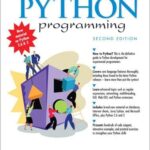
🐍 Python: An Introduction to Programming 2nd Edition – A Complete Engineering Guide for Students & Professionals
🌍 Introduction
In today’s rapidly evolving digital world, programming is no longer optional for engineers—it is a core skill. Whether you are an electrical engineer analyzing signals, a civil engineer optimizing structures, a mechanical engineer simulating systems, or a computer engineer building software, Python has become one of the most powerful and accessible tools in modern engineering.
This article, inspired by the philosophy behind “Python: An Introduction to Programming (2nd Edition)”, provides a complete, beginner-to-advanced engineering-focused guide. It is designed for:
-
🎓 University students
-
🧑💻 Professional engineers
-
🔬 Researchers and analysts
-
🚀 Software and automation developers
Python stands out because it balances simplicity and power. Beginners can write meaningful programs in days, while advanced users can build AI systems, simulation tools, and large-scale applications.
This guide goes far beyond syntax. We will explore:
-
Core theory
-
Engineering-focused explanations
-
Step-by-step workflows
-
Comparisons with other languages
-
Real-world engineering applications
-
Common mistakes and solutions
-
A professional case study
Let’s dive in 🧠⚙️
📘 Background Theory
🔹 What Is Programming?
Programming is the process of giving instructions to a computer to perform tasks. These instructions must be:
-
Precise
-
Logical
-
Structured
At its core, programming is problem-solving.
Engineers use programming to:
-
Automate calculations
-
Analyze large datasets
-
Control hardware systems
-
Build simulations
-
Create intelligent systems
🔹 Why Python Was Created 🐍
Python was created by Guido van Rossum in the late 1980s with three main goals:
-
Readability
-
Simplicity
-
Productivity
Unlike older languages that emphasize hardware-level control, Python emphasizes human thinking and clarity.
🔹 Philosophy Behind Python (The Zen of Python)
Python follows a philosophy known as The Zen of Python, which includes ideas like:
-
✨ Simple is better than complex
-
✨ Readability counts
-
🚀 There should be one obvious way to do it
This philosophy makes Python ideal for engineering education and professional projects.
⚙️ Technical Definition
🔧 What Is Python (Technically)?
Python is a high-level, interpreted, dynamically typed, general-purpose programming language.
Let’s break this down 👇
🧩 High-Level Language
-
Easy to read
-
Closer to human language
-
Abstracts hardware complexity
🔁 Interpreted Language
-
Code is executed line by line
-
No manual compilation step
-
Faster development cycle
🔄 Dynamically Typed
-
No need to declare variable types
-
Flexible and beginner-friendly
🌐 General-Purpose
Used in:
-
Web development
-
Engineering simulations
-
Artificial Intelligence
-
Data science
-
Automation
-
Embedded systems
🪜 Step-by-Step Explanation of Python Programming
🟢 Step 1: Installing Python
-
Download from the official Python website
-
Available for Windows, macOS, Linux
-
Comes with:
-
Python Interpreter
-
Standard Library
-
Package Manager (pip)
-
🟢 Step 2: Understanding Python Syntax ✍️
Python syntax is minimalistic.
Example:
No semicolons, no curly braces—clean and readable.
🟢 Step 3: Variables and Data Types
Python supports:
-
Integers
-
Floats
-
Strings
-
Booleans
Example:
Engineers love this simplicity for fast calculations ⚡
🟢 Step 4: Control Structures 🔄
Conditional Statements
Loops
Used heavily in simulations and automation.
🟢 Step 5: Functions 📦
Functions help organize code.
Essential for reusable engineering models.
🟢 Step 6: Modules and Libraries 🧰
Python’s real power comes from libraries:
-
NumPy
-
SciPy
-
Pandas
-
Matplotlib
-
TensorFlow
⚖️ Comparison with Other Programming Languages
🥊 Python vs C++
| Feature | Python | C++ |
|---|---|---|
| Learning Curve | Easy | Steep |
| Performance | Moderate | Very High |
| Syntax | Simple | Complex |
| Development Speed | Fast | Slow |
| Use Case | AI, Automation | Embedded, High-performance |
🥊 Python vs Java
| Feature | Python | Java |
|---|---|---|
| Code Length | Short | Longer |
| Typing | Dynamic | Static |
| Speed | Slower | Faster |
| Engineering Use | High | Moderate |
🥊 Python vs MATLAB (Engineering Focus)
| Feature | Python | MATLAB |
|---|---|---|
| Cost | Free | Expensive |
| Libraries | Extensive | Strong |
| Industry Use | Growing Fast | Academic-heavy |
| Flexibility | Very High | Moderate |
🧪 Detailed Examples
🔬 Example 1: Electrical Engineering – Ohm’s Law
Used in circuit analysis.
🏗️ Example 2: Civil Engineering – Stress Calculation
Helpful for structural analysis.
🚗 Example 3: Mechanical Engineering – Kinetic Energy
Used in motion simulations.
📊 Example 4: Data Analysis for Engineers
Used in IoT and smart systems.
🌍 Real-World Application in Modern Projects
🏭 Industry Applications
Python is used in:
-
Tesla (automation & AI)
-
NASA (data analysis)
-
Siemens (engineering tools)
-
Google (infrastructure & ML)
🤖 AI & Machine Learning
Python dominates AI due to:
-
TensorFlow
-
PyTorch
-
Scikit-learn
🏗️ Engineering Simulations
Used for:
-
Finite Element Analysis
-
Signal processing
-
Control systems
-
Robotics
🌐 Web & Cloud Engineering
Python frameworks:
-
Django
-
Flask
-
FastAPI
Used for dashboards, APIs, and monitoring systems.
❌ Common Mistakes Beginners Make
⚠️ Ignoring Code Structure
-
Writing everything in one file
⚠️ Not Using Functions
-
Leads to unreadable code
⚠️ Misunderstanding Data Types
-
Mixing strings and numbers
⚠️ Poor Error Handling
-
Ignoring exceptions
🚧 Challenges & Solutions
🔴 Challenge: Performance Limitations
Solution: Use optimized libraries like NumPy or C extensions.
🔴 Challenge: Large Codebases
Solution: Apply modular design and object-oriented programming.
🔴 Challenge: Debugging
Solution: Use debugging tools and logging.
📚 Case Study: Python in a Smart Energy Monitoring System
🏠 Project Overview
A smart system to monitor energy usage in buildings.
🛠️ Tools Used
-
Python
-
Raspberry Pi
-
Sensors
-
Pandas
-
Matplotlib
🔄 Workflow
-
Collect sensor data
-
Process data using Python
-
Visualize energy usage
-
Predict peak loads
📈 Results
-
Reduced energy consumption by 18%
-
Improved fault detection
-
Low-cost implementation
💡 Tips for Engineers Using Python
-
🧠 Think in logic, not syntax
-
📚 Learn libraries related to your field
-
🧪 Practice with real projects
-
🧼 Write clean and documented code
-
🔁 Reuse and refactor often
-
🌐 Join engineering communities
❓ FAQs
❓ Is Python good for engineering students?
✅ Yes, it is one of the best starting languages.
❓ Can Python replace MATLAB?
✅ In many cases, yes—especially with NumPy and SciPy.
❓ Is Python slow?
⚠️ It can be slower, but optimized libraries solve this.
❓ Do engineers need advanced Python?
✅ Basic Python is enough initially; advanced skills come later.
❓ Is Python used in real industries?
✅ Yes, widely used across engineering sectors.
❓ Can Python be used for embedded systems?
✅ Yes, using MicroPython and CircuitPython.
🏁 Conclusion
Python: An Introduction to Programming 2nd Edition represents more than just a programming book—it represents a gateway into modern engineering.
Python empowers engineers to:
-
Solve problems faster
-
Build intelligent systems
-
Analyze data efficiently
-
Adapt to future technologies
Whether you are a student starting your journey or a professional engineer upgrading your skills, Python is a tool you cannot afford to ignore.
🚀 Learn Python, and you future-proof your engineering career.