Machine Learning: Hands-On for Developers and Technical Professionals 2nd Edition — A Practical Guide to Modern ML
Introduction
Machine learning (ML) has moved from an experimental research discipline into a practical engineering technology used in software products, automation systems, cybersecurity, finance, healthcare, manufacturing, transportation, and scientific computing. For developers and technical professionals, learning ML is no longer simply about understanding algorithms—it is about knowing how to transform a real engineering problem into a reliable data-driven system. 🤖⚙️
A hands-on approach is particularly valuable because machine learning sits at the intersection of software engineering, statistics, data engineering, mathematics, cloud computing, and domain knowledge. A model can achieve impressive results in a notebook and still fail when exposed to changing production data, unexpected inputs, latency requirements, or infrastructure constraints.

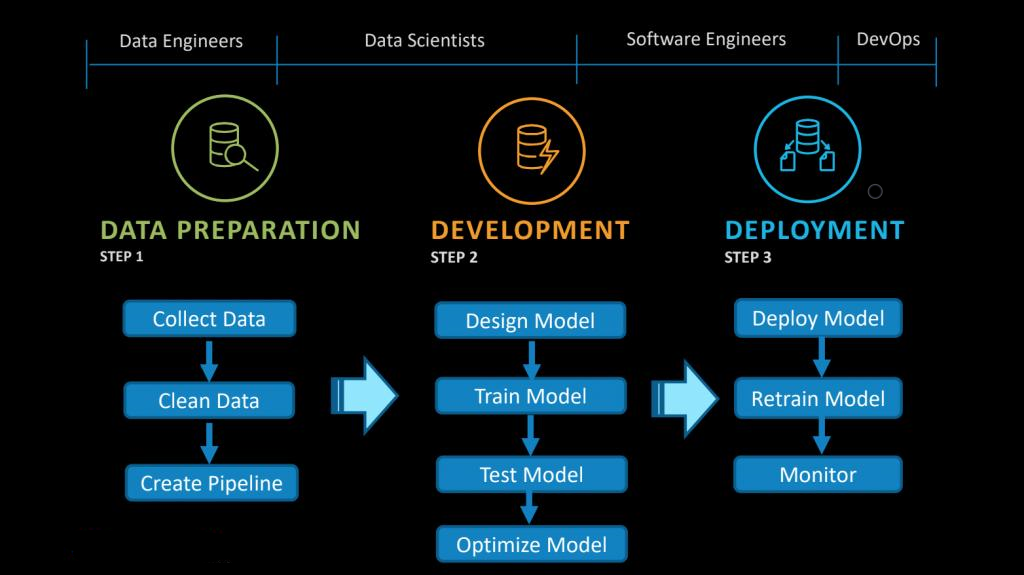
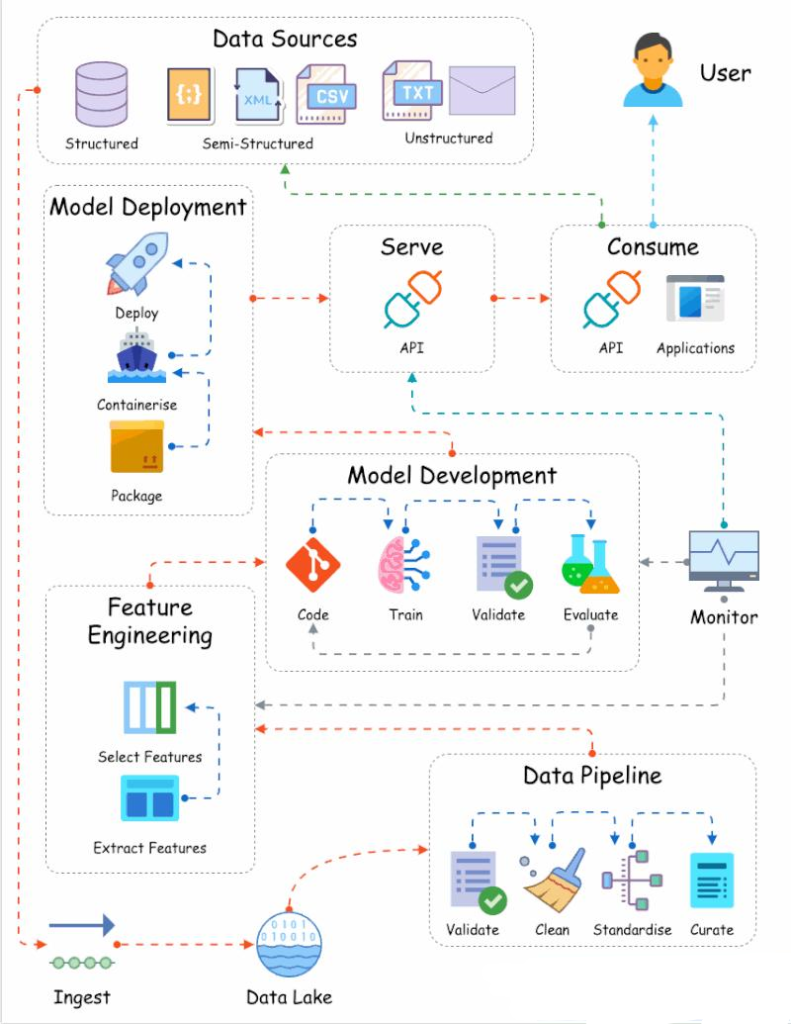
The practical philosophy behind modern machine learning can be summarized as:
Data → Features → Model → Evaluation → Deployment → Monitoring → Improvement 🔄
This article presents a developer-oriented overview of hands-on machine learning, suitable for university students, software developers, engineers, data professionals, and technical decision-makers in the USA, UK, Canada, Australia, and Europe.


Background Theory
From Traditional Programming to Machine Learning
Traditional software generally follows a predictable pattern:
Rules + Input → Output
A developer explicitly writes the rules that determine how the system behaves.
Machine learning changes this approach:
Data + Expected Results → Learned Model
Instead of manually specifying every rule, an ML algorithm identifies useful patterns from examples.
For example, a conventional system might use manually written rules to determine whether an email looks suspicious. A machine-learning system can learn from historical examples of legitimate and unwanted messages.
Why Developers Need a Different Perspective
Machine learning should not be treated as a replacement for conventional programming. Instead, it adds another engineering component.
A production ML application may contain:
- Data collection
- Data validation
- Feature engineering
- Model training
- Model evaluation
- API development
- Database integration
- Cloud infrastructure
- Monitoring
- Security controls
- Model retraining
Therefore, an ML developer needs both algorithmic knowledge and engineering discipline. 🧩
Supervised and Unsupervised Learning
Supervised learning uses examples where the desired outcome is known. Typical applications include classification and prediction.
Unsupervised learning works with data where the desired output is not explicitly provided. It can help identify groups, structures, or unusual observations.
Other important approaches include:
- Semi-supervised learning
- Self-supervised learning
- Reinforcement learning
- Deep learning
- Transfer learning
The best technique depends on the problem, available data, computational resources, and business requirements.
Definition
What Is Hands-On Machine Learning?
Hands-on machine learning is the practical process of designing, building, testing, deploying, and maintaining systems that learn patterns from data.
It differs from purely theoretical ML because the emphasis is placed on the complete engineering lifecycle.
A practical ML professional should be able to answer questions such as:
What data do we have?
Is the data reliable?
What should the model predict?
How will success be measured?
What happens when the model makes a wrong prediction?
How will the model behave after deployment?
Machine Learning as an Engineering Pipeline
A useful conceptual pipeline is:
Problem → Data → Preparation → Training → Validation → Deployment → Monitoring
Each stage can introduce failure.
For example, an excellent algorithm cannot compensate for badly collected data. Similarly, a highly accurate model may be unsuitable if it is too slow for a real-time application.
Step-by-Step Machine Learning Workflow
Step 1: Define the Engineering Problem
Begin with the problem—not the algorithm.
Instead of saying:
“We need an AI model.”
define a measurable objective:
“We need to identify potentially fraudulent transactions before they are completed.”
This distinction prevents teams from adopting unnecessarily complicated technology.
Step 2: Collect and Understand Data
Data may come from:
- Databases
- APIs
- Sensors
- Web applications
- Enterprise systems
- Logs
- Images
- Documents
- Customer interactions
Developers should examine data quality before training anything.
Important questions include:
- 🐍 Are values missing?
- Are records duplicated?
- 🐍 Are categories inconsistent?
- Are timestamps correct?
- Are there abnormal observations?
- 🐍 Is the dataset representative?


Step 3: Prepare the Dataset
Data preparation may involve:
- Cleaning
- Normalization
- Encoding categorical information
- Removing duplicates
- Handling missing values
- Selecting useful features
- Splitting datasets
A common structure is:
Training Data → Model Learning
Validation Data → Model Selection
Test Data → Final Evaluation
Keeping evaluation data isolated helps produce a more realistic assessment.
Step 4: Select an Appropriate Model
Developers should normally begin with a model that is sufficiently simple to establish a baseline.
Potential choices include:
- Linear models
- Decision trees
- Random forests
- Gradient boosting
- Support vector machines
- Neural networks
- Transformer-based architectures
The most sophisticated model is not automatically the best model. ⚡
Step 5: Train the Model
During training, the algorithm searches for patterns that connect input features with desired outcomes.
A training workflow typically involves:
Input Data → Learning Algorithm → Trained Model
Modern development environments can automate much of this process, but developers still need to understand what the training pipeline is doing.
Step 6: Evaluate Performance
Evaluation should reflect the actual application.
For classification systems, professionals may consider:
- Accuracy
- Precision
- Recall
- F1 score
- ROC-AUC
- Confusion matrix
For prediction problems, useful measurements may include:
- Mean absolute error
- Mean squared error
- Root mean squared error
Performance should also be evaluated against practical requirements such as speed, cost, interpretability, and reliability.
Step 7: Deploy the Model
A trained model becomes useful only when it can serve predictions to an application.
Common deployment patterns include:
Application → API → ML Model → Prediction
or:
Data Pipeline → Batch Model → Database → Application


Step 8: Monitor and Improve
Deployment is not the end.
Production data can change over time. User behavior can evolve, external conditions can shift, and previously reliable patterns can disappear.
This creates the need for:
Monitoring → Detection → Retraining → Validation → Redeployment
That continuous cycle is one of the foundations of practical ML engineering. 🔄
Comparison
Traditional Software vs Machine Learning
| Feature | Traditional Software | Machine Learning |
|---|---|---|
| Main logic | Explicit rules | Learned patterns |
| Primary input | Program instructions + data | Data + training process |
| Behavior | Usually deterministic | Often probabilistic |
| Testing | Functional testing | Functional + statistical evaluation |
| Maintenance | Code updates | Code, data, and model updates |
| Main failure source | Software defects | Data, model, infrastructure, or software issues |
| Monitoring | Application metrics | Application + model + data metrics |
Classical ML vs Deep Learning
| Area | Classical ML | Deep Learning |
|---|---|---|
| Data requirements | Often moderate | Often large |
| Feature engineering | Frequently important | Can learn representations automatically |
| Hardware | Often manageable on CPUs | Frequently benefits from GPUs/accelerators |
| Interpretability | Can be relatively accessible | Often more difficult |
| Typical applications | Tabular data, prediction, classification | Vision, language, speech, complex patterns |
Batch vs Real-Time Machine Learning
Batch ML processes data periodically.
Example:
A retailer could generate product-demand predictions every night.
Real-time ML produces predictions while a user or system is interacting with the application.
Example:
A security platform could evaluate a login request immediately.
The appropriate architecture depends on latency, cost, data availability, and business requirements.
Diagrams and Tables
A Practical ML Architecture
             ┌─────────────────┐
             │   Data Sources  │
             └────────┬────────┘
                      ↓
             ┌─────────────────┐
             │ Data Validation │
             └────────┬────────┘
                      ↓
             ┌─────────────────┐
             │ Feature Pipeline│
             └────────┬────────┘
                      ↓
             ┌─────────────────┐
             │ Model Training  │
             └────────┬────────┘
                      ↓
             ┌─────────────────┐
             │ Model Evaluation│
             └────────┬────────┘
                      ↓
             ┌─────────────────┐
             │    Deployment   │
             └────────┬────────┘
                      ↓
             ┌─────────────────┐
             │    Monitoring   │
             └────────┬────────┘
                      │
                      └────→ Retraining
Key Components
| Component | Purpose |
|---|---|
| Dataset | Provides learning examples |
| Features | Represent useful information |
| Model | Learns relationships in data |
| Training pipeline | Automates model learning |
| Validation | Helps select and improve models |
| Deployment system | Makes predictions available |
| Monitoring | Detects changes and failures |
| Model registry | Organizes model versions |


Examples
Example 1: Predicting Customer Churn
A telecommunications company wants to identify customers who may stop using its service.
The development team could examine historical information such as:
- Service usage
- Subscription type
- Customer support interactions
- Contract duration
- Payment behavior
The model can identify patterns associated with customers who previously left.
The company can then use the prediction to prioritize customer-retention activities.
Example 2: Predictive Maintenance
A manufacturing company operates industrial machines equipped with sensors.
The ML system receives information about temperature, vibration, operating time, and other signals.
When the system recognizes patterns associated with previous equipment failures, engineers can investigate the machine before a major breakdown occurs.
Example 3: Document Classification
An organization receives thousands of documents every week.
Instead of manually sorting every document, an ML model can classify incoming files into categories such as:
Invoice → Contract → Report → Application → Other
This can significantly reduce repetitive administrative work.
Real-World Applications
Software Development
ML can support:
- Code classification
- Intelligent search
- Anomaly detection
- Automated testing assistance
- Developer productivity tools
Cybersecurity
Machine learning can analyze network activity, authentication events, endpoint behavior, and other signals to identify suspicious patterns.
Finance
Financial organizations use ML for applications such as:
- Fraud detection
- Risk analysis
- Customer segmentation
- Forecasting
- Transaction monitoring
Healthcare
ML can support medical research, image analysis, operational forecasting, and decision-support systems. High-stakes applications require especially careful validation and human oversight.
Manufacturing
Industrial ML applications include:
- Predictive maintenance
- Quality inspection
- Process optimization
- Demand forecasting
- Equipment monitoring
Transportation
Machine learning can help with traffic forecasting, route optimization, demand prediction, fleet management, and intelligent transportation systems. 🚗📊
Common Mistakes
Starting With the Algorithm
A frequent mistake is selecting a fashionable algorithm before understanding the problem.
Solution: define the objective and success criteria first.
Ignoring Data Quality
Poor data can produce unreliable models regardless of algorithm quality.
Solution: establish data validation procedures before training.
Data Leakage
Data leakage occurs when information unavailable during real-world prediction accidentally enters the training process.
Solution: design the data pipeline around the actual prediction timeline.
Overfitting
A model may perform extremely well on training examples while performing poorly on new data.
Solution: use appropriate validation procedures and evaluate against unseen data.
Ignoring Deployment
A model that works only inside a development notebook is not necessarily a production solution.
Solution: design deployment, APIs, infrastructure, monitoring, and versioning early.
Challenges & Solutions
| Challenge | Practical Solution |
|---|---|
| Poor-quality data | Build automated validation |
| Insufficient training data | Improve collection or use suitable transfer approaches |
| Model overfitting | Improve validation and regularization |
| Slow predictions | Optimize model and infrastructure |
| Data drift | Monitor production distributions |
| Model drift | Track prediction quality |
| Expensive infrastructure | Optimize workloads and model size |
| Difficult debugging | Maintain detailed pipeline logs |
| Reproducibility problems | Version code, data, configuration, and models |
Case Study
Intelligent Equipment Failure Detection
Consider a manufacturing facility where production machines operate continuously.
The company historically reacted to failures after they occurred. This created downtime, emergency maintenance, and production delays.
The engineering team decides to develop an ML-based predictive-maintenance system.
Phase 1: Data Collection
Sensors provide information about machine behavior. Historical maintenance records are combined with sensor readings.
Phase 2: Data Preparation
Engineers remove invalid records, synchronize timestamps, investigate missing information, and create meaningful features representing machine behavior.
Phase 3: Model Development
Several candidate models are tested against historical data.
Instead of choosing the model with the highest single performance score, the team considers:
- Detection quality
- False alarms
- Processing requirements
- Explainability
- Maintenance workflow
Phase 4: Pilot Deployment
The model is initially deployed for monitoring rather than automatic shutdown.
Engineers receive alerts and compare predictions with real machine conditions.
Phase 5: Continuous Improvement
After deployment, the engineering team monitors prediction quality and investigates false positives and missed failures.
The system becomes part of an operational feedback loop:
Sensor Data → ML Prediction → Engineer Review → Maintenance Action → New Data
This illustrates an important principle: successful ML is usually a socio-technical system, not merely an algorithm.
Essential Tips
For Students 🎓
Build small projects instead of trying to understand every ML algorithm simultaneously.
A good learning sequence is:
Python → Data Analysis → Statistics → Classical ML → Deep Learning → Deployment → MLOps
For Developers 💻
Think about ML as another software component.
Use:
- Git
- Automated testing
- Environment management
- APIs
- Containers
- Logging
- Monitoring
- Documentation
For Professionals ⚙️
Always connect model performance to business or engineering outcomes.
A small improvement in prediction quality may be worthless if the model increases operational costs dramatically.
For Production Teams 🚀
Version everything that can affect results:
Code + Data + Features + Configuration + Model + Environment
Reproducibility is one of the most valuable characteristics of a professional ML system.
For Everyone
Remember:
Better data + appropriate modeling + strong engineering > unnecessary algorithmic complexity.
FAQs
What is hands-on machine learning?
Hands-on machine learning focuses on building practical ML systems rather than studying algorithms only from a theoretical perspective. It includes data preparation, model training, evaluation, deployment, and monitoring.
Do developers need advanced mathematics to learn machine learning?
A basic understanding of statistics, probability, and mathematical concepts is valuable. However, developers can begin with practical projects and gradually develop deeper mathematical knowledge.
Is Python necessary for machine learning?
Python is one of the most widely used languages for ML because of its extensive ecosystem for data processing, scientific computing, model development, and deployment. Other languages can also be used depending on the application.
What is the most important part of a machine-learning project?
There is no universal single component, but problem definition and data quality are fundamental. A sophisticated model cannot reliably solve a poorly defined problem with unsuitable data.
Should beginners start with deep learning?
Usually, beginners benefit from learning classical machine-learning concepts first. Understanding data preparation, validation, features, evaluation, and model behavior makes later deep-learning work easier to understand.
What is MLOps?
MLOps applies software engineering and operational practices to machine-learning systems. It can include automated training, model versioning, deployment, monitoring, testing, and retraining.
Why can a model perform well during development but poorly in production?
Production data may differ from training data. User behavior, business conditions, sensor characteristics, or external environments can change. This is why monitoring and continuous evaluation are essential.
Is machine learning useful for ordinary software developers?
Yes. ML can enhance applications through prediction, classification, recommendation, anomaly detection, natural-language processing, computer vision, and intelligent automation.
Conclusion
Machine Learning: Hands-On for Developers and Technical Professionals represents a practical engineering mindset: machine learning should not stop when a model achieves a promising evaluation score. The real objective is to create a dependable system that solves a meaningful problem under real-world conditions. 🤖⚙️
🐍 For students, the journey begins with understanding data and building small experiments. For developers, the next step is integrating models with reliable software systems. For professional engineers, the challenge extends into deployment, scalability, security, monitoring, governance, and continuous improvement.
The most useful mental model is simple:
Understand the problem → Understand the data → Build a baseline → Evaluate honestly → Deploy carefully → Monitor continuously → Improve systematically.
As machine learning continues to influence software engineering, industrial automation, finance, cybersecurity, scientific research, and intelligent products across the USA, UK, Canada, Australia, and Europe, professionals who combine ML knowledge with strong engineering practices will be particularly well positioned to build useful, reliable, and scalable intelligent systems. 🚀📚