Probabilistic Machine Learning: Advanced Topics — A Practical Engineering Guide
Introduction
Probabilistic Machine Learning (PML) combines machine learning with probability theory to build models that can reason about uncertainty, incomplete information, noisy observations, and future outcomes. Instead of simply producing a prediction, a probabilistic model can estimate how confident it is in that prediction. 🎯🤖
This capability is particularly valuable in engineering, scientific computing, finance, robotics, healthcare technology, autonomous systems, and industrial monitoring, where making a prediction without understanding uncertainty can be dangerous or expensive.
Traditional machine learning might answer:
“The machine is likely to fail.”
A probabilistic machine-learning system can provide a richer interpretation:
“The machine has a high probability of failure within the predicted operating period, but uncertainty remains because sensor observations are incomplete.”
That distinction is fundamental.

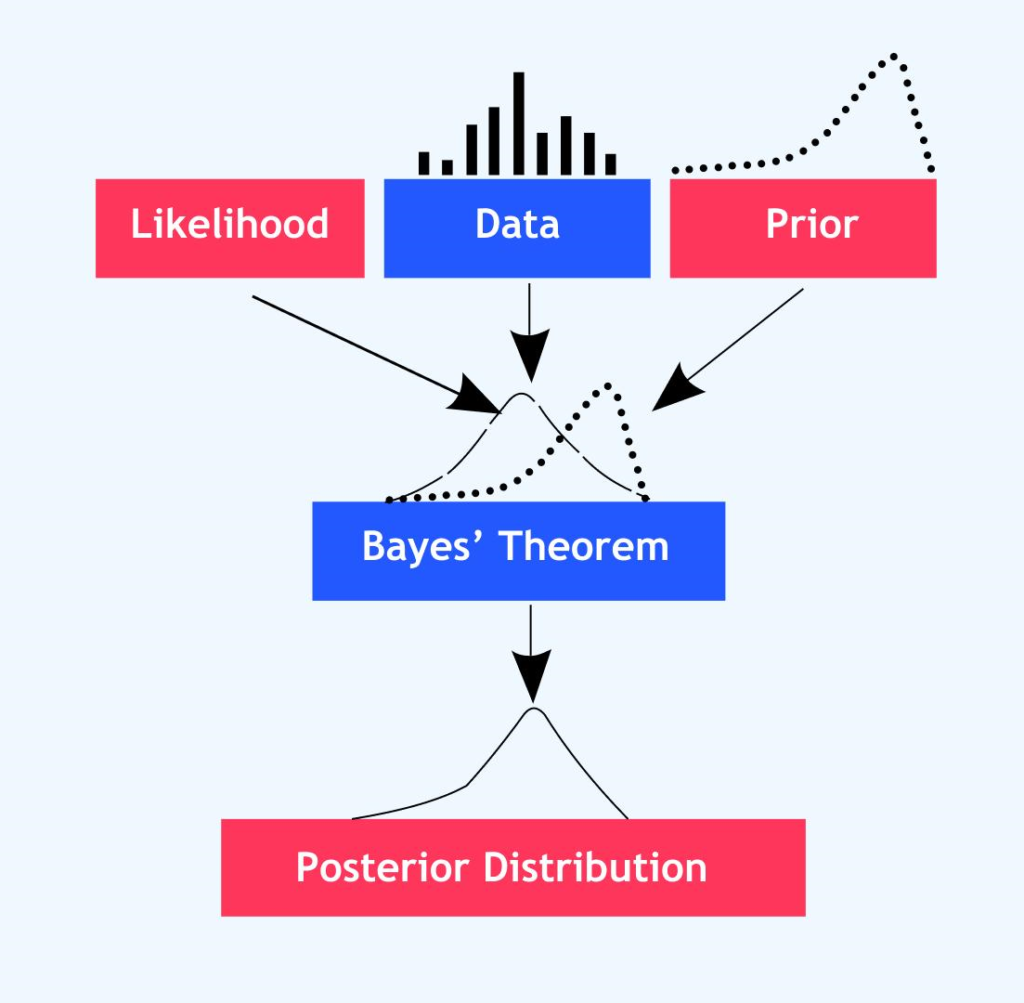


Modern PML extends beyond basic Bayesian statistics. Advanced topics include Bayesian neural networks, Gaussian processes, probabilistic graphical models, variational inference, Monte Carlo methods, probabilistic programming, uncertainty quantification, and generative modeling.
For engineers and students, these techniques provide a framework for designing intelligent systems that do not blindly trust their own predictions.
Background Theory
From deterministic predictions to probability distributions
A conventional regression model may predict one numerical value for a particular input. A probabilistic model instead attempts to characterize the distribution of possible outcomes.
For example, consider an engineering system that estimates the remaining useful life of a turbine.
A deterministic model might return:
Remaining life = approximately 420 hours
A probabilistic model could describe a range of possible remaining lifetimes and indicate how uncertainty changes as additional sensor information becomes available.
This is useful because real engineering systems rarely behave perfectly.
Measurements contain noise.
Sensors can fail.
Operating conditions change.
Materials vary.
Environmental conditions fluctuate.
Consequently, uncertainty is not merely a mathematical inconvenience—it is part of the engineering problem.
Bayesian reasoning
One of the foundations of probabilistic machine learning is Bayesian reasoning.
The general idea is straightforward:
Prior knowledge + observed evidence → updated belief
A model begins with assumptions about a system and then modifies those assumptions when new observations become available.
This makes Bayesian methods particularly attractive for engineering applications where historical knowledge, physical laws, expert judgment, and sensor measurements must work together.
Aleatoric and epistemic uncertainty
Advanced PML commonly distinguishes between two important forms of uncertainty.
Aleatoric uncertainty arises from inherent randomness or noise in the data.
For example, two apparently identical components may experience slightly different vibration patterns because of unavoidable operating variability.
Epistemic uncertainty comes from insufficient knowledge.
For example, a machine-learning model may have very little training data for an unusual temperature range.
Understanding the difference helps engineers decide whether collecting more data could improve a model.
Definition
What is probabilistic machine learning?
Probabilistic Machine Learning is an approach to machine learning in which probability distributions are used to represent uncertainty in data, model parameters, predictions, or hidden variables.
Instead of treating every observation as perfectly known, PML explicitly models uncertainty.
Its major components include:
- Probability distributions 📊
- Bayesian inference
- Statistical modeling
- Machine learning
- Graphical models
- Generative models
- Monte Carlo inference
- Variational inference
- Uncertainty quantification
- Probabilistic programming
Why it matters in engineering
Engineering decisions often depend on risk.
A bridge-monitoring system may need to distinguish between normal vibration and evidence of structural deterioration.
A robot may need to determine whether an object is actually present or merely appears in noisy sensor measurements.
An energy-management system may need to estimate uncertain future demand.
In these situations, confidence matters almost as much as prediction.
Step-by-Step Explanation
Step 1: Define the engineering problem
Start by identifying what needs to be predicted or estimated.
Examples include:
- Equipment failure
- Energy demand
- Structural deterioration
- Traffic conditions
- Temperature
- Sensor behavior
- Manufacturing defects
- Remaining useful life
The objective should be measurable and connected to an engineering decision.
Step 2: Collect observations
Relevant information can come from:
- Sensors
- Historical databases
- Simulation systems
- Laboratory experiments
- Operational records
- Environmental measurements
Data quality is extremely important because probabilistic models can faithfully represent uncertainty—but they cannot automatically correct fundamentally unreliable measurements.
Step 3: Identify uncertainty
Ask where uncertainty originates.
🤖 Is the sensor noisy?
🤖 Is the physical process unpredictable?
Is the training dataset too small?
Are some operating conditions poorly represented?
This step determines which probabilistic techniques may be appropriate.


Step 4: Select a probabilistic model
Possible choices include:
- Bayesian linear models
- Gaussian processes
- Hidden Markov models
- Bayesian neural networks
- Probabilistic graphical models
- Mixture models
- State-space models
- Probabilistic programming models
The simplest model capable of representing the required uncertainty is often the best starting point.
Step 5: Perform inference
Inference means determining what the available evidence tells us about unknown quantities.
Advanced systems may use:
- Markov Chain Monte Carlo
- Variational inference
- Sequential Monte Carlo
- Laplace approximations
- Expectation propagation
The choice depends on model complexity, computational resources, and accuracy requirements.
Step 6: Evaluate uncertainty
A good probabilistic model should not only make accurate predictions. Its uncertainty estimates should also be meaningful.
An engineering team should ask:
When the model says it is highly confident, is it usually correct?
Calibration techniques can help answer this question.
Step 7: Connect predictions to decisions
The final objective is usually not prediction itself.
The model may support:
- Maintenance scheduling
- Safety decisions
- Resource allocation
- Quality control
- Risk management
- Automated control
This is where probabilistic machine learning becomes an engineering tool rather than simply a statistical exercise.
Comparison
Probabilistic vs deterministic machine learning
| Feature | Deterministic ML | Probabilistic ML |
|---|---|---|
| Main output | Prediction | Prediction + uncertainty |
| Uncertainty | Often implicit | Explicitly modeled |
| Risk estimation | Limited | Strong capability |
| Missing information | Can be difficult | Can be naturally represented |
| Interpretability | Model-dependent | Often richer statistical interpretation |
| Computational cost | Often lower | Can be higher |
| Engineering safety applications | Useful | Particularly valuable |
Classical statistics vs probabilistic ML
Classical statistical approaches often focus on estimating relationships between variables and testing hypotheses.
Probabilistic machine learning expands this idea by integrating probabilistic reasoning with flexible machine-learning models.
The boundaries are not rigid. Modern PML frequently combines ideas from both fields.
Diagrams & Tables
Core probabilistic machine-learning architecture
             REAL-WORLD SYSTEM
                    │
                    ▼
              SENSOR DATA
                    │
                    ▼
           ┌─────────────────┐
           │ Probabilistic   │
           │     Model       │
           └─────────────────┘
              │           │
              ▼           ▼
         Prediction    Uncertainty
              │           │
              └─────┬─────┘
                    ▼
              ENGINEERING
               DECISION
The key concept is that the prediction and uncertainty should be considered together.


Important advanced techniques
| Technique | Main purpose | Typical engineering use |
|---|---|---|
| Bayesian inference | Update beliefs using evidence | Fault diagnosis |
| Gaussian processes | Flexible probabilistic regression | Sensor modeling |
| Bayesian neural networks | Neural prediction with uncertainty | Risk-sensitive prediction |
| Hidden Markov models | Model hidden states | Equipment monitoring |
| Monte Carlo methods | Approximate complex distributions | Reliability analysis |
| Variational inference | Efficient approximate inference | Large probabilistic models |
| Probabilistic programming | Flexible model construction | Scientific modeling |
| State-space models | Track changing hidden states | Robotics and control |
Examples Without Equations and Math
Predictive maintenance
Imagine an industrial pump equipped with vibration, temperature, and pressure sensors.
A standard machine-learning system could classify the pump as either healthy or faulty.
A probabilistic system can go further.
It can estimate the likelihood of different failure modes and represent uncertainty caused by incomplete sensor observations.
This allows maintenance engineers to prioritize inspections more intelligently.
Autonomous vehicles
Autonomous systems receive information from cameras, radar, lidar, GPS, and other sensors.
These measurements can disagree.
A probabilistic approach can combine information from different sensors while accounting for uncertainty.
Instead of assuming that every detected object is perfectly known, the system can maintain uncertainty around its location, movement, and classification.
Energy forecasting
Electrical demand changes according to weather, industrial activity, time of day, and human behavior.
A probabilistic forecasting system can estimate several plausible future demand scenarios.
Energy operators can then plan capacity and reserves according to the expected conditions and associated risks.
Real-World Application
Aerospace engineering
Aircraft systems generate enormous quantities of sensor data.
Probabilistic models can support:
- Fault detection
- Engine health monitoring
- Remaining useful-life estimation
- Flight-risk analysis
- Sensor fusion
The ability to distinguish uncertainty caused by noisy measurements from uncertainty caused by limited knowledge is particularly valuable.
Civil engineering
Probabilistic machine learning can support structural-health monitoring.
Sensors installed on bridges, buildings, tunnels, and other structures can continuously collect measurements.
Models can identify unusual patterns and estimate the probability that those patterns indicate structural changes.
Manufacturing
Smart factories can combine probabilistic models with machine vision and sensor networks.
Applications include:
- Defect detection
- Process optimization
- Predictive maintenance
- Quality prediction
- Production forecasting
Renewable energy
Wind and solar power are naturally variable.
Probabilistic forecasting can estimate future production while accounting for weather uncertainty.
This helps grid operators make better decisions about storage, backup generation, and energy distribution. ⚡🌱
Common Mistakes
Treating uncertainty as an afterthought
A common mistake is building a highly accurate prediction model and adding uncertainty estimation only at the end.
Uncertainty should be considered during model design.
Using overly complicated models
Advanced mathematics does not automatically produce a better engineering solution.
A complicated Bayesian model may be unnecessary when a simpler probabilistic model provides sufficient accuracy.
Ignoring calibration
A model can have excellent predictive accuracy while producing poorly calibrated confidence estimates.
Engineers should evaluate both prediction quality and uncertainty quality.
Confusing uncertainty with error
Uncertainty describes what the model does not know or what variability exists in the system.
Prediction error measures how far a prediction is from an observed outcome.
They are related, but they are not identical.
Training on biased data
A probabilistic model cannot magically remove bias from its training dataset.
If certain operating conditions are poorly represented, uncertainty estimates may also become unreliable.
Challenges & Solutions
Computational complexity
Advanced probabilistic inference can be computationally expensive.
Solution: Use approximate inference, variational methods, efficient sampling, or simplified probabilistic models when appropriate.
High-dimensional data
Modern sensors and neural networks can generate extremely large feature spaces.
Solution: Combine dimensionality reduction, structured probabilistic models, representation learning, and domain knowledge.
Difficult model validation
Determining whether uncertainty estimates are realistic can be harder than measuring prediction accuracy.
Solution: Use calibration analysis, predictive intervals, out-of-distribution testing, and stress testing.
Limited training data
Engineering datasets are often smaller than consumer-scale datasets.
Solution: Incorporate prior knowledge, physics-based constraints, transfer learning, simulation data, and carefully designed experiments.
Case Study
Probabilistic monitoring of an industrial machine
Consider a manufacturing facility operating hundreds of rotating machines.
Each machine produces measurements such as vibration, temperature, rotational speed, and power consumption.
Initially, engineers use a conventional classification model to identify abnormal behavior.
The system works well during normal operating conditions but struggles when machines operate under unusual loads.
The engineering team introduces probabilistic modeling.
The new approach does not simply label a machine as normal or abnormal. It estimates the probability of several possible operating states and represents uncertainty when sensor information is insufficient.
During normal operation, the system produces highly concentrated predictions.
When sensors begin disagreeing, uncertainty increases.
This change itself becomes useful information.
Engineers can then prioritize machines for inspection according to both predicted risk and confidence.
The important lesson is that uncertainty can become an engineering signal.
Instead of hiding uncertainty, the system exposes it to decision-makers.
Essential Tips
Start with the engineering decision
Do not begin with “Which Bayesian algorithm should I use?”
Start with:
What decision will this model improve?
Combine data with domain knowledge
Engineering knowledge can dramatically improve probabilistic models.
Physics, material behavior, operating limits, and known failure mechanisms can provide valuable prior information.
Measure calibration
A confidence estimate should mean something.
If a model repeatedly reports high confidence but frequently fails, its uncertainty estimates require investigation.
Test unusual conditions
Do not evaluate the system only on familiar operating conditions.
Test:
- Extreme temperatures
- Sensor failures
- Missing data
- Unusual loads
- New equipment
- Rare events
Prefer interpretable uncertainty
For safety-critical engineering systems, engineers should understand why uncertainty increases.
This can make troubleshooting and operational decisions much easier.
Use Python strategically
Python provides a rich ecosystem for probabilistic modeling, numerical computing, machine learning, and visualization.
Commonly used tools include NumPy, SciPy, PyTorch, JAX, and specialized probabilistic-programming libraries.
The tool should follow the engineering requirement—not the other way around. 🐍⚙️
FAQs
What is probabilistic machine learning?
Probabilistic machine learning uses probability distributions and statistical inference to model predictions and uncertainty. Unlike many conventional models that produce a single answer, PML can describe multiple plausible outcomes and the confidence associated with them.
Is probabilistic machine learning difficult to learn?
The advanced topics can be mathematically demanding, particularly Bayesian inference, Monte Carlo methods, and probabilistic graphical models. However, beginners can start with probability, statistics, Python, and basic machine learning before moving toward advanced inference techniques.
What is Bayesian machine learning?
Bayesian machine learning incorporates Bayesian reasoning into machine-learning models. New observations are used to update existing beliefs, allowing the model to continuously revise its understanding as additional evidence becomes available.
What is uncertainty quantification?
Uncertainty quantification is the process of identifying, measuring, and communicating uncertainty associated with data, model parameters, predictions, or system behavior.
Are probabilistic models useful for engineering?
Yes. They are particularly useful when engineering decisions involve incomplete information, noisy sensors, uncertain operating conditions, reliability, safety, or risk.
What is a Gaussian process?
A Gaussian process is a probabilistic model that can represent relationships between inputs and outputs while providing uncertainty estimates around predictions. It is especially useful when datasets are relatively small and uncertainty is important.
What is a Bayesian neural network?
A Bayesian neural network extends neural-network modeling by representing uncertainty in model parameters or predictions. This can be useful when neural networks must operate in environments where confidence and risk are important.
What should I learn before advanced probabilistic machine learning?
A strong foundation in probability, statistics, linear algebra, calculus, Python, and basic machine learning is recommended. After that, Bayesian inference, graphical models, optimization, and numerical methods provide a strong path toward advanced PML.
Conclusion
Probabilistic Machine Learning represents an important evolution in intelligent engineering systems. 🤖📊
Traditional machine learning often asks:
“What is the most likely prediction?”
Probabilistic machine learning asks a broader and more useful question:
“What could happen, how likely is each possibility, and how certain are we?”
That perspective becomes increasingly important as engineering systems become more autonomous, interconnected, and dependent on imperfect data.
From predictive maintenance and structural-health monitoring to robotics, aerospace, energy forecasting, manufacturing, and autonomous systems, probabilistic methods provide a systematic way to manage uncertainty.
The most effective engineering solutions do not necessarily require the most complicated probabilistic algorithms. Instead, they require the right balance between accuracy, uncertainty, computational efficiency, interpretability, and practical decision-making.
For students, PML offers a powerful bridge between probability, statistics, artificial intelligence, and engineering.
For professionals, it provides a framework for building systems that are not only capable of making predictions—but also capable of acknowledging when those predictions should be trusted. ⚙️🧠📈