📊 Statistical Analysis of Financial Data With Examples in R: Beginner to Advanced Engineering Guide for Real-World Finance Applications
🚀 Introduction
Financial data is everywhere 🌍—from stock prices and interest rates to cryptocurrency markets and economic indicators. For engineers, data scientists, and finance professionals, statistical analysis of financial data is a core skill that bridges mathematics, programming, and decision-making.
In modern projects, companies no longer rely on intuition alone. Instead, they depend on data-driven statistical models to analyze risk, forecast trends, optimize portfolios, and detect anomalies. This is where R programming shines ⭐.
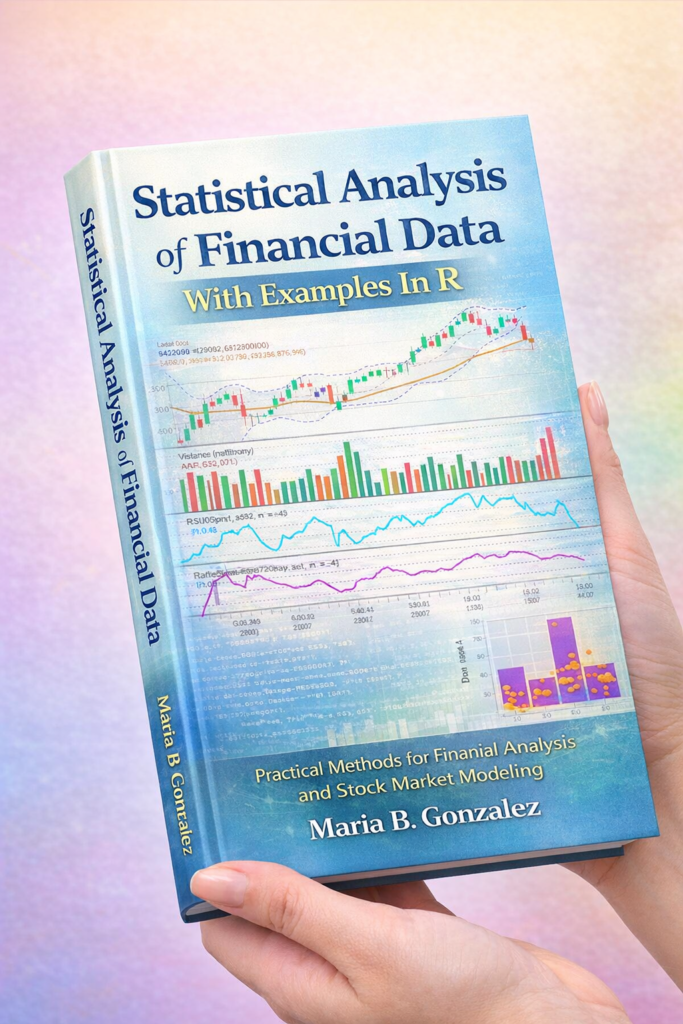
R is widely used in:
-
Quantitative finance 📈
-
Risk modeling ⚠️
-
Algorithmic trading 🤖
-
Financial research & econometrics
This article is designed for both beginners and advanced engineers, offering:
-
Clear theory explanations
-
Step-by-step R examples
-
Real-world applications
-
Practical engineering insights
Whether you are a student learning statistics or a professional working on financial systems, this guide will give you a solid foundation and advanced perspectives.
📚 Background Theory
🔢 Why Statistics Matters in Finance
Financial systems are inherently uncertain. Prices fluctuate, markets react to news, and investor behavior introduces randomness. Statistics provides the tools to:
-
Measure uncertainty 📊
-
Identify patterns 🔍
-
Estimate future behavior 🔮
-
Quantify risk ⚖️
Without statistics, financial decisions would be guesswork.
📉 Types of Financial Data
Financial data generally falls into several categories:
📌 Time Series Data
Data collected over time at regular intervals.
-
Stock prices
-
Exchange rates
-
Inflation rates
📌 Cross-Sectional Data
Data collected at a single point in time.
-
Financial ratios of companies
-
Market capitalization
📌 Panel Data
Combination of time series and cross-sectional data.
-
Company stock prices over years
🎲 Probability and Random Variables
Financial returns are treated as random variables. Common assumptions include:
-
Returns follow a probability distribution
-
Past behavior informs future estimates
Common distributions used:
-
Normal distribution 📉
-
Lognormal distribution
-
Student’s t-distribution
🧠 Technical Definition
📌 What Is Statistical Analysis of Financial Data?
Statistical analysis of financial data is the systematic application of statistical methods to financial datasets in order to:
-
Describe data behavior
-
Test hypotheses
-
Build predictive models
-
Support financial decision-making
When implemented in R, it combines:
-
Statistical theory
-
Computational efficiency
-
Visualization capabilities
🛠 Why Use R for Financial Statistics?
R is preferred in academia and industry because it offers:
-
Built-in statistical functions
-
Financial packages like
quantmod,tidyquant,PerformanceAnalytics -
Advanced visualization with
ggplot2 -
Strong community support
🧭 Step-by-Step Explanation (With R Examples)
🥇 Step 1: Import Financial Data
This loads historical price data into R.
🥈 Step 2: Data Cleaning
Handling missing values is crucial in financial datasets.
🥉 Step 3: Descriptive Statistics
These metrics summarize central tendency and volatility.
🏅 Step 4: Calculate Returns
Log returns are widely used in finance for stability.
🏆 Step 5: Visualization
Visualization helps detect trends and volatility clusters.
⚖️ Comparison of Statistical Techniques
| Technique | Purpose | Use Case |
|---|---|---|
| Mean & SD | Measure central tendency | Portfolio evaluation |
| Regression | Relationship modeling | CAPM, factor models |
| Correlation | Dependency analysis | Diversification |
| Hypothesis Testing | Decision validation | Strategy testing |
| Time Series Models | Forecasting | Stock price prediction |
🧪 Detailed Examples
📈 Example 1: Regression Analysis
Used to estimate asset sensitivity to market movements.
📊 Example 2: Volatility Measurement
Volatility is a key risk metric in finance.
📉 Example 3: Correlation Matrix
Helps assess portfolio diversification.
🏗 Real-World Application in Modern Projects
💼 Banking Systems
-
Credit risk modeling
-
Fraud detection
🤖 Algorithmic Trading
-
Strategy backtesting
-
Performance evaluation
📊 Investment Management
-
Portfolio optimization
-
Risk-return analysis
🏢 FinTech Platforms
-
Real-time analytics
-
User behavior modeling
R integrates smoothly with production pipelines via APIs and cloud platforms.
❌ Common Mistakes
🚫 Assuming normal distribution for all returns
🚫 Ignoring outliers
🌍 Overfitting models
🚫 Using small sample sizes
🚫 Ignoring stationarity in time series
🧗 Challenges & Solutions
⚠️ Challenge: Noisy Data
Solution: Apply smoothing and filtering techniques
⚠️ Challenge: Non-stationary Time Series
Solution: Differencing and transformation
⚠️ Challenge: High Dimensionality
Solution: Feature selection and PCA
📚 Case Study: Stock Market Risk Analysis
🎯 Objective
Analyze risk and returns of a technology stock.
🛠 Tools
-
R
-
quantmod -
Historical price data
📊 Methodology
-
Import stock data
-
Calculate daily returns
-
Measure volatility
-
Perform regression against market index
📈 Outcome
-
Identified high volatility periods
-
Estimated beta value
-
Improved risk-adjusted decision making
💡 Tips for Engineers
✅ Always visualize your data
✅ Validate assumptions before modeling
🌍 Use multiple metrics, not just one
✅ Document your analysis
✅ Combine statistical insight with domain knowledge
❓ FAQs
Q1: Is R better than Python for financial statistics?
A: R excels in statistical analysis and academic finance, while Python is stronger in system integration.
Q2: Do I need advanced math to use R in finance?
A: Basic statistics is enough to start; advanced math helps with complex models.
Q3: Can R handle real-time financial data?
A: Yes, with APIs and streaming integrations.
Q4: Is R used in professional finance jobs?
A: Absolutely—especially in quantitative finance and research roles.
Q5: What packages are essential for financial analysis in R?
A: quantmod, tidyquant, PerformanceAnalytics, ggplot2.
Q6: Can I use R for crypto market analysis?
A: Yes, crypto prices are time series data suitable for R analysis.
🏁 Conclusion
Statistical analysis of financial data is a cornerstone skill for modern engineers, analysts, and finance professionals. With R programming, you gain access to powerful statistical tools that turn raw numbers into actionable insights.
From basic descriptive statistics to advanced regression models and real-world case studies, R enables you to:
-
Understand financial behavior
-
Manage risk effectively
-
Build data-driven financial systems
Whether you are studying finance, engineering large-scale platforms, or developing trading strategies, mastering statistical analysis with R will future-proof your career 🚀.