Machine Learning with Python: Theory, Algorithms, and Practical Implementation – The Complete Engineering Guide for Beginners and Professionals 🚀🤖
Introduction 📘


Machine Learning (ML) has transformed modern engineering, science, healthcare, finance, manufacturing, transportation, and countless other industries. Rather than explicitly programming every rule, engineers can now develop intelligent systems capable of learning from historical data, identifying hidden patterns, and making accurate predictions.
Python has become the world’s leading programming language for Machine Learning because of its simplicity, readability, extensive scientific ecosystem, and outstanding community support. Today, organizations across the United States, Canada, the United Kingdom, Australia, and Europe rely on Python-powered machine learning systems to optimize business operations, automate repetitive tasks, detect fraud, improve medical diagnosis, and develop autonomous technologies.
Whether you are an engineering student beginning your AI journey or an experienced professional designing predictive systems, understanding both theoretical concepts and practical implementation is essential for building reliable, scalable, and accurate machine learning solutions.
This comprehensive guide explains Machine Learning with Python from the ground up while covering modern algorithms, implementation steps, engineering practices, common mistakes, industrial applications, and practical examples.
Background Theory 🧠
Machine Learning is a branch of Artificial Intelligence (AI) that enables computers to improve their performance by learning from experience instead of following fixed programming instructions.
Traditional programming follows this model:
Input + Program → Output
Machine Learning changes the paradigm:
Input + Output Data → Learning Algorithm → Predictive Model
The model continuously improves as it receives more training data.
The fundamental objective is minimizing prediction errors while maximizing generalization on unseen data.
Machine Learning combines concepts from:
- 📊 Statistics
- ➗ Mathematics
- 🧮 Linear Algebra
- 📈 Probability
- 💻 Computer Science
- 🧠 Artificial Intelligence
- ⚙️ Optimization
- 📚 Data Science
The quality of a machine learning model depends on:
- Data quality
- Feature engineering
- Algorithm selection
- Hyperparameter tuning
- Validation strategy
- Computational resources
Definition 📖
Machine Learning is the scientific discipline that develops algorithms capable of automatically learning patterns from data to make predictions or decisions without being explicitly programmed for every possible scenario.
Python provides an ideal platform because of libraries including:
- NumPy
- Pandas
- Scikit-learn
- TensorFlow
- PyTorch
- XGBoost
- LightGBM
- CatBoost
- Matplotlib
- Seaborn
These libraries simplify complex mathematical operations into user-friendly programming interfaces.
Types of Machine Learning 🎯
Supervised Learning
Uses labeled datasets.
Examples:
- House price prediction
- Email spam detection
- Medical diagnosis
- Credit scoring
Popular algorithms:
- Linear Regression
- Logistic Regression
- Decision Trees
- Random Forest
- Support Vector Machine
- Neural Networks
Unsupervised Learning
Uses unlabeled datasets.
Examples:
- Customer segmentation
- Image compression
- Market basket analysis
Popular algorithms:
- K-Means
- DBSCAN
- Hierarchical Clustering
- PCA
Reinforcement Learning
Learns by interacting with an environment.
Examples include:
- Robotics
- Game AI
- Autonomous vehicles
- Industrial automation
Machine Learning Workflow 🔄


Step 1 — Define the Problem
Identify:
- Classification
- Regression
- Clustering
- Recommendation
- Forecasting
Example:
Predict equipment failure before it occurs.
Step 2 — Collect Data 📂
Sources include:
- IoT sensors
- SQL databases
- CSV files
- APIs
- Cloud storage
- Manufacturing systems
More data generally improves performance when the data is representative and clean.
Step 3 — Clean Data 🧹
Tasks include:
✔ Missing value handling
✔ Duplicate removal
♻️ Outlier detection
✔ Feature normalization
✔ Data transformation
Python libraries:
- Pandas
- NumPy
Step 4 — Feature Engineering ⚙️
Feature engineering often contributes more to model accuracy than selecting a more complex algorithm.
Common techniques:
- One-hot encoding
- Label encoding
- Polynomial features
- Feature scaling
- Standardization
- Normalization
Step 5 — Split Dataset
Typical ratios:
| Dataset | Percentage |
|---|---|
| Training | 70% |
| Validation | 15% |
| Testing | 15% |
Step 6 — Select an Algorithm
Selection depends on:
- Data size
- Problem type
- Accuracy needs
- Interpretability
- Training speed
Step 7 — Train Model
The algorithm learns relationships between variables.
Training adjusts internal parameters until prediction errors become minimal.
Step 8 — Evaluate Performance
Metrics include:
Regression:
- MAE
- MSE
- RMSE
- R²
Classification:
- Accuracy
- Precision
- Recall
- F1 Score
- ROC-AUC
Step 9 — Hyperparameter Optimization
Methods include:
- Grid Search
- Random Search
- Bayesian Optimization
Step 10 — Deployment 🚀
Production environments include:
- Flask APIs
- FastAPI
- Docker
- Kubernetes
- Cloud platforms
Popular Machine Learning Algorithms 🤖
| Algorithm | Category | Best Use |
|---|---|---|
| Linear Regression | Regression | Continuous prediction |
| Logistic Regression | Classification | Binary classification |
| Decision Tree | Both | Easy interpretation |
| Random Forest | Ensemble | High accuracy |
| XGBoost | Ensemble | Competitions |
| SVM | Classification | Small datasets |
| KNN | Classification | Pattern recognition |
| Naive Bayes | Classification | Text classification |
| K-Means | Clustering | Customer segmentation |
| Neural Networks | Deep Learning | Complex problems |
Comparison of Popular Algorithms ⚖️
| Feature | Linear Regression | Random Forest | Neural Networks |
|---|---|---|---|
| Speed | ⭐⭐⭐⭐⭐ | ⭐⭐⭐ | ⭐⭐ |
| Accuracy | ⭐⭐⭐ | ⭐⭐⭐⭐ | ⭐⭐⭐⭐⭐ |
| Interpretability | Excellent | Moderate | Low |
| Scalability | High | High | Very High |
| Training Time | Low | Medium | High |
Machine Learning Architecture & Visual Diagrams 🖼️
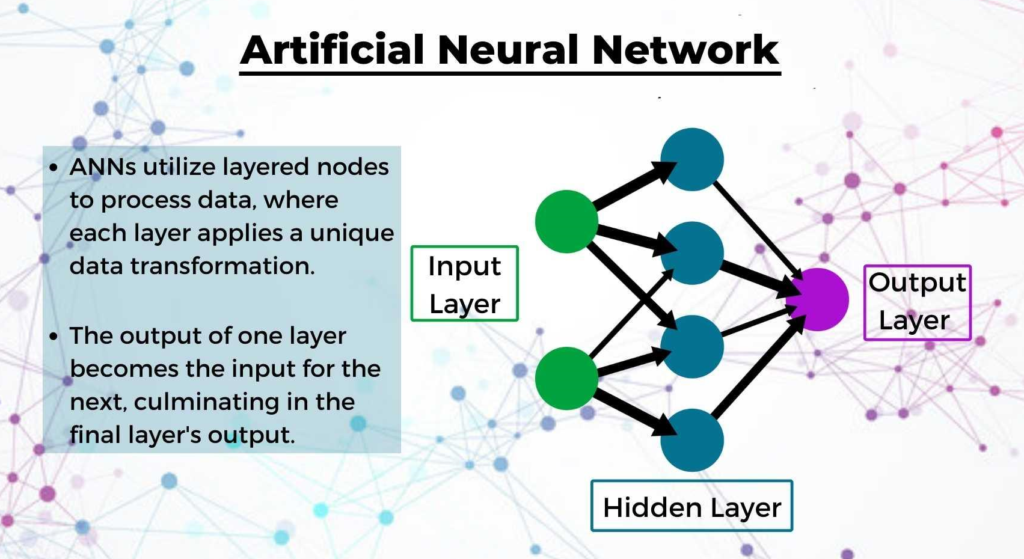


Typical Pipeline
| Stage | Description |
|---|---|
| Data Collection | Acquire raw data |
| Cleaning | Remove inconsistencies |
| Feature Engineering | Build meaningful variables |
| Model Training | Learn patterns |
| Evaluation | Measure performance |
| Deployment | Publish model |
| Monitoring | Improve continuously |
Practical Python Implementation 💻
Example workflow:
- Import dataset
- Explore data
- Clean missing values
- Encode categorical variables
- Scale numerical features
- Split training/testing sets
- Train Random Forest
- Evaluate accuracy
- Save model
- Deploy API
Popular Python libraries:
| Library | Purpose |
|---|---|
| NumPy | Mathematics |
| Pandas | Data manipulation |
| Matplotlib | Visualization |
| Scikit-learn | Classical ML |
| TensorFlow | Deep Learning |
| PyTorch | Neural Networks |
| XGBoost | Gradient Boosting |
Practical Examples 💡
Example 1 — House Price Prediction
Inputs:
- Bedrooms
- Area
- Garage
- Location
- Year Built
Output:
Estimated selling price.
Example 2 — Medical Diagnosis
Input:
- Blood pressure
- Age
- Blood sugar
- Symptoms
Output:
Disease probability.
Example 3 — Manufacturing
Predict machine failures before breakdown.
Benefits:
✔ Reduced downtime
♻️ Lower maintenance costs
✔ Increased productivity
Example 4 — Fraud Detection
Banks analyze:
- Transaction amount
- Device
- Location
- Purchase history
The model identifies suspicious activities instantly.
Real-World Engineering Applications 🌍
Machine Learning is revolutionizing engineering across multiple industries.
Manufacturing 🏭
- Predictive maintenance
- Quality inspection
- Process optimization
- Robot control
Civil Engineering 🏗️
- Structural health monitoring
- Traffic prediction
- Smart cities
Mechanical Engineering ⚙️
- Failure prediction
- Thermal analysis
- Design optimization
Electrical Engineering ⚡
- Smart grids
- Load forecasting
- Energy optimization
Healthcare 🩺
- Disease diagnosis
- Medical imaging
- Drug discovery
Finance 💰
- Fraud detection
- Credit scoring
- Risk analysis
Transportation 🚗
- Autonomous driving
- Route optimization
- Fleet management
Agriculture 🌾
- Crop prediction
- Disease detection
- Precision farming
Common Mistakes ❌
Many beginners encounter avoidable pitfalls:
Ignoring Data Cleaning
Garbage data produces poor models.
Using Too Many Features
More features do not always improve accuracy.
Data Leakage
Future information should never appear in training data.
Overfitting
Excellent training accuracy but poor real-world performance.
Underfitting
Model too simple to capture relationships.
Ignoring Feature Scaling
Algorithms like SVM and KNN require normalization.
Evaluating Only Accuracy
Precision and Recall may be more important.
Challenges and Solutions 🔧
| Challenge | Solution |
|---|---|
| Missing data | Imputation |
| Imbalanced dataset | SMOTE, class weighting |
| High dimensionality | PCA |
| Overfitting | Regularization |
| Slow training | GPU acceleration |
| Limited data | Data augmentation |
| Model drift | Continuous retraining |
Case Study 📊
Predictive Maintenance in an Automotive Factory
A manufacturing company wanted to reduce unexpected machine failures.
Problem:
Unexpected downtime caused production delays and financial losses.
Solution:
Engineers collected sensor data:
- Temperature
- Pressure
- Vibration
- Motor current
- Runtime
Python Workflow:
- Data cleaning
- Feature engineering
- Random Forest training
- Cross-validation
- Model deployment
Results:
✅ 92% prediction accuracy
♻️ 38% reduction in maintenance costs
✅ 45% fewer machine failures
✅ Increased equipment availability
This demonstrates how combining engineering expertise with machine learning can produce measurable operational improvements.
Essential Tips ⭐
✔ Always understand the business problem before choosing an algorithm.
✔ Spend more time preparing data than tuning models.
♻️ Start with simple algorithms before deep learning.
✔ Use cross-validation to estimate generalization performance.
✔ Track experiments and model versions.
♻️ Monitor models after deployment for performance drift.
✔ Prioritize explainability when decisions affect people.
✔ Continue learning new Python libraries and emerging ML techniques.
Frequently Asked Questions ❓
What programming language is best for Machine Learning?
Python is the most popular because of its simplicity and extensive ecosystem of ML libraries.
Is mathematics required?
Yes. Linear algebra, probability, calculus, and statistics help you understand algorithms and improve model performance.
Which Python library should beginners learn first?
Scikit-learn is an excellent starting point because it provides easy-to-use implementations of many classical machine learning algorithms.
What is the difference between AI and Machine Learning?
Artificial Intelligence is the broader field of creating intelligent systems, while Machine Learning is a subset that focuses on learning patterns from data.
Can Machine Learning work without big data?
Yes. Many practical applications achieve strong results with modest, high-quality datasets, provided the data is representative.
How long does it take to learn Machine Learning?
With consistent study and hands-on projects, beginners can understand the fundamentals in a few months, while mastering advanced topics typically takes longer.
Is Machine Learning used in engineering?
Absolutely. Engineers use ML for predictive maintenance, quality control, optimization, simulation, energy management, structural monitoring, robotics, and many other applications.
Conclusion 🎯
Machine Learning with Python has become one of the most valuable skills in modern engineering. By combining solid theoretical knowledge with practical implementation, engineers can build systems that predict outcomes, automate decisions, optimize complex processes, and unlock insights from data.
Python’s rich ecosystem—including libraries for data analysis, visualization, classical machine learning, and deep learning—makes it an ideal platform for developing intelligent applications across industries. Success in machine learning depends not only on choosing the right algorithm but also on collecting high-quality data, performing careful preprocessing, engineering meaningful features, evaluating models rigorously, and monitoring them after deployment.
For students, mastering Machine Learning with Python opens doors to careers in artificial intelligence, data science, software engineering, robotics, and research. For professionals, it provides powerful tools to solve real-world engineering challenges, improve efficiency, and drive innovation. As AI technologies continue to evolve, a strong foundation in Python-based machine learning will remain a critical asset for engineers and organizations aiming to stay competitive in an increasingly data-driven world.