Python for Probability, Statistics, and Machine Learning 3rd Edition: A Complete Engineering Guide for Data Science, AI, and Statistical Computing 🚀📊🐍
Introduction 📚🐍
Probability, statistics, and machine learning are the mathematical foundations behind modern Artificial Intelligence (AI), predictive analytics, robotics, autonomous systems, finance, healthcare, cybersecurity, manufacturing, and scientific research. Today, Python has become the world’s leading programming language for implementing these concepts because of its simplicity, readability, and powerful scientific ecosystem.
Python for Probability, Statistics, and Machine Learning (3rd Edition) is designed to bridge the gap between mathematical theory and practical implementation. Rather than focusing only on equations, the book demonstrates how Python libraries can solve real engineering and data science problems efficiently.
Whether you are:
- 🎓 Engineering student
- 💻 Software developer
- 🤖 AI engineer
- 📈 Data scientist
- 🔬 Researcher
- 🏭 Industrial engineer
this guide provides the statistical foundation necessary for modern engineering analysis.
Python’s popularity continues to grow because engineers can quickly move from theoretical concepts to working applications using libraries such as:
- NumPy
- SciPy
- Pandas
- Matplotlib
- Scikit-learn
- Statsmodels
Instead of spending hours performing manual calculations, engineers can analyze millions of observations within seconds.


Background Theory 📖
Probability and statistics have existed for centuries, but machine learning has transformed these mathematical disciplines into practical engineering tools.
Classical statistics primarily focuses on:
- Estimating unknown parameters
- Hypothesis testing
- Confidence intervals
- Experimental analysis
Machine learning expands these ideas by allowing computers to automatically discover patterns from large datasets.
Modern engineering combines all three disciplines:
- 🎯 Probability models uncertainty
- 📊 Statistics analyzes data
- 🤖 Machine Learning predicts future outcomes
Python acts as the bridge connecting these mathematical concepts with real engineering applications.
Definition 📘
Probability
Probability measures the likelihood that an event will occur.
Formula:
P(Event) = Favorable Outcomes / Total Outcomes
Example:
Rolling a six-sided die:
Probability of rolling 4:
P(4)=1/6
Statistics
Statistics is the science of collecting, organizing, analyzing, interpreting, and presenting data.
It answers questions like:
- Is this machine reliable?
- Is this medicine effective?
- Which product performs better?
Machine Learning
Machine Learning is a branch of Artificial Intelligence where computers learn patterns from data instead of being explicitly programmed.
Main categories include:
- Supervised Learning
- Unsupervised Learning
- Reinforcement Learning
Step-by-Step Explanation 🛠️


Step 1 — Install Python
Install Python together with:
- NumPy
- Pandas
- Matplotlib
- SciPy
- Scikit-learn
These libraries provide almost everything needed for engineering statistics.
Step 2 — Load Data
Most datasets are stored as:
- CSV
- Excel
- SQL databases
- APIs
Example:
import pandas as pd

df = pd.read_csv("data.csv")
Step 3 — Explore the Dataset
Check:
- Missing values
- Data types
- Number of observations
- Statistical summaries
df.describe()
Step 4 — Visualize Data
Visualizations help engineers understand trends before building models.
Common plots:
- Histogram
- Scatter plot
- Box plot
- Heatmap
- Bar chart
Step 5 — Apply Statistical Analysis
Examples include:
- Mean
- Median
- Variance
- Standard deviation
- Correlation
- Regression
Step 6 — Build Machine Learning Models
Popular algorithms include:
- Linear Regression
- Logistic Regression
- Decision Trees
- Random Forest
- Support Vector Machines
- K-Means
- Neural Networks
Step 7 — Evaluate Performance
Use metrics such as:
- Accuracy
- Precision
- Recall
- F1-score
- ROC-AUC
- Mean Squared Error
Comparison ⚖️
| Feature | Probability | Statistics | Machine Learning |
|---|---|---|---|
| Purpose | Measure uncertainty | Analyze data | Learn patterns |
| Input | Mathematical models | Collected data | Large datasets |
| Output | Probability values | Statistical conclusions | Predictions |
| Engineering Use | Risk analysis | Quality control | Intelligent systems |
| Python Libraries | SciPy | Statsmodels | Scikit-learn |
Diagrams, Tables & Visual Learning 📊


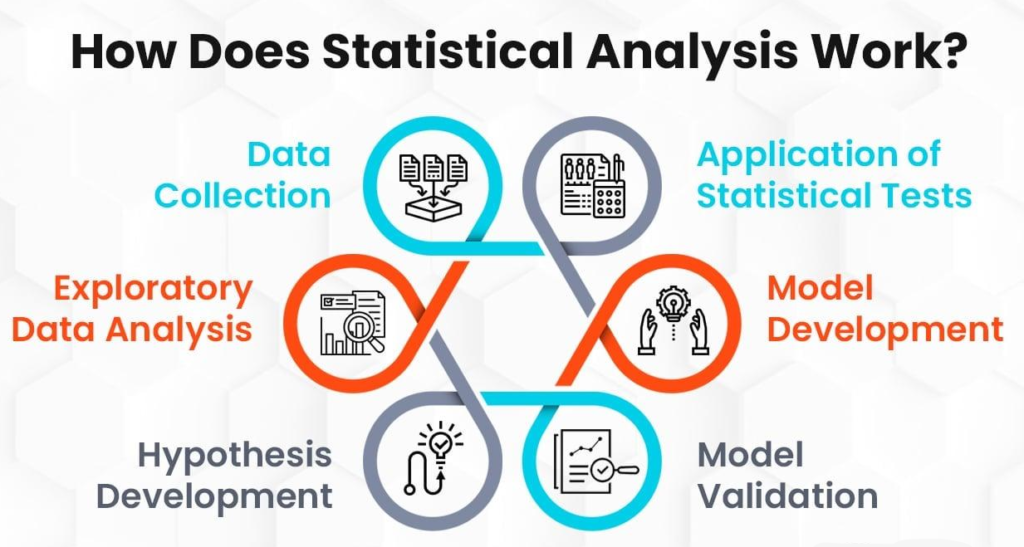
Complete Engineering Workflow
| Stage | Python Library | Purpose |
|---|---|---|
| Data Collection | Pandas | Import datasets |
| Cleaning | Pandas | Remove errors |
| Visualization | Matplotlib | Explore patterns |
| Statistics | SciPy | Analyze data |
| Machine Learning | Scikit-learn | Build predictive models |
| Evaluation | Scikit-learn | Measure accuracy |
Popular Python Libraries
| Library | Main Purpose |
|---|---|
| NumPy | Numerical computing |
| Pandas | Data manipulation |
| SciPy | Scientific computing |
| Matplotlib | Visualization |
| Seaborn | Statistical graphics |
| Scikit-learn | Machine learning |
| Statsmodels | Statistical modeling |
Examples 💡
Example 1: Manufacturing
A factory collects temperature readings every minute.
Statistics determine:
- Average temperature
- Process variation
- Control limits
Machine learning predicts future failures.
Example 2: Healthcare
Hospitals analyze patient records.
Probability estimates disease risk.
Machine learning predicts patient outcomes.
Example 3: Finance
Banks evaluate loan applications.
Probability estimates default risk.
Machine learning classifies applicants.
Example 4: Robotics
Robots receive noisy sensor measurements.
Probability models uncertainty.
Machine learning improves navigation.
Example 5: Civil Engineering
Bridge sensors collect vibration data.
Statistics detect abnormal behavior.
Machine learning predicts maintenance needs.
Real-World Applications 🌍
Python for probability and machine learning is used across nearly every engineering discipline.
Artificial Intelligence 🤖
- Chatbots
- Computer vision
- Speech recognition
Mechanical Engineering ⚙️
- Predictive maintenance
- Fault detection
- Manufacturing optimization
Electrical Engineering ⚡
- Signal processing
- Smart grids
- Fault diagnosis
Civil Engineering 🏗️
- Structural health monitoring
- Earthquake prediction models
- Traffic analysis
Biomedical Engineering ❤️
- Medical imaging
- Disease prediction
- Drug discovery
Aerospace Engineering ✈️
- Flight optimization
- Navigation systems
- Aircraft diagnostics
Environmental Engineering 🌱
- Climate modeling
- Pollution forecasting
- Flood prediction
Common Mistakes ❌
Many beginners make similar errors:
Ignoring Data Cleaning
Poor-quality data produces poor models.
Using Small Datasets
Small datasets often produce unreliable conclusions.
Overfitting
A model memorizes training data instead of learning patterns.
Ignoring Feature Scaling
Some algorithms require normalized features.
Misinterpreting Correlation
Correlation does not imply causation.
Selecting the Wrong Evaluation Metric
Accuracy alone may be misleading for imbalanced datasets.
Challenges & Solutions 🛡️
| Challenge | Solution |
|---|---|
| Missing values | Imputation techniques |
| Outliers | Statistical detection |
| High dimensionality | PCA |
| Large datasets | Distributed computing |
| Imbalanced classes | SMOTE and resampling |
| Model complexity | Cross-validation |
Case Study 🏭
Predictive Maintenance in Manufacturing
A manufacturing company collects:
- Temperature
- Pressure
- Vibration
- Power consumption
Historical data contains records of machine failures.
Engineers first clean the dataset.
They calculate:
- Mean
- Variance
- Correlation matrix
Machine learning models are trained using Random Forest.
Results:
- Failure prediction accuracy improved to 96%.
- Unexpected downtime reduced by 40%.
- Maintenance costs decreased by 25%.
- Equipment availability increased significantly.
This demonstrates how probability, statistics, and machine learning combine to deliver measurable engineering benefits.
Essential Tips ⭐
- 🐍 Learn Python fundamentals before advanced machine learning.
- 📊 Always visualize data before modeling.
- 🧹 Clean data carefully.
- 📚 Understand statistical assumptions.
- 🎯 Use cross-validation for reliable evaluation.
- ⚡ Master NumPy and Pandas early.
- 📈 Compare multiple algorithms instead of relying on one.
- 🔍 Interpret model results, not just accuracy scores.
- 💾 Document experiments for reproducibility.
- 🚀 Practice with real-world engineering datasets.
Frequently Asked Questions ❓
Is this book suitable for beginners?
Yes. It introduces probability, statistics, Python programming, and machine learning in a structured progression while also providing material valuable to experienced learners.
Do I need advanced mathematics?
Basic algebra is enough to get started. Familiarity with calculus and linear algebra becomes increasingly useful for more advanced machine learning topics.
Which Python libraries are most important?
The core libraries are NumPy, Pandas, SciPy, Matplotlib, Scikit-learn, and Statsmodels.
Can engineers from non-computer science backgrounds benefit?
Absolutely. Mechanical, electrical, civil, chemical, biomedical, and industrial engineers increasingly rely on statistical computing and machine learning.
Is coding experience required?
Some basic Python knowledge is helpful, but many examples begin with fundamental concepts before progressing to more advanced implementations.
What industries use these skills?
Industries include healthcare, finance, aerospace, automotive, manufacturing, telecommunications, energy, logistics, environmental science, and research.
Why is Python preferred over other languages?
Python offers a simple syntax, a vast ecosystem of scientific libraries, strong community support, and excellent tools for visualization, statistical analysis, and AI development.
Conclusion 🎯
Python for Probability, Statistics, and Machine Learning (3rd Edition) serves as a comprehensive resource for transforming mathematical concepts into practical engineering solutions. By combining probability theory, statistical reasoning, and machine learning algorithms within Python’s powerful ecosystem, engineers can tackle challenges ranging from predictive maintenance and quality control to intelligent automation and scientific discovery.
For students, the book provides a structured path from foundational mathematics to real-world programming. For professionals, it offers practical workflows that improve decision-making, optimize processes, and unlock insights from complex datasets. As data-driven engineering continues to shape industries across the USA, UK, Canada, Australia, and Europe, mastering these skills is no longer optional—it is a critical advantage for building innovative, reliable, and intelligent engineering systems. 🚀📊🐍