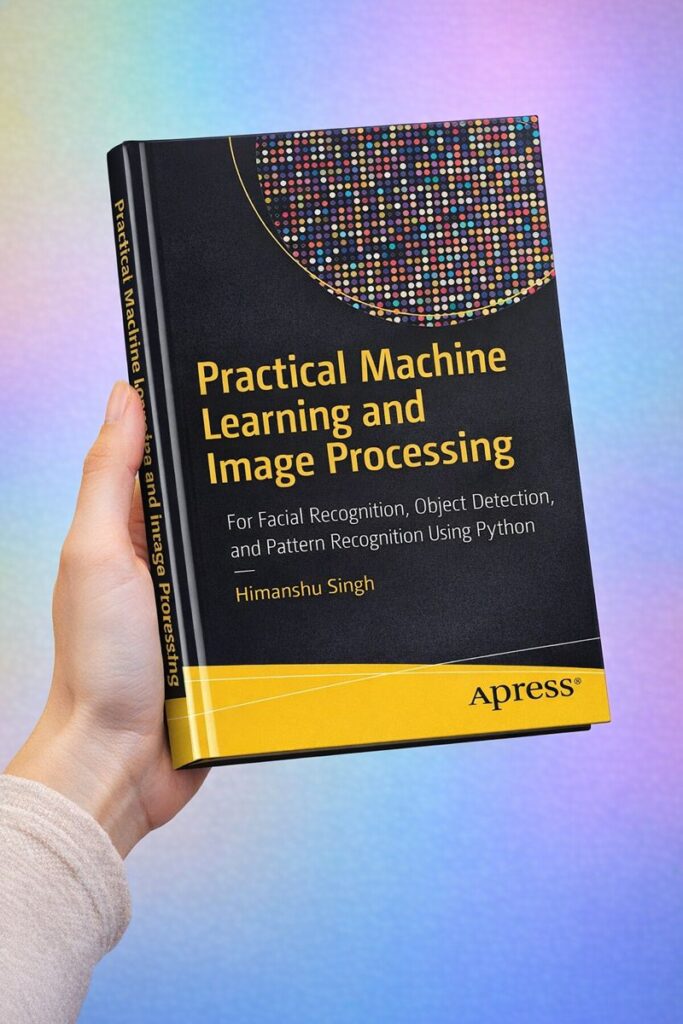
Practical Machine Learning and Image Processing: For Facial Recognition, Object Detection, and Pattern Recognition Using Python
Introduction
In recent years, Machine Learning (ML) and Image Processing have become two of the most influential technologies in modern engineering. From facial recognition on smartphones to medical image analysis and self-driving cars, these fields are shaping how machines understand and interact with the world.
For many beginners, however, machine learning and image processing seem complex, mathematical, and difficult to apply in real projects. This article is designed to bridge the gap between theory and practice, explaining concepts in a simple engineering-focused way while showing how they are used in real-world systems.
This guide targets:
-
Engineering students starting with AI and computer vision
-
Software developers moving into ML-based projects
-
Professionals who want a structured and practical overview
By the end of this article, you will understand:
-
The theoretical background of machine learning and image processing
-
How these fields work together
-
Step-by-step workflows
-
Practical examples and real-world applications
-
Common mistakes, challenges, and engineering solutions
Background Theory
What Is Machine Learning?
Machine Learning is a subset of Artificial Intelligence (AI) that allows systems to learn patterns from data instead of being explicitly programmed.
Instead of writing rules like:
Machine learning systems learn these rules automatically from examples.
At its core, ML is based on:
-
Data
-
Mathematical models
-
Optimization algorithms
What Is Image Processing?
Image processing focuses on manipulating and analyzing digital images to extract useful information.
An image, from a computer’s perspective, is:
-
A matrix of numbers
-
Each number represents pixel intensity or color
Image processing operations include:
-
Noise removal
-
Edge detection
-
Image enhancement
-
Feature extraction
Why Combine Machine Learning and Image Processing?
Image processing prepares visual data, while machine learning learns patterns from it.
Together, they enable systems to:
-
Recognize objects
-
Classify images
-
Detect faces
-
Understand scenes
This combination is often called Computer Vision.
Technical Definition
Machine Learning (Engineering Definition)
Machine Learning is a data-driven approach where algorithms automatically learn mathematical representations (models) that map inputs to outputs by minimizing prediction error.
Mathematically:
y=f(x;θ)
Where:
-
x = input data
-
= output prediction
-
θ = model parameters
Image Processing (Engineering Definition)
Image processing is the application of signal processing techniques to digital images to enhance, analyze, and extract meaningful features.
An image can be represented as:
I(x,y)=Pixel Intensity
Combined System
In practical ML-based image systems:
-
Image Processing → Feature preparation
-
Machine Learning → Decision making
Step-by-Step Explanation
Step 1: Image Acquisition
Images are captured from:
-
Cameras
-
Sensors
-
Medical scanners
-
Satellites
Images can be:
-
Grayscale
-
RGB (Red, Green, Blue)
-
Multispectral
Step 2: Preprocessing
Before ML can work, images must be cleaned.
Common preprocessing techniques:
-
Resizing images
-
Normalization
-
Noise filtering
-
Contrast adjustment
Example:
Inormalized=σI−μ
Step 3: Feature Extraction
Features are measurable characteristics of an image.
Examples:
-
Edges
-
Corners
-
Textures
-
Shapes
Traditional methods:
-
Sobel operator
-
Canny edge detection
-
Histogram of Oriented Gradients (HOG)
Step 4: Model Selection
Choose a machine learning model:
-
Logistic Regression
-
Support Vector Machines (SVM)
-
Decision Trees
-
Neural Networks
-
Convolutional Neural Networks (CNNs)
For images, CNNs are most effective.
Step 5: Training the Model
Training involves:
-
Feeding labeled images
-
Calculating prediction error
-
Updating model parameters
Loss function example:
L=N1∑(y−y^)2
Step 6: Evaluation
Performance metrics:
-
Accuracy
-
Precision
-
Recall
-
F1-score
Step 7: Deployment
The trained model is integrated into:
-
Web apps
-
Mobile apps
-
Embedded systems
Detailed Examples
Example 1: Handwritten Digit Recognition
Problem:
-
Recognize digits (0–9) from images
Steps:
-
Input image (28×28 pixels)
-
Normalize pixel values
-
Extract features using CNN
-
Predict digit class
Applications:
-
Postal code recognition
-
Bank check processing
Example 2: Face Detection
Goal:
-
Detect human faces in images
Image processing:
-
Convert to grayscale
-
Detect edges
-
Identify facial regions
Machine learning:
-
Classifier trained on face and non-face images
Example 3: Medical Image Classification
Problem:
-
Detect tumors in X-ray or MRI scans
Workflow:
-
Image enhancement
-
Feature extraction
-
Deep learning classification
Benefits:
-
Faster diagnosis
-
Reduced human error
Real World Application in Modern Projects
1. Autonomous Vehicles
Used for:
-
Lane detection
-
Traffic sign recognition
-
Pedestrian detection
Technologies:
-
CNNs
-
Real-time image processing
2. Smart Surveillance Systems
Features:
-
Motion detection
-
Face recognition
-
Behavior analysis
Used in:
-
Airports
-
Smart cities
-
Security systems
3. Industrial Quality Control
Applications:
-
Defect detection
-
Surface inspection
-
Product classification
Benefits:
-
High accuracy
-
Reduced manual labor
4. Medical Diagnostics
Used in:
-
Cancer detection
-
Retinal disease analysis
-
COVID-19 diagnosis
Common Mistakes
-
Ignoring Data Quality
Poor image quality leads to poor model performance. -
Overfitting
Model performs well on training data but fails on new data. -
Wrong Model Selection
Using complex models for simple problems. -
No Proper Evaluation
Relying only on accuracy. -
Ignoring Ethical Issues
Bias in datasets can lead to unfair decisions.
Challenges & Solutions
Challenge 1: Large Data Requirements
Solution:
-
Data augmentation
-
Transfer learning
Challenge 2: High Computational Cost
Solution:
-
GPU acceleration
-
Model optimization
Challenge 3: Noise and Variability
Solution:
-
Robust preprocessing
-
Regularization techniques
Challenge 4: Deployment Constraints
Solution:
-
Model compression
-
Edge computing
Case Study
Case Study: Automated Defect Detection in Manufacturing
Problem:
Manual inspection was slow and error-prone.
Solution:
-
Cameras installed on production line
-
Images preprocessed and normalized
-
CNN trained to detect defects
Results:
-
30% increase in detection accuracy
-
40% reduction in inspection time
Engineering Impact:
-
Improved product quality
-
Reduced operational costs
Tips for Engineers
-
Start with simple models before deep learning
-
Always visualize image data
-
Use pre-trained models when possible
-
Validate with real-world data
-
Keep systems explainable
-
Focus on practical constraints, not only accuracy
FAQs
Q1: Do I need strong math to start machine learning?
No. Basic algebra and understanding concepts is enough to start.
Q2: Why are CNNs better for images?
They automatically learn spatial features from images.
Q3: Can image processing work without machine learning?
Yes, but ML makes systems more adaptive and accurate.
Q4: What programming language is best?
Python is the most popular due to its ML libraries.
Q5: Is machine learning suitable for embedded systems?
Yes, using optimized and lightweight models.
Q6: How much data is enough?
It depends on problem complexity, but more diverse data is better.
Q7: What is transfer learning?
Using pre-trained models to solve new problems efficiently.
Conclusion
Practical machine learning and image processing are no longer advanced research topics—they are essential engineering tools used across industries. By understanding the fundamentals, following structured workflows, and focusing on real-world constraints, engineers can build intelligent systems that solve complex visual problems efficiently.
For beginners, the key is to:
-
Learn concepts step by step
-
Practice with real datasets
-
Focus on practical implementation
As technology evolves, the integration of machine learning and image processing will continue to drive innovation, making this knowledge invaluable for modern engineers.