Big Data and Artificial Intelligence in Digital Finance: The Complete Engineering Guide to Smarter Financial Systems 💰🤖📊
Introduction 🚀
Digital finance has evolved from simple online banking into a highly intelligent ecosystem powered by Big Data and Artificial Intelligence (AI). Every second, millions of financial transactions generate enormous amounts of information that traditional software cannot process efficiently. AI combined with Big Data enables financial institutions to analyze this information in real time, detect fraud instantly, personalize customer experiences, and improve investment decisions.
Today, banks, insurance companies, investment firms, payment platforms, cryptocurrency exchanges, and fintech startups rely on intelligent algorithms instead of manual analysis.
Whether you are an engineering student, software developer, data scientist, financial analyst, or technology enthusiast, understanding the relationship between AI and Big Data in finance has become an essential skill for the future.


Background Theory 📚
Modern financial systems generate data from numerous sources including:
- Credit card transactions
- Online banking
- Mobile payment applications
- Stock markets
- Cryptocurrency exchanges
- IoT payment devices
- Insurance claims
- Customer interactions
- Social media
- Economic indicators
Traditional databases were designed for structured information and relatively small datasets. However, financial organizations now process petabytes of structured and unstructured data every day.
The combination of Big Data technologies and Artificial Intelligence provides a scalable solution capable of:
- Processing massive datasets
- Learning customer behavior
- Predicting financial risks
- Automating investment strategies
- Detecting suspicious activities
Without these technologies, today’s digital financial ecosystem would simply be impossible.
Definition 📖
What is Big Data?
Big Data refers to extremely large datasets that cannot be processed efficiently using traditional database systems.
It is commonly characterized by the Five Vs:
| Characteristic | Description |
|---|---|
| Volume | Massive quantities of financial data |
| Velocity | Continuous real-time data generation |
| Variety | Structured and unstructured information |
| Veracity | Data accuracy and reliability |
| Value | Useful business insights extracted from data |
What is Artificial Intelligence?
Artificial Intelligence is the simulation of human intelligence using computer systems capable of:
- Learning from data
- Recognizing patterns
- Making predictions
- Solving problems
- Improving decisions automatically
Machine Learning and Deep Learning are major branches of AI widely used in finance.
What is Digital Finance?
Digital Finance refers to financial services delivered through digital technologies such as:
- Mobile banking
- Internet banking
- Digital wallets
- Online lending
- Robo-advisors
- Cryptocurrency platforms
- Electronic payments
How Big Data and AI Work Together in Digital Finance ⚙️
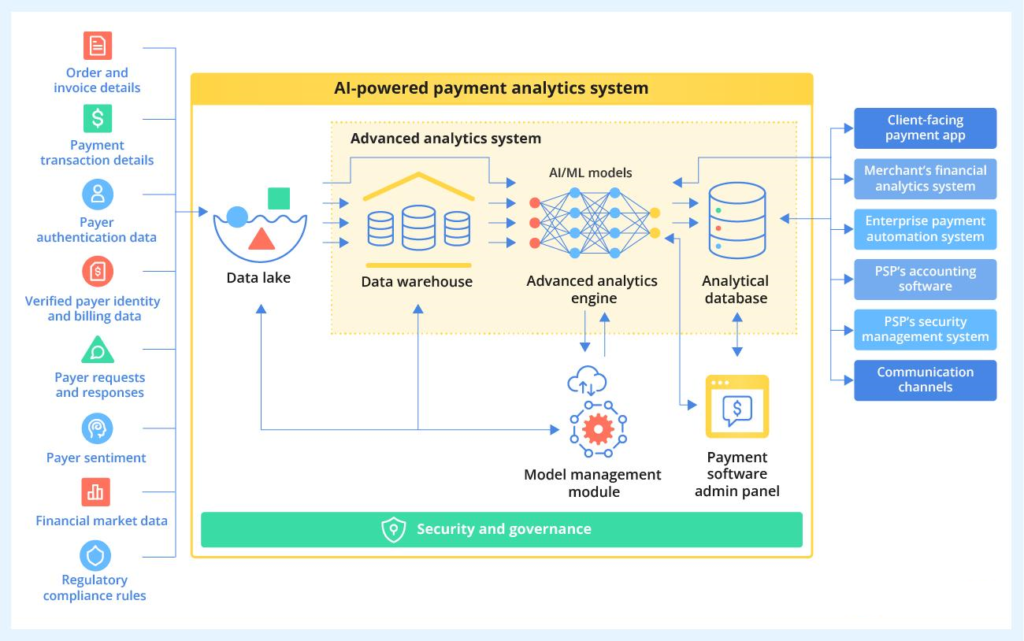
The workflow can be understood as a sequence of engineering processes.
Step 1️⃣ Data Collection
Financial organizations collect information from multiple sources:
- ATM transactions
- POS terminals
- Mobile apps
- Websites
- Payment gateways
- Trading platforms
- Banking systems
Step 2️⃣ Data Storage
Collected information is stored in scalable infrastructures such as:
- Cloud Data Lakes
- Distributed Databases
- Hadoop
- Apache Spark
- NoSQL databases
Step 3️⃣ Data Cleaning
Before AI can learn, engineers remove:
- Duplicate records
- Missing values
- Invalid transactions
- Incorrect customer information
Clean data significantly improves AI accuracy.
Step 4️⃣ Feature Engineering
Engineers convert raw financial data into meaningful variables.
Examples include:
- Monthly spending
- Credit utilization
- Transaction frequency
- Payment history
- Device usage
- Customer age
Step 5️⃣ AI Model Training
Machine Learning algorithms learn historical financial patterns.
Popular algorithms include:
- Decision Trees
- Random Forest
- Neural Networks
- Support Vector Machines
- Gradient Boosting
- Deep Learning
Step 6️⃣ Real-Time Decision Making
After deployment, AI continuously evaluates incoming financial data and produces decisions within milliseconds.
Examples:
- Approve a loan
- Reject suspicious transactions
- Recommend investments
- Detect fraud


Comparison ⚖️
| Feature | Traditional Finance | AI + Big Data Finance |
|---|---|---|
| Processing Speed | Slow | Real Time |
| Fraud Detection | Manual | Automatic |
| Customer Service | Human Only | AI Chatbots + Humans |
| Loan Approval | Days | Minutes |
| Investment Analysis | Manual | Predictive AI |
| Risk Assessment | Limited | Advanced Analytics |
| Personalization | Low | Very High |
| Operational Cost | High | Lower |
Engineering Architecture 🏗️
Data Layer
- Transaction databases
- Customer profiles
- Payment records
- External financial data
Storage Layer
- Hadoop
- Distributed File Systems
- Cloud Storage
Processing Layer
- Apache Spark
- Stream Processing
- ETL Pipelines
AI Layer
- Machine Learning
- Deep Learning
- Natural Language Processing
- Predictive Analytics
Business Layer
- Banking
- Investment
- Insurance
- Digital Payments
- Wealth Management
AI Technologies Used in Digital Finance 🤖
Machine Learning
Learns customer behavior from historical data.
Applications:
- Credit scoring
- Loan approval
- Risk prediction
Deep Learning
Processes highly complex financial patterns.
Applications:
- Stock prediction
- Image verification
- Identity recognition
Natural Language Processing (NLP)
Allows computers to understand human language.
Applications:
- Financial chatbots
- Customer support
- Document analysis
- Contract processing
Computer Vision
Analyzes images and scanned documents.
Applications:
- ID verification
- Check scanning
- Invoice processing
Examples 💡
Example 1: Fraud Detection
A customer normally spends $50 per transaction in London.
Suddenly, a $5,000 purchase appears in another country.
AI immediately:
- Detects abnormal behavior
- Blocks the transaction
- Alerts the customer
Example 2: Loan Approval
Traditional process:
- Manual review
- Days of waiting
AI process:
- Analyze income
- Evaluate spending
- Calculate risk
- Approve within minutes
Example 3: Investment Recommendation
AI analyzes:
- Market trends
- Investor goals
- Risk tolerance
Then automatically builds a diversified investment portfolio.
Real-World Applications 🌍
Big Data and AI power many financial services:
Banking 🏦
- Fraud detection
- Customer segmentation
- Smart lending
- Personalized banking
Insurance 🛡️
- Claim automation
- Risk prediction
- Premium calculation
- Fraud investigation
Investment 📈
- Algorithmic trading
- Portfolio optimization
- Market prediction
Credit Scoring 💳
AI evaluates:
- Payment history
- Income
- Spending habits
- Financial behavior
Cryptocurrency 💹
AI supports:
- Blockchain analytics
- Trading bots
- Wallet monitoring
- Risk assessment
Customer Support 💬
AI chatbots provide:
- 24/7 assistance
- Instant responses
- Personalized financial advice
Advantages ⭐
✔ Faster decisions
✔ Better customer experience
📊 Reduced operational costs
✔ Improved fraud prevention
✔ Accurate predictions
📊 Personalized financial products
✔ Increased automation
✔ Better regulatory compliance
Common Mistakes ❌
Ignoring Data Quality
Poor-quality data produces inaccurate AI predictions.
Using Small Datasets
AI requires sufficient training data.
Overfitting Models
Models that memorize training data often fail on new financial situations.
Lack of Explainability
Banks should understand why AI made a decision.
Weak Cybersecurity
Financial systems must protect customer information using strong encryption and continuous monitoring.
Challenges & Solutions 🛠️
| Challenge | Solution |
|---|---|
| Data Privacy | Encryption and anonymization |
| Cybersecurity | Multi-factor authentication |
| Regulatory Compliance | AI governance frameworks |
| Bias in AI | Fair training datasets |
| High Infrastructure Cost | Cloud computing |
| Large Data Volume | Distributed processing |
| Real-Time Processing | Stream analytics |
| Customer Trust | Transparent AI systems |
Case Study 📈
AI-Based Fraud Detection in a Digital Bank
Problem
A digital bank experienced thousands of fraudulent transactions every month.
Financial losses were increasing rapidly.
Solution
Engineers built an AI system using:
- Big Data platform
- Machine Learning
- Real-time analytics
- Behavioral modeling
The system analyzed:
- Device information
- Transaction history
- Location
- Time
- Purchase behavior
Results
- Fraud detected within seconds
- Significant reduction in fraudulent transactions
- Faster customer notifications
- Improved customer trust
- Lower operational costs
This case illustrates how combining scalable data infrastructure with AI models can dramatically improve security and efficiency in digital finance.
Essential Tips 💡
For Students
- Learn Python programming.
- Study statistics and probability.
- Understand databases and SQL.
- Practice data visualization.
- Explore cloud computing basics.
- Build simple machine learning projects.
For Engineers
- Focus on scalable architectures.
- Prioritize cybersecurity.
- Monitor AI model performance.
- Keep datasets updated.
- Validate models regularly.
- Design systems with explainability and compliance in mind.
Frequently Asked Questions ❓
What is Big Data in finance?
Big Data refers to massive volumes of financial information generated from banking, payments, investments, insurance, and digital transactions that require advanced technologies for storage and analysis.
How does AI improve digital finance?
AI automates financial decisions, detects fraud, predicts risks, personalizes services, and improves operational efficiency through intelligent data analysis.
Is Machine Learning the same as Artificial Intelligence?
No. Machine Learning is a subset of Artificial Intelligence that enables systems to learn from data without being explicitly programmed for every task.
Which programming language is most popular for financial AI?
Python is widely used because of its rich ecosystem of libraries for data analysis, machine learning, visualization, and automation.
Is AI replacing financial professionals?
AI automates repetitive and data-intensive tasks, but financial professionals remain essential for strategic decision-making, governance, ethics, customer relationships, and regulatory oversight.
Why is cybersecurity important in digital finance?
Financial systems handle sensitive customer and transaction data, making robust cybersecurity essential to prevent fraud, protect privacy, and maintain trust.
Can small companies benefit from AI in finance?
Yes. Cloud-based AI platforms and managed analytics services allow startups and small businesses to adopt intelligent financial solutions without building large on-premises infrastructures.
Conclusion 🎯
Big Data and Artificial Intelligence have become the technological foundation of modern digital finance. Together, they enable financial institutions to process enormous datasets, automate complex decisions, detect fraud in real time, assess risks more accurately, and deliver highly personalized services. As digital transactions continue to grow worldwide, engineers who understand data engineering, machine learning, cloud computing, cybersecurity, and financial systems will play a central role in shaping the future of banking, fintech, insurance, and investment. For students and professionals alike, mastering these technologies is an investment in a rapidly evolving career landscape where intelligent, data-driven financial solutions are becoming the global standard.