Structural Analysis: Complete Guide to Methods, Types, Applications, and Engineering Principles
Introduction 🏗️
Structural analysis is one of the fundamental disciplines of civil and structural engineering. It provides the technical foundation for understanding how buildings, bridges, towers, industrial structures, and other engineered systems respond when subjected to loads.
Every structure must safely transfer forces from where they are applied to the ground. A roof transfers loads to beams, beams transfer them to columns or walls, and columns ultimately transfer the forces to foundations and soil. Structural analysis helps engineers understand this complete load path before a structure is constructed.


Structural analysis is not simply about calculating forces. Modern analysis also considers stiffness, deformation, stability, material behavior, support conditions, load combinations, construction conditions, and sometimes dynamic effects such as earthquakes and wind.
For students, structural analysis develops engineering intuition. For professionals, it provides the basis for safe and economical structural design.
🏢 Key idea: A successful structural analysis should explain not only how much force exists, but also where the force travels and how the structure responds.
Background Theory 📚
Structural analysis is based on several interconnected concepts from mechanics, materials science, mathematics, and engineering mechanics.
Equilibrium
A structure must satisfy equilibrium under the applicable loading conditions. In practical terms, forces and moments acting on a stable structure must balance appropriately.
For a simple beam, for example, the applied loads generate reactions at the supports. These reactions maintain equilibrium and transfer the structural forces toward the foundation.
Compatibility
Compatibility describes how different parts of a structure deform relative to one another.
If two members are connected, their deformation cannot normally occur independently. A joint connecting several structural members must maintain geometric compatibility.
This becomes particularly important when analyzing continuous beams, rigid frames, and complex structures.
Material Behavior
Structural analysis also depends on how materials respond to loading.
Common structural materials include:
- Reinforced concrete
- Structural steel
- Timber
- Masonry
- Aluminum
- Composite materials
Engineers need to understand whether a material behaves elastically, plastically, brittlely, or in another manner under the expected loading conditions.
Stiffness
Stiffness represents the resistance of a structural element to deformation.
Two members can carry similar forces while experiencing very different deflections because their stiffness characteristics differ.
💡 Engineering insight: Strength tells you whether a component can resist a load; stiffness tells you how much it moves while doing so.
Definition of Structural Analysis 🔍
Structural analysis is the engineering process of determining the internal forces, reactions, stresses, strains, displacements, and overall response of a structure under specified loading and boundary conditions.
The process generally begins with an idealized structural model. The engineer defines:
- Structural geometry
- Material properties
- Member properties
- Supports and connections
- Applied loads
- Load combinations
- Analysis method
- Required response quantities
The resulting information can then be used during structural design.
Main Objectives
The primary objectives include:
- Determining support reactions
- Identifying critical members
- Understanding load distribution
- Estimating structural deformation
- Evaluating stability
- Detecting unfavorable load paths
- Providing information for structural design
- Checking whether performance requirements are satisfied
Types of Structural Analysis 🏢
Structural analysis can be classified according to the structural model, material behavior, loading conditions, and analysis technique.
Static Analysis
Static analysis examines structures subjected to loads that are treated as slowly applied or effectively stationary.
Typical examples include:
- Building dead loads
- Floor live loads
- Equipment loads
- Permanent roof loads
Dynamic Analysis
Dynamic analysis considers loads or structural responses that vary with time.
Examples include:
- Earthquakes
- Machinery vibration
- Impact
- Wind-induced vibration
- Moving vehicles
Dynamic analysis can become particularly important for tall buildings, long-span bridges, towers, and structures exposed to significant vibration.
Linear Analysis
Linear analysis assumes a simplified relationship between load and structural response.
It is widely used because it is computationally efficient and suitable for many conventional engineering problems.
Nonlinear Analysis
Nonlinear analysis considers situations where the relationship between load and response is no longer approximately linear.
Nonlinearity can result from:
- Material yielding
- Cracking
- Large deformation
- Contact behavior
- Geometric instability
Nonlinear analysis is especially useful for advanced structural assessment and unusual loading scenarios.
Step-by-Step Structural Analysis Process 🧩
A reliable structural analysis normally follows a logical sequence rather than immediately entering data into software.


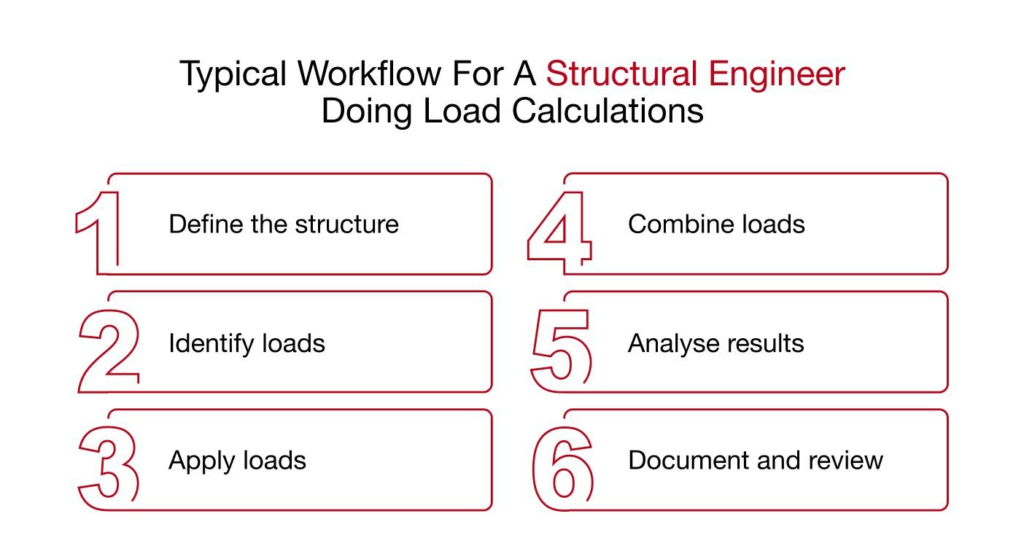

Step 1: Understand the Structural System
First, identify what the structure actually is.
Ask:
- What members carry the loads?
- Where are the supports?
- Which members are connected?
- Is the system stable?
- What is the primary load path?
For a building, this might involve slabs, beams, columns, shear walls, foundations, and connections.
Step 2: Identify Loads
Determine all relevant loads.
Common categories include:
- Dead loads
- Live loads
- Wind loads
- Snow loads
- Seismic loads
- Thermal effects
- Construction loads
- Equipment loads
- Accidental loads
The applicable loads depend strongly on the structure’s location, use, geometry, and governing building standards.
Step 3: Establish Load Paths
The engineer should determine how each important load travels through the structure.
For example:
Roof → beams → columns → foundations → soil
Understanding this path can reveal problems before detailed calculations begin.
Step 4: Define Boundary Conditions
Supports strongly influence structural behavior.
Typical idealized supports include:
- Pinned supports
- Roller supports
- Fixed supports
- Elastic supports
Incorrect support assumptions can produce completely different structural responses.
Step 5: Create the Structural Model
The real structure is converted into an analytical model.
Depending on the problem, members may be represented using:
- Beam elements
- Frame elements
- Truss elements
- Shell elements
- Plate elements
- Solid elements
The model should be sufficiently detailed to represent the behavior that matters without introducing unnecessary complexity.
Step 6: Select an Analysis Method
The appropriate method depends on structural complexity.
Common methods include:
- Free-body diagrams
- Classical beam analysis
- Slope-deflection method
- Moment distribution
- Force method
- Matrix stiffness method
- Finite element analysis
- Modal analysis
- Response spectrum analysis
- Nonlinear analysis
Step 7: Check the Results
Never assume software output is automatically correct.
Review:
- Support reactions
- Member forces
- Deflections
- Deformed shape
- Load distribution
- Stability
- Unexpected concentrations
- Model warnings
Step 8: Interpret Engineering Behavior
Finally, convert numerical results into engineering decisions.
A professional engineer should be able to explain:
Why is this member highly loaded?
Why is this location experiencing large displacement?
Why does the load travel through this particular path?
That interpretation is often more valuable than simply obtaining a numerical result.
Comparison of Structural Analysis Methods ⚖️
| Method | Typical Use | Main Advantage | Main Limitation |
|---|---|---|---|
| Free-body analysis | Simple structural systems | Easy to understand | Limited for complex structures |
| Moment distribution | Continuous beams and frames | Useful classical technique | Manual and time-consuming |
| Matrix methods | Modern structural systems | Systematic and powerful | Requires computational implementation |
| Finite element analysis | Complex structures | Handles complicated geometry | Requires careful modeling |
| Modal analysis | Dynamic structures | Identifies vibration characteristics | Requires appropriate dynamic modeling |
| Nonlinear analysis | Advanced structural behavior | Represents complex response | Computationally demanding |
Hand Calculation vs Software 💻
Hand calculations remain extremely valuable because they help engineers develop structural intuition.
Computer software becomes increasingly useful as the structure becomes more complicated.
The best professional approach is not “hand calculations versus software.”
It is:
Engineering understanding + simplified verification + appropriate software modeling.
Structural Diagrams and Load Paths 📐
Diagrams are among the most effective ways to understand structural behavior.


A basic structural diagram can show:
Applied Load ↓
Slab ↓
Beam ↓
Column / Wall ↓
Foundation ↓
Ground
This simple representation provides an immediate picture of the structural load path.
Important Structural Quantities
| Quantity | Meaning | Why It Matters |
|---|---|---|
| Reaction | Force developed at support | Indicates support demand |
| Axial force | Force along a member | Important for columns and trusses |
| Shear force | Internal transverse force | Important near supports and connections |
| Bending moment | Internal rotational effect | Critical for beams and frames |
| Torsion | Twisting effect | Important in irregular structures |
| Displacement | Movement of a structural point | Indicates serviceability |
| Stress | Internal force intensity | Related to material demand |
| Strain | Material deformation | Indicates structural response |
Examples 🛠️
Example 1: Simply Supported Beam
Consider a beam supporting a floor.
The floor load is transferred to the beam. The beam then transfers its reactions to the supports.
The largest bending effects commonly occur toward the central region, while significant shear effects generally develop near the supports.
An engineer would examine both strength and deflection rather than considering only one response.
Example 2: Multi-Story Building
Imagine a five-story office building.
Floor loads are transferred through slabs to beams, then into columns and structural walls. The vertical forces eventually reach the foundations.
Meanwhile, wind or earthquake forces can produce lateral movement. The lateral-force-resisting system must transfer these forces safely to the ground.
Example 3: Roof Truss
A roof truss uses interconnected members to carry roof loads.
Some members primarily experience tension while others may experience compression. The geometry allows the structure to efficiently transfer forces.
This is why trusses can achieve relatively long spans without requiring a solid structural member across the entire distance.
Real-World Applications 🌍
Structural analysis is used throughout the built environment.
Buildings 🏢
Engineers analyze:
- Residential buildings
- Offices
- Hospitals
- Schools
- Industrial facilities
- High-rise towers
Analysis helps determine member forces, deformation, stability, and lateral response.
Bridges 🌉
Bridge structures experience combinations of:
- Permanent loads
- Vehicle loads
- Wind
- Temperature effects
- Dynamic effects
Structural analysis helps engineers understand how loads move through decks, girders, arches, cables, piers, and foundations.
Industrial Structures ⚙️
Industrial facilities often contain heavy equipment and complicated load arrangements.
Structural analysis can evaluate platforms, pipe racks, machinery supports, frames, and equipment foundations.
Tall Buildings 🏙️
Tall structures require particular attention to lateral behavior.
Wind and seismic actions can cause significant building movement, making stiffness and dynamic behavior important design considerations.
Common Mistakes ❌
Incorrect Support Conditions
A model may look correct but behave incorrectly because a support was modeled improperly.
Solution: Carefully understand the actual connection between the structure and its supports.
Ignoring Load Paths
Applying loads without understanding how they travel can hide structural problems.
Solution: Draw a load-path diagram before detailed analysis.
Over-Reliance on Software
A software-generated result is not automatically an engineering solution.
Solution: Use approximate calculations and engineering judgment to validate important results.
Incorrect Member Properties
Incorrect section dimensions, material properties, or member orientations can significantly affect results.
Solution: Check the model inputs systematically.
Ignoring Deformation
A structure can have sufficient strength but excessive movement.
Solution: Evaluate both strength and serviceability requirements.
Poor Load Combinations
Using inappropriate combinations may produce unrealistic or unconservative results.
Solution: Follow the applicable structural design standard and project requirements.
Challenges and Solutions 🚧
| Challenge | Potential Problem | Practical Solution |
|---|---|---|
| Complex geometry | Difficult modeling | Simplify intelligently |
| Uncertain loads | Incorrect structural demand | Establish realistic load assumptions |
| Soil interaction | Foundation response uncertainty | Coordinate structural and geotechnical models |
| Dynamic effects | Unexpected vibration | Perform appropriate dynamic analysis |
| Nonlinear behavior | Linear model may be inadequate | Use nonlinear methods when justified |
| Software errors | Misleading results | Perform independent checks |
| Large models | Long computational time | Use efficient modeling strategies |
Model Validation
A strong structural model should be tested before relying on its results.
Useful checks include:
- Total reactions versus applied loads
- Expected symmetry
- Approximate deformation behavior
- Member-force trends
- Boundary-condition behavior
- Sensitivity to important assumptions
Case Study: Structural Analysis of a Mid-Rise Office Building 🏢
Consider a hypothetical six-story office building constructed in an urban environment.
The building contains reinforced-concrete floors supported by beams and columns, with dedicated lateral-resisting elements.
Initial Assessment
The engineering team first establishes:
- Building geometry
- Floor layout
- Material properties
- Column arrangement
- Beam arrangement
- Foundation assumptions
- Applicable environmental loads
Gravity Load Analysis
The team traces gravity loads from each floor toward the foundations.
The analysis identifies several heavily loaded interior columns because they support larger tributary areas than perimeter columns.
Instead of automatically increasing every column size, engineers investigate the load distribution and structural efficiency.
Lateral Analysis
Wind and seismic actions are then considered according to the project’s governing requirements.
The lateral system produces horizontal forces and overturning effects.
The analysis focuses on:
- Building drift
- Lateral member forces
- Foundation reactions
- Overall stability
- Relative movement between floors
Model Verification
The engineers compare software results against simplified engineering calculations.
The purpose is not to reproduce every software result manually. Instead, the simplified checks verify whether the overall structural behavior is reasonable.
Engineering Decision
The final structural system is refined to achieve an appropriate balance between:
Safety + stiffness + constructability + material efficiency + cost.
This illustrates an important principle:
Structural analysis is a decision-making process, not merely a calculation process.
Essential Tips for Structural Analysis ⭐
Start With a Simple Model
Before constructing a highly detailed computational model, understand the structure using a simplified representation.
Think in Load Paths
Always ask:
Where does the load come from?
Where does it go?
Which members carry it?
Check Reactions First
Support reactions provide one of the quickest ways to detect major modeling problems.
Examine the Deformed Shape
The deformed shape often reveals errors that are difficult to identify from numerical tables.
Use Multiple Verification Methods
For important structural systems, combine:
- Hand calculations
- Approximate engineering checks
- Software analysis
- Independent review
Understand Boundary Conditions
A sophisticated model with incorrect supports is still an incorrect model.
Separate Strength and Serviceability
Do not focus only on failure prevention. Excessive deflection, vibration, or drift can also make a structure unsuitable.
Document Assumptions
Record:
- Material assumptions
- Load assumptions
- Support conditions
- Member properties
- Modeling simplifications
- Analysis methods
Good documentation improves quality control and future review.
Frequently Asked Questions ❓
What is structural analysis?
Structural analysis is the process of evaluating how a structure responds to applied loads, including reactions, internal forces, deformation, stresses, and stability.
Why is structural analysis important?
It allows engineers to understand structural behavior and provides essential information for developing safe, reliable, and efficient structural designs.
What are the main types of structural analysis?
Common categories include static, dynamic, linear, nonlinear, elastic, plastic, and finite element analysis. The appropriate approach depends on the structural problem.
Is structural analysis the same as structural design?
No. Analysis determines structural response, while design uses that information to select dimensions, materials, reinforcement, connections, and other details that satisfy applicable requirements.
Can structural analysis be performed without software?
Yes. Simple structures can often be analyzed using classical engineering methods. However, complex modern structures generally require computational tools.
Why are load paths important?
Load paths show how forces move through a structure toward the ground. Understanding them helps engineers identify critical structural components and potential weaknesses.
What is finite element analysis?
Finite element analysis is a computational method that divides a complex structural system into smaller elements. Their behavior is combined to approximate the response of the complete structure.
What should engineers check after running structural software?
Engineers should check inputs, support conditions, reactions, deformation patterns, member forces, stability, load combinations, and whether the results make physical and engineering sense.
Conclusion 🏗️✨
Structural analysis is the bridge between engineering theory and real structural behavior. It allows engineers to move beyond simply looking at a building or bridge and understand how forces travel through its components.
The fundamental process begins with understanding the structural system, identifying loads, establishing realistic boundary conditions, defining load paths, selecting an appropriate analytical method, evaluating structural response, and independently checking the results.
Modern software and computational techniques have transformed structural engineering, but the fundamentals remain essential. A sophisticated finite element model cannot compensate for incorrect assumptions, poor load definitions, or misunderstood structural behavior.
For students, learning structural analysis develops the ability to think like an engineer. For practicing professionals, it supports safer and more efficient decisions across buildings, bridges, industrial facilities, infrastructure, and other engineered systems.
🚀 The most important lesson is simple: good structural analysis combines mechanics, modeling, engineering judgment, verification, and clear understanding of load paths.
When these principles work together, structural analysis becomes more than a collection of calculations—it becomes a powerful method for creating structures that are safe, stable, efficient, and fit for purpose.