Code of Practice for Project Management for Construction and Development 5th Edition: A Practical Engineering Guide
Introduction 🏗️📋
Construction and development projects combine engineering, finance, procurement, design, contracts, people, materials, equipment, regulations, and time. Managing all these elements successfully requires much more than simply creating a construction schedule.
A Code of Practice for Project Management for Construction and Development provides a structured way to understand how construction projects should be planned, organized, monitored, controlled, and delivered. It helps project teams establish consistent procedures from the earliest development concept through design, procurement, construction, commissioning, and handover.

For students, engineers, architects, quantity surveyors, contractors, project managers, and developers, understanding project-management principles is essential. A technically excellent building can still become a project failure if it suffers from uncontrolled costs, poor communication, unrealistic schedules, defective work, procurement delays, or unmanaged risks.
This article presents an original educational overview of construction project management principles and explains how a code-of-practice approach can be applied in real engineering environments. 🦺📐
Background Theory 📚
Construction project management developed as projects became larger, more technically complex, and more dependent on multiple organizations.
A small building project may involve only a client, designer, contractor, and several subcontractors. A major infrastructure or commercial development can involve hundreds of organizations and thousands of workers.
From Construction to Integrated Project Management
Traditional construction management often focused heavily on:
- Site operations
- Labour
- Materials
- Equipment
- Construction sequences
Modern project management takes a broader view.
It considers the complete project lifecycle:
Concept → Feasibility → Planning → Design → Procurement → Construction → Commissioning → Handover → Operation
The project manager must coordinate technical and commercial objectives throughout this lifecycle.
The Project Management Triangle 🔺
Three traditional project constraints are:
- Time ⏱️
- Cost 💰
- Quality/Scope 📐
Changing one constraint often affects the others.
For example, accelerating construction may increase labour and procurement costs. Reducing the budget may require design changes. Expanding project scope may increase both schedule duration and cost.
Modern practice also emphasizes:
- Safety
- Sustainability
- Risk
- Stakeholder satisfaction
- Legal compliance
- Environmental performance
- Information management
Definition 🏢
A Code of Practice for Project Management for Construction and Development can be understood as a structured set of professional principles, procedures, responsibilities, and recommended practices used to manage construction and development projects effectively.
It does not simply tell a project manager how to build a structure.
Instead, it establishes a framework for controlling the entire management process.
Main Objectives
A good construction project-management practice aims to ensure that:
- The project objectives are clearly defined.
- Responsibilities are properly allocated.
- Risks are identified early.
- Costs are controlled.
- Design information is coordinated.
- Procurement is properly planned.
- Construction quality is monitored.
- Health and safety are protected.
- Changes are formally controlled.
- Project information is documented.
- Stakeholders receive appropriate communication.
- The completed facility satisfies the client’s requirements.
Who Uses It?
A code-of-practice approach is useful for:
- Project managers
- Civil engineers
- Structural engineers
- Architects
- Contractors
- Developers
- Quantity surveyors
- Cost consultants
- Construction managers
- Procurement teams
- Facility managers
- Government agencies
- Students and researchers
Step-by-Step Project Management Process 🪜
Construction management should be treated as a connected sequence rather than a collection of independent tasks.


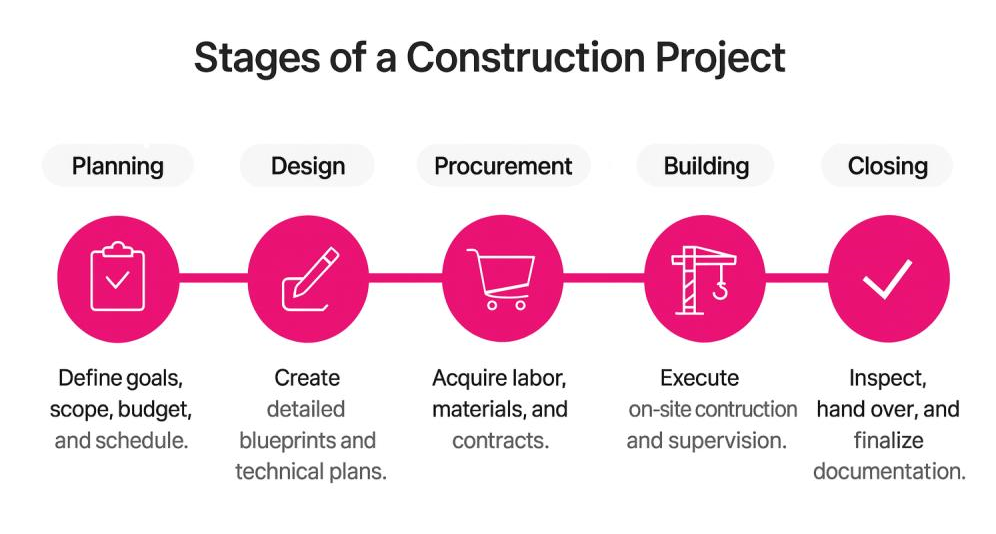


Step 1: Establish the Project Brief 🎯
The first step is understanding what the client actually wants.
The project brief should address:
- Project purpose
- Functional requirements
- Site requirements
- Expected quality
- Budget expectations
- Target completion
- Sustainability objectives
- Regulatory requirements
- Performance requirements
A poorly defined brief can create problems throughout the project.
Step 2: Conduct Feasibility Studies 🔍
Before committing significant resources, the development team should investigate whether the project is practical.
Important areas include:
- Site conditions
- Planning restrictions
- Environmental constraints
- Access
- Utilities
- Market requirements
- Construction complexity
- Funding
- Expected operational requirements
Step 3: Develop the Project Strategy 🧭
The team determines how the project will be delivered.
Key decisions include:
- Procurement route
- Contract strategy
- Design responsibility
- Construction sequencing
- Risk allocation
- Quality strategy
- Cost-control procedures
- Information-management processes
Step 4: Manage Design 📐
Design management ensures that architectural, structural, civil, mechanical, electrical, and other disciplines work together.
Design coordination should identify conflicts before construction begins.
For example, a structural beam should not unintentionally occupy the same space required for a major mechanical duct.
Step 5: Plan Procurement 📦
Procurement determines how resources will be obtained.
The project team should consider:
- Long-lead materials
- Specialist subcontractors
- Equipment
- Supplier capacity
- Delivery requirements
- Commercial terms
- Quality requirements
Poor procurement planning can stop an otherwise well-planned construction site.
Step 6: Control Construction 🏗️
During construction, the project manager coordinates:
- Labour
- Materials
- Equipment
- Subcontractors
- Drawings
- Inspections
- Testing
- Safety
- Progress
- Costs
Daily site information should feed into broader project-control systems.
Step 7: Monitor Progress 📊
Actual performance should be compared with the approved baseline.
The team can monitor:
- Planned vs actual progress
- Budget vs actual expenditure
- Procurement status
- Design progress
- Quality defects
- Safety performance
- Change requests
- Risk exposure
Step 8: Commission and Handover 🔑
The project is not finished simply because construction activities are complete.
The handover process may include:
- Testing
- Commissioning
- Inspections
- Defect correction
- Training
- Operating manuals
- As-built information
- Certificates
- Final documentation
Comparison: Traditional vs Modern Project Management ⚖️
| Aspect | Traditional Approach | Integrated Modern Approach |
|---|---|---|
| Planning | Mainly construction focused | Whole project lifecycle |
| Design | Often separated from construction | Strong design coordination |
| Risk | Reactive | Proactive |
| Communication | Periodic | Continuous |
| Cost control | Focused on expenditure | Forecasting and lifecycle control |
| Quality | Inspection focused | Prevention and assurance |
| Technology | Paper-based | Digital information systems |
| Sustainability | Often secondary | Integrated into project objectives |
| Stakeholders | Limited involvement | Structured engagement |
The modern approach is generally more effective for complex projects because construction problems frequently originate from decisions made before construction begins.
Diagrams and Project-Control Tables 📊🏗️


Project Lifecycle Diagram
A simplified lifecycle can be represented as:
Client Need
↓
Feasibility
↓
Project Brief
↓
Design
↓
Procurement
↓
Construction
↓
Testing & Commissioning
↓
Handover
↓
Operation & Maintenance
Each stage produces information needed by the next stage.
Risk-Control Table
| Risk Area | Typical Problem | Management Response |
|---|---|---|
| Design | Incomplete information | Design reviews |
| Cost | Budget growth | Regular forecasting |
| Programme | Delays | Schedule monitoring |
| Procurement | Late materials | Early procurement |
| Quality | Defective work | Inspection and testing |
| Safety | Unsafe activities | Risk assessments |
| Contract | Disputes | Clear documentation |
| Environment | Unexpected impacts | Environmental planning |
Practical Examples 🔧
Example 1: Commercial Building
A developer plans a new office building.
The project team establishes the business requirements, evaluates the site, develops the design, obtains approvals, selects a procurement strategy, and prepares construction information.
During construction, the project manager discovers that a critical façade component has a long manufacturing lead time.
Instead of waiting until the installation stage, procurement records identify the problem early and the team can investigate alternative suppliers or adjust the programme.
Lesson: Procurement planning must begin before materials are urgently needed.
Example 2: Infrastructure Project
A road project involves excavation, drainage, utilities, pavement construction, and traffic management.
Unexpected underground utilities create a potential delay.
A well-managed project already has a risk-management process. The issue is recorded, investigated, communicated, and assigned to responsible team members.
Lesson: Risk management is an active process rather than a document created only at project commencement.
Example 3: Building Quality Problem
A contractor discovers repeated defects in concrete finishes.
Instead of repairing every defect individually, the management team investigates the underlying cause.
The problem may originate from:
- Incorrect formwork preparation
- Poor workmanship
- Incorrect concrete handling
- Insufficient inspection
- Inadequate instructions
Correcting the process can prevent future defects.
Lesson: Quality management should focus on prevention as well as correction.
Real-World Applications 🌍
A code-of-practice approach can be applied to almost every major construction environment.
Commercial Buildings
Office buildings require coordination between architecture, structure, building services, fire protection, IT systems, interiors, and external works.
Residential Developments 🏘️
Large housing developments require careful control of repeated construction activities, infrastructure, planning requirements, utilities, landscaping, and handover.
Transportation Infrastructure 🚆
Railways, airports, bridges, tunnels, and highways often involve complex interfaces between engineering disciplines and public authorities.
Energy Projects ⚡
Power stations, renewable-energy facilities, and industrial plants require strong safety, commissioning, procurement, and technical coordination.
Public-Sector Projects
Government projects typically involve strict procurement, reporting, accountability, regulatory compliance, and stakeholder requirements.
Common Mistakes ❌
Starting Construction Before Design Is Ready
Beginning physical work with incomplete information can create rework and disputes.
Ignoring Early Risks
Small uncertainties can become expensive problems when they are not addressed early.
Poor Change Control
Informal instructions can cause disagreement about scope, cost, responsibility, and completion dates.
Weak Communication
A technically competent team can still fail if information does not reach the correct people at the correct time.
Focusing Only on Cost
The cheapest initial option is not necessarily the best overall solution.
Treating Quality as Final Inspection
Finding defects after installation is often more expensive than preventing them.
Ignoring Handover
Incomplete documentation can create operational difficulties after practical completion.
Challenges and Solutions 🧩
| Challenge | Recommended Solution |
|---|---|
| Design changes | Formal change-control process |
| Cost uncertainty | Regular cost forecasting |
| Programme delays | Frequent schedule reviews |
| Supply-chain disruption | Early procurement and alternatives |
| Poor coordination | Multidisciplinary design reviews |
| Quality failures | Inspection and quality assurance |
| Safety risks | Task-specific risk management |
| Stakeholder conflict | Clear communication structure |
| Information overload | Controlled document management |
| Sustainability demands | Integrate environmental goals early |
Digital Transformation 💻
Modern construction projects increasingly use:
- Building Information Modelling
- Cloud-based document systems
- Digital inspection platforms
- Mobile site reporting
- Drones
- Geographic information systems
- Digital schedules
- Data dashboards
- Automated progress monitoring
Technology is valuable when it improves decision-making rather than simply increasing the number of digital tools.
Case Study: Managing a Hypothetical Mixed-Use Development 🏙️
Consider a hypothetical mixed-use development containing residential apartments, commercial spaces, parking, landscaping, and building services.
Initial Problem
The developer has a fixed investment target and wants the project completed within a specific commercial window.
The early design appears attractive, but several risks exist:
- Incomplete site information
- Complex building-services coordination
- Long-lead equipment
- Multiple specialist contractors
- Changing tenant requirements
Management Strategy
The project team establishes a structured management framework.
First, the project brief is finalized.
Next, the design team coordinates architectural and engineering information.
A procurement schedule identifies equipment that requires early ordering.
A risk register tracks the major uncertainties.
The programme is divided into measurable activities.
Construction inspections are linked to quality requirements.
Change requests are reviewed before implementation.
Result
The project team can identify emerging problems earlier and make informed decisions before they become major disruptions.
The important lesson is not that every project will avoid problems.
Good project management means creating a system that identifies, communicates, evaluates, and controls problems before they cause unacceptable consequences. 🧠🏗️
Essential Tips for Engineers and Project Managers ⭐
1. Understand the Project Before Managing It
Read the brief, drawings, specifications, contracts, approvals, and programme.
2. Build a Strong Communication Structure
Everyone should know:
- Who makes decisions
- Who provides information
- Who approves changes
- Who reports problems
3. Manage Information Carefully
Use controlled document versions. A project team working from outdated drawings can create serious construction problems.
4. Think About Risk Early
Ask:
“What could prevent this project from achieving its objectives?”
Then determine how each significant risk will be managed.
5. Monitor Trends, Not Only Current Status
A project can appear acceptable today while moving toward a serious future problem.
6. Connect Cost and Schedule
A delay often has financial consequences, while financial restrictions can affect programme performance.
7. Make Quality Everyone’s Responsibility
Quality should be built into processes rather than left entirely to final inspection.
8. Document Important Decisions
Good documentation provides traceability and helps prevent misunderstandings.
9. Consider the Entire Lifecycle ♻️
A building should not be evaluated only by its construction cost. Design decisions can affect energy consumption, maintenance, durability, adaptability, and eventual replacement.
10. Keep Learning
Construction management continuously evolves through new technology, regulations, procurement models, sustainability requirements, and project-delivery methods.
Frequently Asked Questions ❓
What is a code of practice in construction project management?
It is a structured collection of professional principles and recommended procedures that helps project teams manage construction and development activities consistently and effectively.
Why is project planning important?
Planning establishes objectives, responsibilities, resources, schedules, procurement requirements, risks, and control procedures before major construction activities begin.
Is project management only important during construction?
No. Effective project management begins during the development and feasibility stages and continues through design, procurement, construction, commissioning, and handover.
What are the most important project constraints?
Time, cost, scope, quality, safety, risk, resources, and stakeholder requirements are among the most important constraints.
How does risk management improve construction projects?
It helps teams identify uncertainties early, evaluate their potential consequences, assign responsibilities, and implement appropriate responses.
Why is design management important?
Construction problems frequently originate from incomplete, conflicting, or poorly coordinated design information. Design management reduces these risks before they reach the site.
What role does technology play in project management?
Digital tools can improve information sharing, scheduling, document control, design coordination, inspections, reporting, and decision-making.
What makes a construction project successful?
Success requires more than completing construction. A successful project should satisfy its agreed objectives for scope, quality, cost, time, safety, functionality, compliance, and long-term performance.
Conclusion 🏁🏗️
The Code of Practice for Project Management for Construction and Development represents an important way of thinking about construction projects as integrated systems rather than isolated building activities.
Effective project management begins long before workers arrive on site. A strong project starts with a clear brief, realistic feasibility assessment, coordinated design, appropriate procurement strategy, proactive risk management, effective communication, controlled information, and reliable project monitoring.
During construction, the focus expands to safety, quality, productivity, procurement, programme performance, cost control, change management, and stakeholder coordination.
For engineering students, learning these principles provides a foundation for understanding how technical decisions interact with commercial and managerial requirements. For experienced professionals, the same principles provide a framework for improving project predictability and reducing avoidable failures.
Ultimately, successful construction project management is about making the right decisions at the right time, with the right information, and ensuring that those decisions are translated into controlled action. 📐🤝🏗️
When engineering knowledge, disciplined management, digital information, risk awareness, and effective teamwork work together, construction projects become significantly more predictable, transparent, and capable of delivering long-term value.