Elements of Civil Engineering and Engineering Mechanics 3rd Edition: A Complete Guide for Students and Professionals
Introduction
Civil engineering is one of the oldest and most important engineering disciplines in the world. From bridges and highways to skyscrapers, dams, airports, tunnels, and water-treatment systems, civil engineers design and maintain the infrastructure that supports modern society. 🏗️🌍
Two fundamental areas form the foundation of civil engineering education: the elements of civil engineering and engineering mechanics. Understanding both helps students develop the ability to analyze structures, select materials, understand forces, and make safe engineering decisions.
Engineering mechanics provides the scientific framework for understanding how objects behave when subjected to forces. Civil engineering applies these principles to real structures and infrastructure.


Whether you are studying civil engineering at university in the USA, UK, Canada, Australia, or Europe—or already working as an engineer—these concepts provide essential knowledge for structural design, construction, transportation, geotechnical engineering, water resources, and infrastructure management.
The subject can initially appear complex because it combines physics, materials, geometry, design, and practical construction. However, once the fundamental concepts are organized logically, engineering mechanics becomes much easier to understand. 🔧📐


Background Theory
Civil engineering developed from humanity’s need to construct safe buildings, transportation systems, water networks, and defensive structures. Ancient civilizations developed impressive engineering solutions long before modern computers and advanced construction equipment existed.
Modern civil engineering combines several scientific and technical disciplines, including:
- Physics ⚙️
- Mathematics 📐
- Geology 🌍
- Materials science
- Environmental science
- Computer modeling 💻
- Surveying
- Structural analysis
- Construction management
Engineering mechanics sits near the center of this knowledge system.
The role of mechanics in civil engineering
A civil engineer must understand what happens when a structure experiences loads.
For example, a bridge may experience:
- Its own weight
- Vehicles
- Pedestrians
- Wind
- Temperature changes
- Earthquakes
- Vibrations
- Construction loads
These forces can produce different effects inside structural components. A beam may bend, a column may compress, a cable may experience tension, and a foundation may transfer loads into the ground.
Main branches of engineering mechanics
Engineering mechanics is commonly divided into two major areas:
Statics ⚖️ — studies bodies that are in equilibrium or effectively stationary.
Dynamics 🚀 — studies bodies experiencing motion and includes concepts associated with movement and changing forces.
Statics is particularly important in introductory civil engineering because buildings, bridges, retaining walls, and many other structures are designed around equilibrium conditions.
Definition
Elements of civil engineering refers to the fundamental concepts, disciplines, materials, systems, and practices involved in planning, designing, constructing, operating, and maintaining civil infrastructure.
Engineering mechanics is the branch of engineering science concerned with the behavior of physical bodies under the influence of forces, loads, and motion.
Together, these subjects help engineers answer fundamental questions:
🏗️ Will the structure remain stable?
⚖️ How will loads travel through the structure?
🧱 Which materials are appropriate?
🌍 Can the foundation safely support the building?
🌬️ How will wind affect a tall structure?
🚗 How can transportation infrastructure safely carry expected traffic?
Major elements of civil engineering
Civil engineering includes several specialized areas.
| Civil Engineering Element | Main Purpose |
|---|---|
| Structural Engineering | Buildings, bridges, towers, and structural systems |
| Geotechnical Engineering | Soil, foundations, slopes, and underground structures |
| Transportation Engineering | Roads, railways, airports, and traffic systems |
| Water Resources Engineering | Dams, drainage, rivers, and water systems |
| Environmental Engineering | Pollution control, waste, and sustainable infrastructure |
| Construction Engineering | Construction methods, equipment, scheduling, and management |
| Surveying | Measuring and mapping land and infrastructure |
| Materials Engineering | Concrete, steel, asphalt, timber, and construction materials |
Fundamental Concepts of Engineering Mechanics
Force
A force represents an interaction capable of changing the motion or condition of an object.
In civil engineering, forces can originate from many sources, including gravity, vehicles, wind, water, soil pressure, machinery, and seismic activity.
Load
A load is an external action applied to a structure.
Common structural loads include:
- Dead loads 🧱
- Live loads 🚶
- Wind loads 🌬️
- Snow loads ❄️
- Seismic loads 🌎
- Water loads 💧
- Construction loads
Equilibrium
A structure is considered stable when the forces and rotational effects acting on it are appropriately balanced.
This concept is fundamental to structural engineering. Engineers use equilibrium principles to determine whether beams, columns, frames, trusses, and other systems can safely support their expected loads.
Moment
A force can create a tendency for an object to rotate. This rotational effect is known as a moment.
Understanding moments is essential when analyzing:
- Beams
- Levers
- Structural frames
- Foundations
- Crane systems
- Bridge components
Friction
Friction resists relative movement between surfaces.
Civil engineers consider friction in areas such as:
- Soil stability
- Foundation behavior
- Retaining walls
- Pavements
- Construction equipment
- Connections between materials
Step-by-Step Explanation: From Load to Foundation
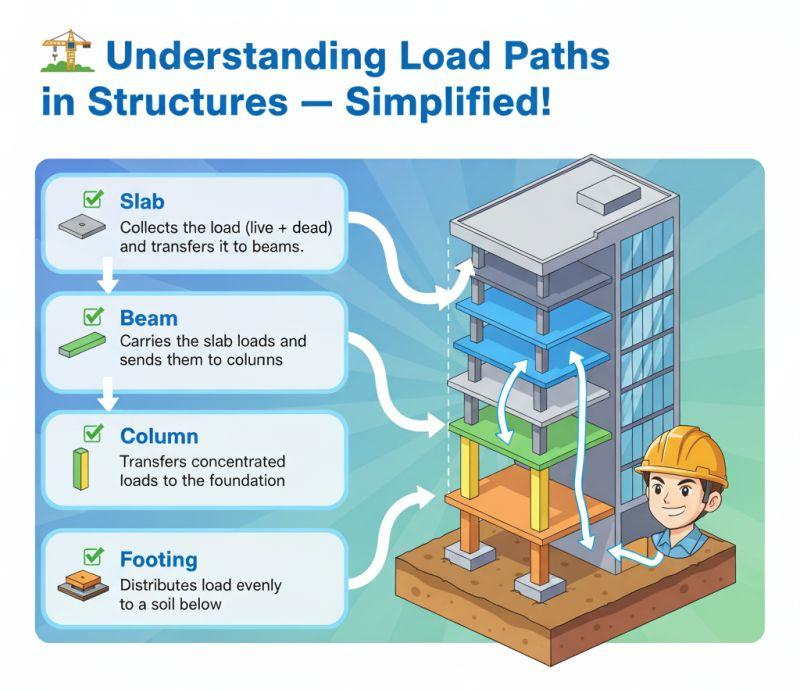
Understanding the path of a load through a structure is one of the most useful ways to connect engineering mechanics with civil engineering.




Step 1: Identify the structure
First, engineers identify what is being designed.
It could be:
- A residential building
- A commercial tower
- A bridge
- A retaining wall
- An industrial facility
- A water tank
Each structure has different requirements.
Step 2: Identify expected loads
Engineers determine the loads the structure may experience throughout its service life.
For a building, these could include furniture, occupants, equipment, wind, and the structure’s own weight.
Step 3: Determine the load path
The load must travel through the structural system.
A simplified building load path can be visualized as:
Roof → Beams → Columns/Walls → Foundation → Soil 🌍
The load path must remain continuous and reliable.
Step 4: Analyze structural components
Engineers examine how individual components respond.
A beam may primarily experience bending, while a column may primarily carry compression. Other structural components can experience combinations of tension, compression, bending, torsion, and shear.
Step 5: Select suitable materials
Material selection depends on strength, durability, availability, cost, environmental exposure, construction methods, and expected service life.
Common materials include:
- Reinforced concrete
- Structural steel
- Timber
- Masonry
- Asphalt
- Composite materials
Step 6: Design and verify
Engineers use design standards, engineering software, calculations, simulations, and professional judgment to verify the proposed system.
Step 7: Construct and inspect
A theoretically excellent design can fail if it is poorly constructed.
Therefore, construction quality control, inspections, testing, documentation, and site supervision are essential.
Comparison: Statics, Dynamics, and Civil Engineering
| Feature | Statics | Dynamics | Civil Engineering Application |
|---|---|---|---|
| Main focus | Equilibrium | Motion and changing forces | Infrastructure design |
| Typical condition | Stationary structure | Moving system | Buildings, bridges, roads |
| Important factors | Loads and reactions | Motion and acceleration | Safety and performance |
| Example | Building frame | Moving crane component | Structural and construction design |
| Primary objective | Stability | Predict behavior | Safe, durable infrastructure |
Structural materials comparison
| Material | Major Strength | Typical Applications |
|---|---|---|
| Concrete | Compression performance and durability | Buildings, foundations, dams |
| Steel | High strength and flexibility | Bridges, towers, frames |
| Timber | Lightweight and renewable when responsibly sourced | Buildings and structural frames |
| Masonry | Durability and fire resistance | Walls and buildings |
| Asphalt | Suitable for flexible pavements | Roads and highways |
Diagrams and Engineering Visualization
Visual models are extremely useful when learning mechanics because they transform abstract concepts into physical systems.


Free-body diagrams
A free-body diagram isolates an object or structural component and represents the important external forces acting on it.
For beginners, this is one of the most valuable engineering skills to develop.
A simplified beam model might show:
Load ↓ → Beam → Support ↑
This simple visualization helps engineers understand how external actions interact with supports.
Load distribution
Structures rarely depend on a single component.
For example:
Floor → Secondary beams → Main beams → Columns → Foundation → Ground
This interconnected system demonstrates why engineers must consider the complete structure rather than examining components independently.
Practical Examples
Example 1: A residential building
Consider a two-story house.
The roof and floors carry their own weight and the weight of occupants and furniture. These loads are transferred to beams and walls or columns. The loads then reach the foundations and are distributed into the soil.
The engineer must consider both the structural system and the characteristics of the ground.
Example 2: A highway bridge
A highway bridge must support its own structural weight, vehicles, pedestrians, wind, environmental effects, and other anticipated actions.
The deck transfers loads to structural members, which transfer them toward piers and foundations.
Engineers must also consider durability because bridges can experience moisture, temperature variations, corrosion, and repeated traffic loading.
Example 3: A retaining wall
A retaining wall holds soil at different elevations.
The soil creates pressure against the wall. Engineers must consider wall stability, foundation conditions, drainage, material strength, and potential sliding or overturning.
Real-World Applications
Engineering mechanics is used throughout the entire civil engineering industry. 🏗️
Buildings and skyscrapers
Structural engineers use mechanics to understand how vertical and lateral loads travel through high-rise buildings.
Wind becomes particularly important as building height increases.
Bridges
Bridge engineers study load distribution, structural behavior, vibration, fatigue, environmental exposure, and foundation conditions.
Dams
Dam engineering requires consideration of water pressure, foundation conditions, seepage, material behavior, and long-term stability.
Roads and highways
Transportation engineers apply engineering principles to pavement systems, traffic infrastructure, drainage, bridges, and earthworks.
Tunnels
Tunnel projects require interaction between structural mechanics and geotechnical engineering. Engineers must understand the behavior of surrounding rock or soil and the support system.
Renewable-energy infrastructure
Modern civil engineering also contributes to wind farms, solar facilities, hydroelectric projects, and other energy infrastructure.
Common Mistakes
Ignoring the load path
One of the most common beginner mistakes is looking at individual components without understanding how forces travel through the entire structure.
Solution: Always ask, “Where does this load go next?”
Using incorrect support assumptions
A structural model can produce misleading results if supports are represented incorrectly.
Solution: Understand the physical behavior of pinned, roller, fixed, and other support conditions.
Forgetting environmental conditions
Structures do not exist in laboratories. They operate in real environments.
Solution: Consider wind, temperature, moisture, corrosion, earthquakes, flooding, and other relevant conditions.
Choosing materials based only on strength
The strongest material is not automatically the best material.
Solution: Consider durability, constructability, cost, environmental impact, maintenance, and availability.
Depending completely on software
Engineering software is powerful, but it cannot replace engineering judgment.
Solution: Understand the physical principles before trusting computational results. 💻⚠️
Challenges and Solutions
| Challenge | Engineering Solution |
|---|---|
| Complex loading | Develop realistic load models |
| Uncertain soil conditions | Conduct geotechnical investigation |
| Material degradation | Use durability design and inspection |
| Extreme weather | Apply appropriate environmental design criteria |
| Construction errors | Quality control and site inspection |
| Aging infrastructure | Condition monitoring and maintenance |
| Climate-related risks | Resilient and adaptive design |
| Complex structures | Combine analytical and computational methods |
Sustainability challenge
Modern engineers face an additional responsibility: infrastructure must increasingly balance safety, economic performance, environmental impact, and long-term resilience. 🌱
Solutions may include:
- Efficient structural systems
- Recycled materials
- Low-carbon concrete technologies
- Responsible steel production
- Sustainable transportation
- Water conservation
- Energy-efficient buildings
- Infrastructure reuse
Case Study: Engineering Mechanics Behind a Bridge
Imagine a highway bridge connecting two communities.
The bridge must support regular traffic while remaining stable under environmental conditions.
Initial investigation
Engineers begin by studying the site, ground conditions, traffic requirements, environmental conditions, and project constraints.
Structural concept
The engineering team selects an appropriate structural arrangement. The choice may involve concrete, steel, or a combination of materials.
Load assessment
The team identifies permanent structural weight and expected traffic and environmental loads.
Load transfer
Engineers establish how the deck transfers forces into beams, piers, and foundations.
Foundation design
The foundation must transfer structural forces safely into the ground.
Geotechnical engineers investigate soil or rock conditions to determine an appropriate foundation strategy.
Construction
During construction, engineers monitor material quality, dimensions, reinforcement placement, connections, concrete quality, and other critical details.
Inspection and maintenance
After completion, the bridge requires periodic inspection.
Engineers look for:
- Cracks
- Corrosion
- Deformation
- Drainage problems
- Joint deterioration
- Surface damage
- Foundation problems
This demonstrates an important principle:
Civil engineering does not end when construction finishes.
The structure must remain safe and functional throughout its intended service life. 🔍🏗️
Essential Tips for Learning Engineering Mechanics
Build strong fundamentals
Do not rush directly into advanced structural software.
First understand:
- Forces
- Loads
- Supports
- Equilibrium
- Moments
- Friction
- Stress and deformation
- Structural load paths
Draw before calculating
A good engineering sketch can reveal problems before detailed analysis begins.
✏️ Sketch → Identify forces → Understand behavior → Analyze → Verify
Connect theory to physical structures
🌍 When studying a beam, look at a real building.
When studying compression, observe a column.
When studying soil pressure, examine a retaining wall.
This makes theoretical concepts easier to remember.
Learn engineering software gradually
Tools such as structural analysis, BIM, CAD, and finite-element software are valuable professional skills.
However, software should support engineering understanding—not replace it.
Study engineering standards
Professional civil engineering requires familiarity with relevant design standards and regulations.
Requirements differ between countries, so engineers working in the USA, UK, Canada, Australia, and Europe should understand the standards applicable to their projects and jurisdictions.
FAQs
What are the main elements of civil engineering?
The major areas include structural, geotechnical, transportation, environmental, water resources, construction, surveying, and materials engineering.
Why is engineering mechanics important in civil engineering?
Engineering mechanics helps engineers understand forces, equilibrium, motion, structural behavior, and load transfer. These principles are essential for designing safe infrastructure.
Is engineering mechanics difficult for beginners?
It can initially be challenging because it combines physics, visualization, and analytical thinking. However, learning concepts progressively and practicing physical examples can make it much easier.
What is the difference between statics and dynamics?
Statics focuses primarily on bodies in equilibrium, while dynamics examines systems involving motion and changing mechanical conditions.
Which materials are most important in civil engineering?
Concrete, steel, timber, masonry, asphalt, and composite materials are among the most widely used. The appropriate material depends on the project requirements.
Is engineering software necessary for civil engineers?
Modern engineering practice relies heavily on software, but engineers still need a strong understanding of fundamental mechanics to interpret and verify computational results.
How does mechanics apply to buildings?
Mechanics helps engineers understand how building loads travel through floors, beams, columns, walls, foundations, and eventually into the ground.
What should civil engineering students study first?
Students should begin with fundamental mechanics, materials, surveying, structural concepts, soil mechanics, construction methods, and engineering drawing before progressing toward specialized design.
Conclusion
The elements of civil engineering and engineering mechanics form a fundamental knowledge base for anyone entering the civil engineering profession. 🏗️📐
Civil engineering transforms scientific principles into practical infrastructure, while engineering mechanics provides the tools for understanding how forces and loads affect physical systems.
From a small residential building to a massive suspension bridge, the same fundamental ideas remain important: identify the loads, understand the load path, evaluate structural behavior, select appropriate materials, verify safety, and consider the environment and service life.
For students, mastering these principles creates a strong foundation for advanced subjects such as structural analysis, reinforced concrete design, steel design, geotechnical engineering, earthquake engineering, and computational mechanics.
For professionals, these fundamentals remain relevant even when sophisticated software and digital engineering platforms are used.
The future of civil engineering will require more than simply constructing larger structures. Engineers will need to create infrastructure that is safer, smarter, more sustainable, more resilient, and better adapted to changing environmental conditions. 🌍♻️
Ultimately, engineering mechanics teaches us how structures respond to the physical world—and civil engineering turns that understanding into infrastructure that communities can depend on.