Mathematics and Programming for Machine Learning with R: From the Ground Up – A Complete Beginner-to-Advanced Engineering Guide
Introduction 🚀
Machine Learning has become one of the most influential technologies in modern engineering, data science, healthcare, finance, robotics, and artificial intelligence. Behind every intelligent prediction model lies a powerful combination of mathematics and programming.
Among the many programming languages available today, R continues to be one of the most respected environments for statistical computing, predictive analytics, visualization, and research. Universities, research institutions, healthcare organizations, and financial companies across the United States, Canada, the United Kingdom, Australia, and Europe widely use R because of its rich ecosystem for statistical modeling and machine learning.
📚 Mathematics and Programming for Machine Learning with R: From the Ground Up focuses on building a solid understanding of both mathematical foundations and practical programming skills. Rather than treating machine learning as a “black box,” this approach explains why algorithms work, how mathematical equations influence learning, and how R implements these concepts efficiently.
Whether you are:
- 🎓 Engineering student
- 💻 Software developer
- 📊 Data analyst
- 🤖 AI enthusiast
- 🔬 Research scientist
this guide provides a structured path from basic mathematics to practical machine learning implementation.


Background Theory 📖
Machine learning combines several engineering disciplines into one powerful framework.
These include:
- ➕ Linear Algebra
- 📈 Calculus
- 🎲 Probability
- 📊 Statistics
- 💻 Programming
- 🤖 Artificial Intelligence
Every machine learning algorithm learns by discovering mathematical relationships inside data.
For example:
- Linear Regression learns a line.
- Decision Trees learn logical rules.
- Neural Networks learn millions of mathematical weights.
- Support Vector Machines optimize geometric boundaries.
- Clustering algorithms discover hidden structures.
Without mathematics, these algorithms become impossible to understand or improve.
Programming with R provides the tools needed to implement these mathematical models efficiently.
Definition 📘
Mathematics and Programming for Machine Learning with R is the study of applying mathematical principles and R programming techniques to build, train, evaluate, and optimize machine learning models.
It combines:
- Mathematical reasoning
- Statistical analysis
- Algorithm development
- Data visualization
- Computational programming
- Predictive modeling
The goal is transforming raw data into meaningful predictions.
Core Mathematical Foundations 🧮
Linear Algebra
Linear algebra forms the backbone of nearly every machine learning algorithm.
Important topics include:
- Vectors
- Matrices
- Matrix multiplication
- Dot products
- Eigenvalues
- Eigenvectors
- Matrix decomposition
Applications include:
- Principal Component Analysis (PCA)
- Neural Networks
- Computer Vision
- Recommendation Systems
Calculus
Calculus helps optimize machine learning models.
Key concepts include:
- Derivatives
- Partial derivatives
- Chain rule
- Gradient
- Gradient Descent
Optimization algorithms repeatedly calculate gradients to reduce prediction errors.
Probability
Probability allows algorithms to estimate uncertainty.
Important concepts include:
- Random variables
- Conditional probability
- Bayes’ theorem
- Probability distributions
- Independence
These ideas are heavily used in:
- Bayesian Learning
- Hidden Markov Models
- Naive Bayes
- Reinforcement Learning
Statistics
Statistics helps interpret data.
Topics include:
- Mean
- Median
- Standard deviation
- Variance
- Correlation
- Confidence intervals
- Hypothesis testing
Without statistics, data analysis becomes unreliable.
Programming Foundations in R 💻
Learning R begins with understanding its core building blocks.
Variables
Variables store values.
Example:
x <- 25
Vectors
Vectors hold multiple values.
scores <- c(82,91,77,95)
Data Frames
Data frames resemble spreadsheets.
students <- data.frame(
Name=c("Anna","John"),
Score=c(90,88)
)
Functions
Functions automate repetitive work.
square <- function(x){
x*x
}
Packages
Popular machine learning packages include:
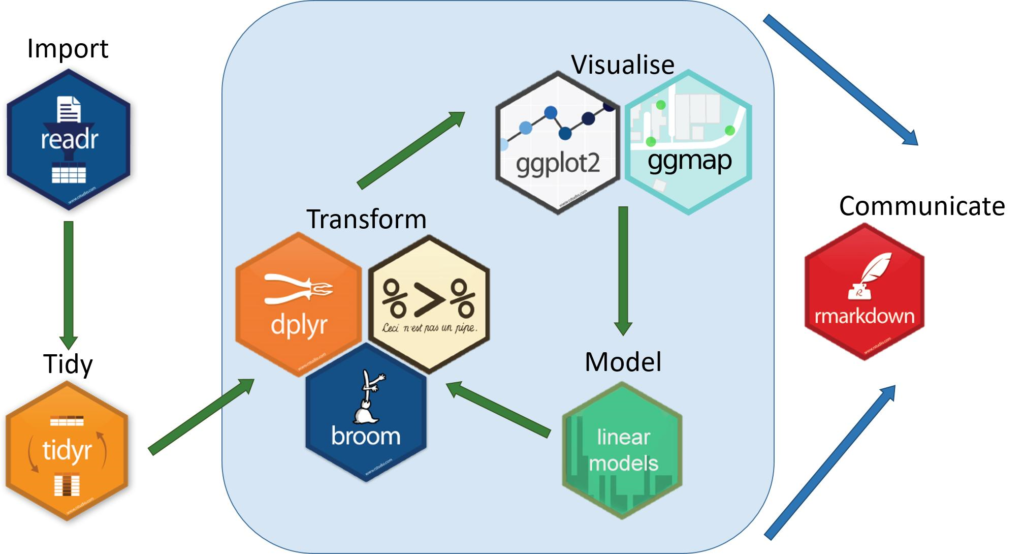
- caret
- tidymodels
- randomForest
- e1071
- xgboost
- ggplot2
- dplyr
- tidyr
Step-by-Step Learning Path 🔧


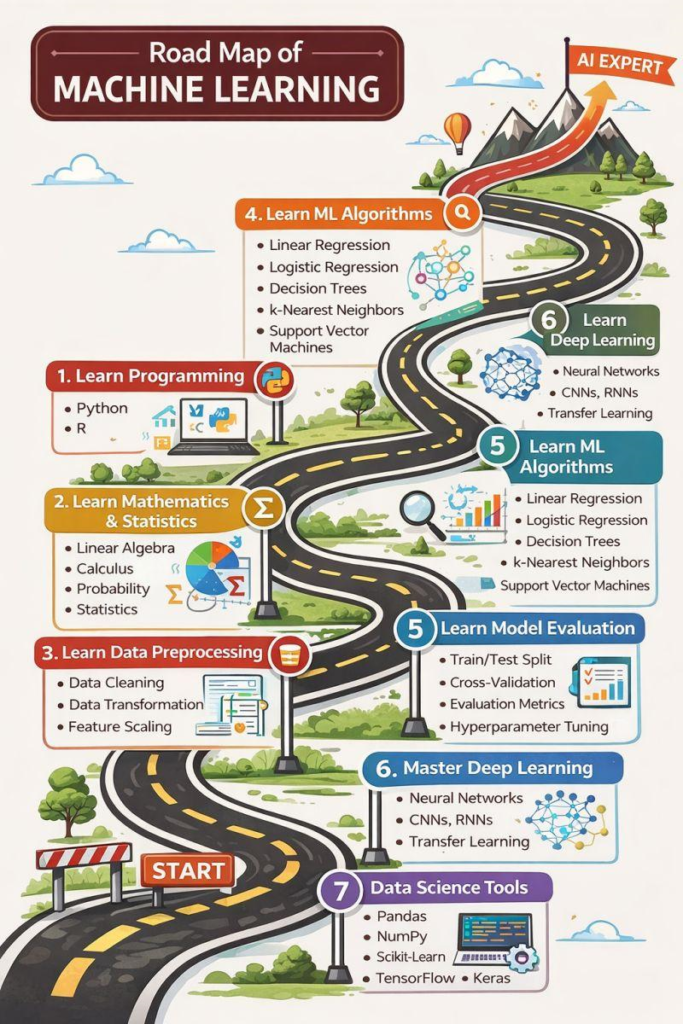
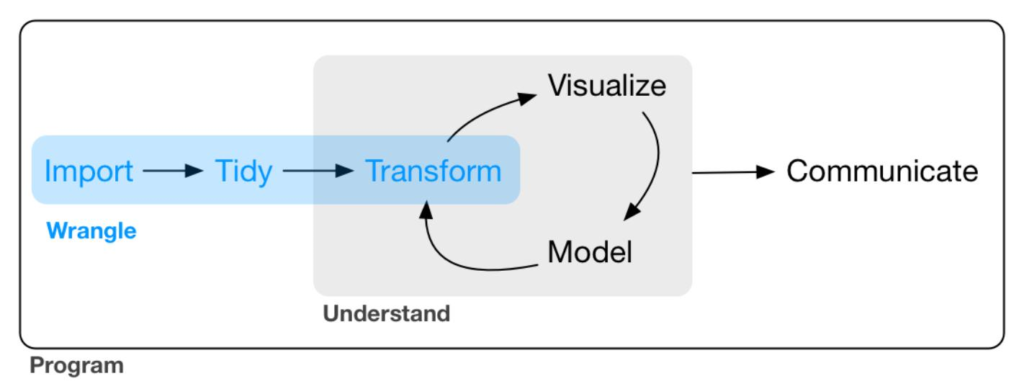
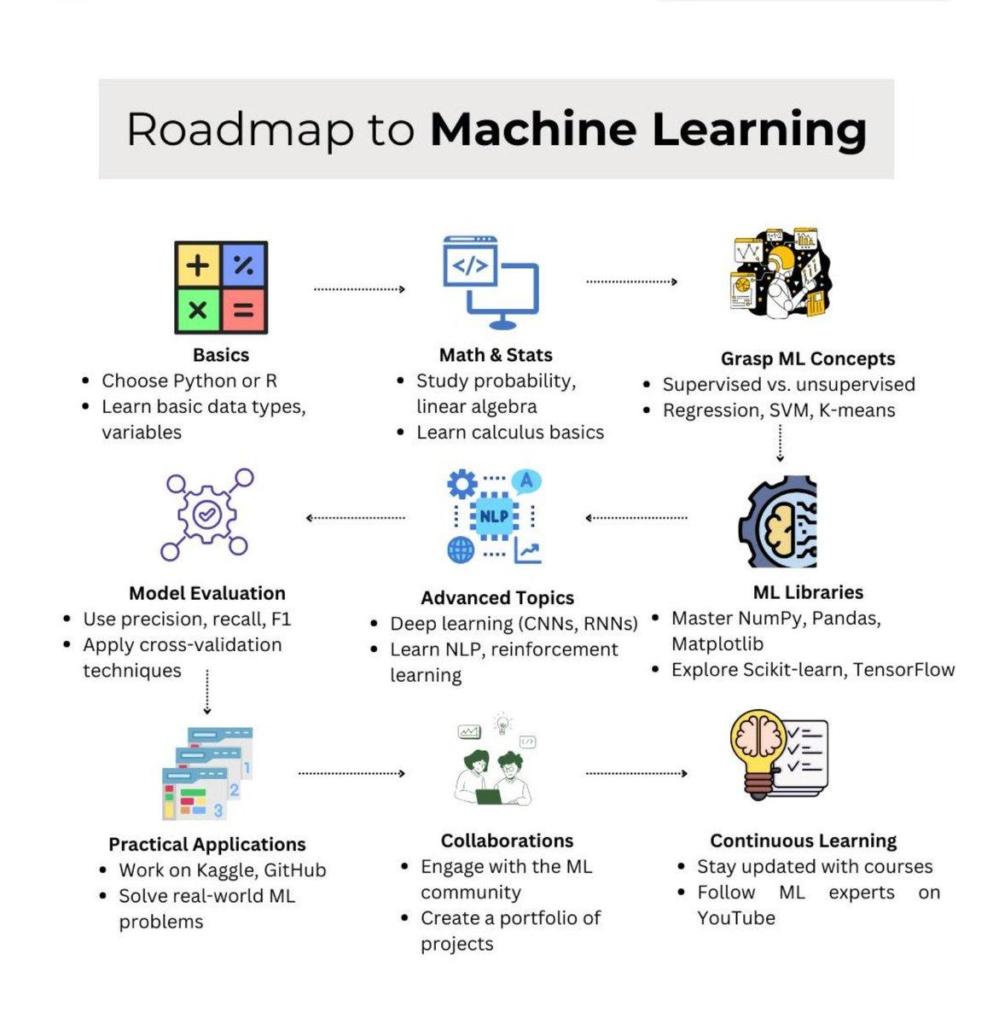
Step 1 — Learn Basic Mathematics
Master:
- Algebra
- Functions
- Equations
- Graphs
Step 2 — Study Statistics
Learn:
- Mean
- Variance
- Probability
- Sampling
Step 3 — Install R and RStudio
Install:
- R
- RStudio IDE
These provide a complete development environment.
Step 4 — Learn Basic Programming
Practice:
- Variables
- Loops
- Functions
- Conditions
Step 5 — Explore Data
Clean and inspect datasets.
Tasks include:
- Missing values
- Outliers
- Visualization
Step 6 — Build Models
Examples include:
- Linear Regression
- Logistic Regression
- Decision Trees
- Random Forest
- K-Means
Step 7 — Evaluate Performance
Use metrics like:
- Accuracy
- Precision
- Recall
- RMSE
- MAE
- ROC Curve
Step 8 — Improve Models
Improve through:
- Hyperparameter tuning
- Cross-validation
- Feature engineering
- Ensemble learning
Comparing R with Other Machine Learning Languages ⚖️
| Feature | R | Python | MATLAB |
|---|---|---|---|
| Statistics | ⭐⭐⭐⭐⭐ | ⭐⭐⭐⭐ | ⭐⭐⭐⭐ |
| Visualization | Excellent | Excellent | Very Good |
| Deep Learning | Good | Excellent | Good |
| Academic Research | Excellent | Excellent | Excellent |
| Ease for Beginners | High | High | Medium |
| Business Analytics | Excellent | Very Good | Good |
| Community Support | Large | Very Large | Moderate |
| Open Source | Yes | Yes | No |
Mathematics Required for Popular Algorithms
| Algorithm | Linear Algebra | Calculus | Probability | Statistics |
|---|---|---|---|---|
| Linear Regression | ✅ | ✅ | ✅ | ✅ |
| Logistic Regression | ✅ | ✅ | ✅ | ✅ |
| Decision Trees | ❌ | ❌ | ✅ | ✅ |
| Random Forest | ❌ | ❌ | ✅ | ✅ |
| Support Vector Machine | ✅ | ✅ | ❌ | ✅ |
| Neural Networks | ✅ | ✅ | ✅ | ✅ |
| PCA | ✅ | ❌ | ❌ | ✅ |
| K-Means | ✅ | ✅ | ❌ | ✅ |
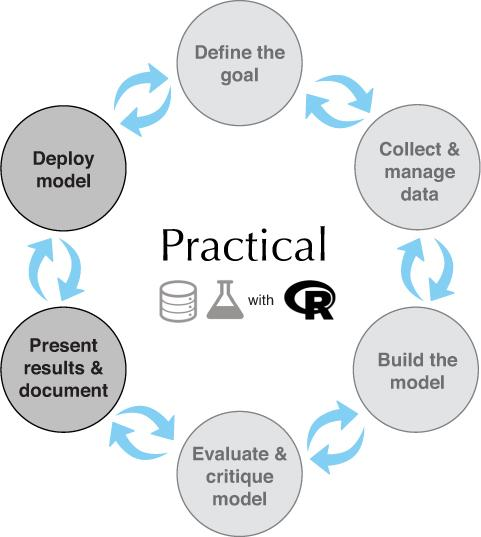
Machine Learning Workflow Diagram 🧩


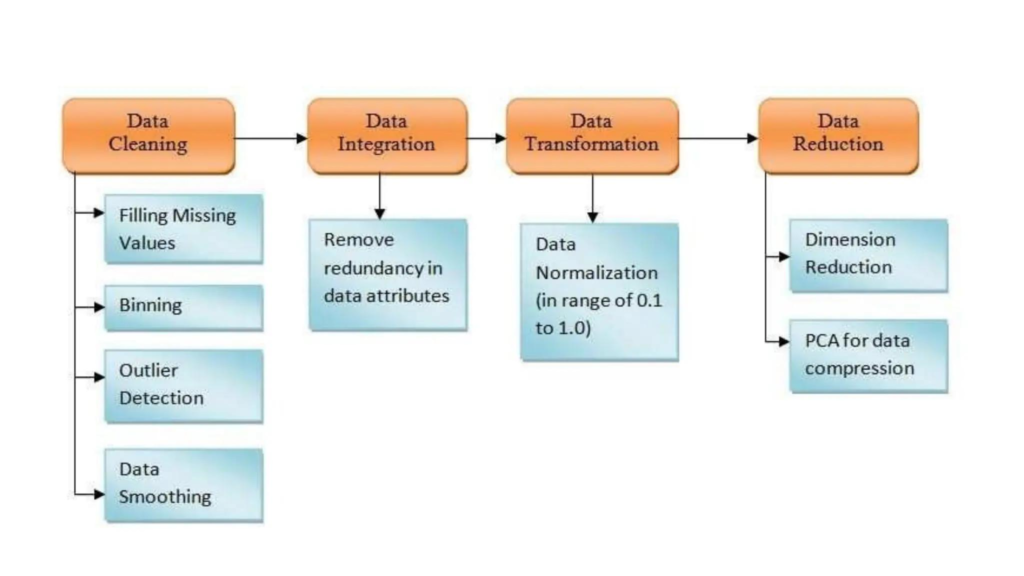
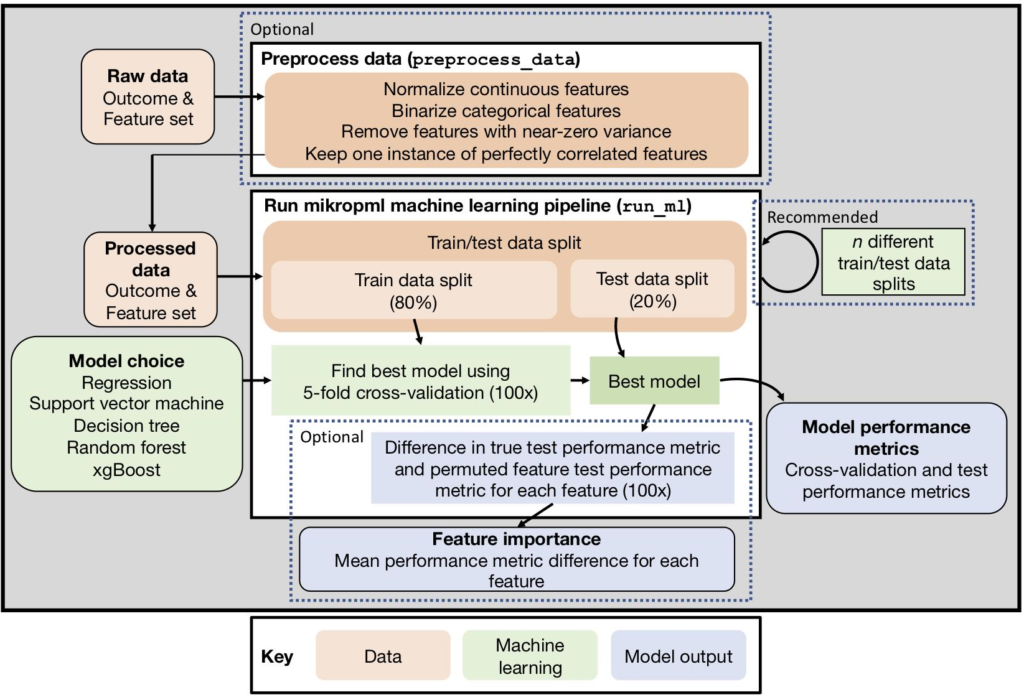
| Stage | Description |
|---|---|
| Data Collection | Gather raw information |
| Data Cleaning | Remove errors |
| Feature Engineering | Create useful variables |
| Model Selection | Choose algorithm |
| Training | Learn patterns |
| Validation | Tune parameters |
| Testing | Evaluate performance |
| Deployment | Real-world use |
Examples 💡
Example 1: Predicting House Prices
Inputs:
- Bedrooms
- Area
- Age
- Location
Output:
Estimated house price.
Example 2: Disease Prediction
Hospital data can predict:
- Diabetes
- Heart disease
- Cancer risk
Example 3: Email Spam Detection
Algorithms classify:
- Spam
- Legitimate emails
Example 4: Customer Churn
Companies predict which customers may leave.
Example 5: Image Classification
Computer vision models identify:
- Animals
- Vehicles
- Medical images
Real-World Engineering Applications 🌍
Machine learning with R supports numerous engineering and scientific domains:
Civil Engineering
🏗️ Predictive maintenance for bridges and roads.
Mechanical Engineering
⚙️ Equipment failure prediction.
Electrical Engineering
⚡ Smart grid optimization.
Biomedical Engineering
🩺 Disease diagnosis.
Aerospace Engineering
✈️ Flight safety analysis.
Environmental Engineering
🌱 Climate forecasting.
Manufacturing
🏭 Quality inspection.
Finance
💰 Fraud detection.
Agriculture
🌾 Crop yield prediction.
Robotics
🤖 Intelligent navigation.
Common Mistakes ❌
Many beginners struggle because they:
- Ignore mathematical fundamentals.
- Skip data cleaning.
- Use default model settings.
- Overfit training data.
- Forget feature scaling.
- Ignore cross-validation.
- Misinterpret evaluation metrics.
- Use insufficient data.
- Neglect visualization.
- Fail to document experiments.
Avoiding these issues greatly improves model quality.
Challenges and Solutions 🛠️
| Challenge | Solution |
|---|---|
| Poor data quality | Perform thorough cleaning |
| Small datasets | Collect more data or use augmentation |
| High dimensionality | Apply PCA or feature selection |
| Overfitting | Use regularization and cross-validation |
| Slow computation | Optimize code and use efficient packages |
| Class imbalance | Resample or apply weighted models |
| Missing values | Impute or remove carefully |
| Feature redundancy | Correlation analysis |
Case Study 📚
Predicting Equipment Failure in Manufacturing
A manufacturing company wanted to reduce machine downtime.
The engineering team collected:
- Temperature
- Pressure
- Vibration
- Motor current
- Production rate
Using R, the workflow included:
- Cleaning sensor data.
- Visualizing trends.
- Engineering predictive features.
- Training a Random Forest model.
- Validating with cross-validation.
- Deploying the model for continuous monitoring.
Results
✅ 22% reduction in unexpected failures.
✅ Lower maintenance costs.
📊 Higher production efficiency.
✅ Improved worker safety.
This demonstrates how mathematical modeling combined with R programming delivers measurable engineering benefits.
Essential Tips ⭐
✔ Master algebra before deep learning.
✔ Learn statistics before advanced AI.
📊 Practice coding daily.
✔ Read algorithm documentation.
✔ Visualize every dataset.
📊 Understand each model mathematically.
✔ Build small projects first.
✔ Participate in Kaggle competitions.
📊 Use Git for version control.
✔ Keep learning new R packages.
✔ Validate every model.
📊 Never ignore data quality.
Frequently Asked Questions ❓
Is R good for machine learning?
Yes. R excels in statistics, predictive analytics, visualization, and research-focused machine learning.
Should I learn mathematics before machine learning?
Absolutely. Mathematics helps you understand how algorithms learn and make predictions instead of treating them as black boxes.
Is R easier than Python?
For statistical analysis and exploratory data analysis, many learners find R intuitive. Python, however, has a broader ecosystem for general-purpose programming and large-scale deep learning.
Which mathematical topics are most important?
Linear algebra, calculus, probability, statistics, and optimization form the core mathematical foundation for most machine learning algorithms.
Can beginners learn machine learning with R?
Yes. Starting with basic programming and mathematics, then progressing to simple algorithms such as linear regression and decision trees, provides a manageable learning path.
Which industries use R?
Healthcare, pharmaceuticals, finance, manufacturing, engineering, government, education, environmental science, and academic research all use R extensively.
How long does it take to become proficient?
With consistent study and hands-on projects, learners often build solid foundational skills within several months, while mastering advanced machine learning typically requires ongoing practice and real-world experience.
Conclusion 🎯
Mathematics and programming are the twin pillars of successful machine learning. By learning linear algebra, calculus, probability, statistics, and R programming together, engineers and data professionals gain the ability to understand, build, and improve predictive models rather than simply using them.
R remains a powerful language for statistical computing, data visualization, and machine learning, making it an excellent choice for students, researchers, and professionals working across engineering disciplines. A structured, ground-up approach—starting with mathematical fundamentals, progressing through programming concepts, and culminating in practical machine learning projects—creates a strong foundation for tackling real-world challenges in industries such as healthcare, manufacturing, finance, robotics, and environmental engineering.
As artificial intelligence continues to evolve, professionals who combine mathematical insight with practical R programming skills will be well positioned to design more accurate models, interpret results responsibly, and deliver innovative engineering solutions that create lasting impact.