Life Cycle Costing for the Analysis, Management and Maintenance of Civil Engineering Infrastructure: Complete Guide for Engineers, Students, and Asset Managers 🏗️📊
Introduction
Civil engineering infrastructure forms the backbone of modern society. Roads, bridges, tunnels, dams, railways, ports, airports, pipelines, and public buildings all support transportation, safety, trade, housing, and economic growth. Yet one of the biggest mistakes in infrastructure planning is focusing only on the initial construction cost instead of the total cost over the asset’s entire life.
A bridge may appear cheap to build today, but if it requires constant repairs, expensive inspections, traffic closures, and early replacement, it may become far more expensive than a higher-quality alternative. This is where Life Cycle Costing (LCC) becomes essential.
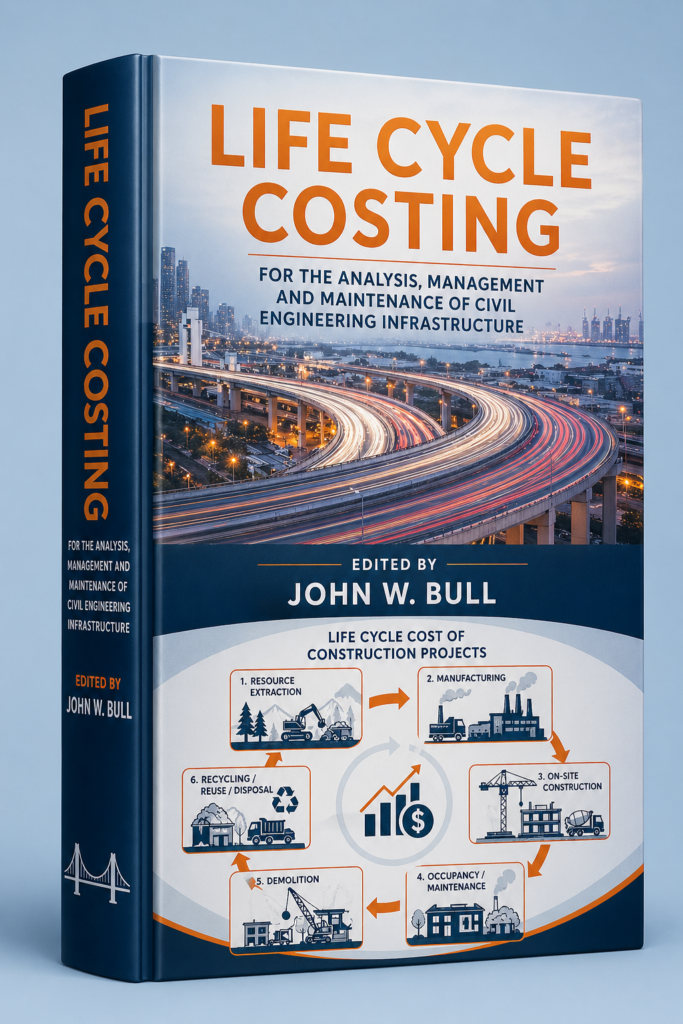
Life Cycle Costing is a structured engineering and financial method used to estimate the total cost of ownership of an infrastructure asset from planning and design through operation, maintenance, rehabilitation, and disposal.
For civil engineers, LCC helps answer critical questions:
- Should we use asphalt or concrete pavement?
- Is stainless steel reinforcement worth the higher initial cost?
- How often should preventive maintenance be scheduled?
- Which bridge design offers the best long-term value?
- Should an aging tunnel be repaired or replaced?
For governments and private investors, LCC improves decision-making, reduces waste, and supports sustainable development.
This article provides a complete beginner-to-advanced guide to Life Cycle Costing in civil engineering infrastructure. Whether you are a student, consultant, contractor, municipal engineer, or asset manager in the USA, UK, Canada, Australia, or Europe, this guide will help you understand how LCC works in real practice.
Background Theory
Why Traditional Cost Thinking Fails 💸
Many projects are awarded based on the lowest bid. While competitive pricing is important, lowest construction cost does not always mean lowest total cost.
Consider two road pavement options:
| Option | Initial Cost | Annual Maintenance | Service Life |
|---|---|---|---|
| Asphalt | Low | High | 15 years |
| Concrete | High | Low | 30 years |
If decision-makers only compare first cost, asphalt wins. But when maintenance, resurfacing, traffic delay, and replacement are included, concrete may become the better investment.
This demonstrates the central idea of LCC:
Engineering decisions must consider total long-term value, not only short-term spending.
Evolution of Asset Management
As infrastructure networks aged in developed countries, engineers realized that reactive repair strategies were inefficient. Roads were failing faster, bridges required emergency repairs, and public budgets were under pressure.
This led to modern practices such as:
- Asset management systems
- Reliability engineering
- Preventive maintenance planning
- Risk-based inspection
- Sustainability analysis
- Life Cycle Costing models
Today, many transport agencies require LCC studies before approving major projects.
Engineering Economics Foundation
Life Cycle Costing is built on time value of money principles.
Money spent today is not equal to money spent 20 years later because of:
- Inflation
- Interest rates
- Investment returns
- Opportunity cost
Therefore, future costs are converted into Present Value (PV) using discounting.
Technical Definition
What is Life Cycle Costing?
Life Cycle Costing (LCC) is the process of calculating all significant costs associated with an infrastructure asset during its service life.
These costs typically include:
- Planning cost
- Design cost
- Construction cost
- Operation cost
- Inspection cost
- Preventive maintenance cost
- Corrective maintenance cost
- Rehabilitation cost
- User delay cost
- Energy cost
- Environmental cost (optional)
- Demolition/disposal cost
- Residual or salvage value
Standard Formula
Where PV = Present Value of future cash flows.
Main Objective 🎯
The purpose is to select the option with:
- Lowest total ownership cost
- Highest long-term value
- Best performance-to-cost ratio
- Acceptable risk level
Step-by-step Explanation
Step 1: Define the Asset and Scope
Clearly identify the infrastructure system.
Examples:
- 2 km urban bridge deck
- 50 km highway pavement
- Water treatment plant
- Railway station roof structure
- Stormwater drainage network
Determine boundaries:
- Structural only?
- Structural + electrical + mechanical?
- User traffic impacts included?
Step 2: Determine Service Life
Estimate design life or analysis period.
Typical ranges:
| Asset Type | Typical Analysis Life |
|---|---|
| Pavement | 20–40 years |
| Bridge | 50–100 years |
| Tunnel | 75–120 years |
| Building | 30–60 years |
| Water pipeline | 40–80 years |
Step 3: Identify Cost Elements
Direct Costs
- Materials
- Labor
- Equipment
- Construction management
Operating Costs
- Lighting
- Pumping
- Cleaning
- Security
Maintenance Costs
- Crack sealing
- Painting steel
- Bearing replacement
- Drain cleaning
End-of-Life Costs
- Demolition
- Waste transport
- Recycling
Step 4: Predict Timing of Costs
Example for bridge:
| Year | Activity |
|---|---|
| 0 | Construction |
| 5 | Inspection |
| 10 | Deck repair |
| 20 | Repainting |
| 35 | Major rehabilitation |
| 50 | Replacement |
Step 5: Select Discount Rate
Common public-sector rates vary by country and policy.
Typical range:
- 2% to 8%
Higher rate = future costs matter less
Lower rate = future costs matter more
Step 6: Convert Future Costs to Present Value
Formula:
Where:
- F = future cost
- r = discount rate
- n = number of years
Example:
$100,000 repair in year 10 at 5%
Step 7: Sum All Present Values
Add all discounted costs.
Step 8: Compare Alternatives
Choose based on:
- Lowest LCC
- Performance requirements
- Safety compliance
- Environmental goals
Comparison
Initial Costing vs Life Cycle Costing
| Factor | Initial Costing | Life Cycle Costing |
|---|---|---|
| Focus | Construction only | Whole asset life |
| Time Horizon | Short | Long |
| Maintenance Included | No | Yes |
| Better for Infrastructure? | Limited | Excellent |
| Risk Awareness | Low | Higher |
| Sustainability | Weak | Strong |
Reactive vs Preventive Maintenance
| Strategy | Description | Long-Term Cost |
|---|---|---|
| Reactive | Repair after failure | High |
| Preventive | Scheduled upkeep | Lower |
| Predictive | Sensor-based intervention | Often lowest |
Asphalt vs Concrete Pavement Example
| Factor | Asphalt | Concrete |
|---|---|---|
| Initial Cost | Lower | Higher |
| Maintenance Frequency | Higher | Lower |
| Life Span | Moderate | Long |
| Heavy Traffic Suitability | Good | Excellent |
| LCC in many highways | Can be higher | Often competitive |
Diagrams & Tables
Infrastructure Life Cycle Diagram
↓
Design
↓
Construction
↓
Operation
↓
Maintenance
↓
Rehabilitation
↓
Replacement / Disposal
Cost Distribution Example for Bridge
| Cost Component | Share (%) |
|---|---|
| Construction | 45 |
| Routine Maintenance | 10 |
| Major Repairs | 20 |
| Traffic Delay During Works | 15 |
| Inspection | 5 |
| Disposal | 5 |
This table shows why focusing only on construction cost can be misleading.
Examples
Example 1: Bridge Coating Selection 🌉
Two coating systems for steel bridge:
| Item | System A | System B |
|---|---|---|
| Initial Cost | $500,000 | $800,000 |
| Repainting Cycle | 10 years | 20 years |
| Analysis Life | 40 years | 40 years |
Although System B costs more initially, fewer repainting cycles may reduce total LCC.
Example 2: Concrete Mix Design
Option A:
- Normal concrete
- Lower first cost
- More chloride penetration
Option B:
- High-performance concrete
- Higher first cost
- Longer durability
For marine environments, Option B often wins in life cycle terms.
Example 3: Water Pumping Station
Efficient pumps may cost more initially but save energy yearly. Over 20 years, energy savings can exceed purchase cost several times.
Real World Application
Highways and Roads 🚗
Transport agencies use LCC for:
- Pavement type selection
- Resurfacing timing
- Lane closure cost analysis
- Drainage upgrades
Bridges
Used for:
- Deck replacement planning
- Corrosion protection systems
- Inspection intervals
- Seismic retrofit decisions
Buildings
Used in:
- HVAC system selection
- Roofing systems
- Façade materials
- Energy retrofits
Rail Infrastructure
Applied to:
- Track systems
- Sleepers (timber vs concrete)
- Signaling equipment
- Station lifecycle upgrades
Water Infrastructure
Used for:
- Pipe material choice
- Pump replacement
- Leak reduction programs
- Treatment plant modernization
Ports and Marine Structures ⚓
Especially valuable because corrosion and wave exposure create major maintenance burdens.
Common Mistakes
1. Ignoring Maintenance Costs
Many designs underestimate future maintenance. This leads to budget shock later.
2. Using Unrealistic Service Life
Assuming a bridge coating lasts 30 years without evidence can distort results.
3. Wrong Discount Rate
Too high or too low rates can reverse decisions.
4. Excluding User Costs
Road closure delays, detours, and congestion may exceed repair costs.
5. No Sensitivity Analysis
Single-value assumptions create false certainty.
6. Choosing Cheapest Bid Automatically
Lowest tender price is not always best public value.
7. Ignoring Climate Effects 🌦️
Flooding, freeze-thaw cycles, heat, and salt exposure change lifecycle costs dramatically.
Challenges & Solutions
Challenge 1: Uncertain Future Costs
Material prices, labor rates, and energy costs may change.
Solution
Use scenarios:
- Low inflation
- Medium inflation
- High inflation
Challenge 2: Incomplete Maintenance Data
Older assets may lack records.
Solution
Use:
- Historical databases
- Similar projects
- Expert judgement
- Sensor monitoring
Challenge 3: Political Preference for Low First Cost
Short-term budgets often dominate.
Solution
Present total savings clearly with charts and payback periods.
Challenge 4: Complex Models
Some LCC models become too technical.
Solution
Start simple:
- Major cost items only
- Clear assumptions
- Spreadsheet model
Challenge 5: Risk of Failure Not Included
A bridge failure has massive consequences.
Solution
Use risk-adjusted LCC:
Case Study
Urban Bridge Deck Replacement Program 🌉📈
Background
A city owns 25 reinforced concrete bridges built in the 1970s. Chloride from winter de-icing salts caused deck deterioration.
Two options were studied.
Option A: Patch Repairs
- Lower yearly budget impact
- Frequent lane closures
- Continued deterioration
Option B: Full Deck Replacement with Durable Concrete
- Higher upfront capital cost
- Reduced maintenance for decades
- Better traffic reliability
Cost Summary (30-Year Present Value)
| Cost Item | Option A | Option B |
|---|---|---|
| Initial Work | $12M | $30M |
| Future Repairs | $28M | $8M |
| Traffic Delay Cost | $18M | $4M |
| Inspections | $6M | $5M |
| Total LCC | $64M | $47M |
Result
Although Option B cost more initially, it saved $17M in life cycle terms.
Lessons Learned
- Traffic user cost matters greatly
- Durable materials can be economical
- Short-term budgets may hide long-term waste
Tips for Engineers
Design Phase Tips 🧠
- Compare at least two realistic alternatives
- Include maintainability in design
- Select durable materials for exposure conditions
Construction Phase Tips
- Quality control reduces future repair cost
- Poor workmanship increases lifecycle burden
- Record as-built data accurately
Maintenance Phase Tips
- Use preventive maintenance schedules
- Inspect before visible failure
- Prioritize critical assets first
Data Tips
- Build maintenance history databases
- Track unit costs yearly
- Use BIM + GIS + asset software when possible
Communication Tips
- Show decision-makers simple visuals
- Explain long-term savings clearly
- Translate engineering terms into financial value
Advanced Engineering Considerations
Reliability-Based Life Cycle Costing
Include probability of failure:
Useful for bridges, dams, retaining walls.
Sustainability LCC
Combines:
- Economic cost
- Carbon cost
- Energy use
- Social disruption
Monte Carlo Simulation 🎲
Used when uncertainty is high.
Inputs vary randomly:
- Material life
- Inflation
- Repair cost
Output:
- Probability distribution of total LCC
Digital Twin Integration
Modern smart infrastructure uses sensors to monitor:
- Vibration
- Crack growth
- Corrosion
- Traffic loading
This improves maintenance timing and reduces unnecessary interventions.
Software Tools Used in Practice
Engineers often use:
- Excel models
- Asset management platforms
- BIM systems
- GIS databases
- Reliability software
- Custom Python / MATLAB models
Practical Formula Set
Net Present Value of Repeated Costs
If annual maintenance cost = A for n years:
Equivalent Annual Cost (EAC)
Useful when comparing assets with different lives.
Benefit-Cost Ratio
If >1, project may be justified.
Material Selection Through LCC
Steel vs Prestressed Concrete Bridge
Steel Bridge
Pros:
- Faster erection
- Long spans possible
- Lightweight
Cons:
- Corrosion protection needed
Prestressed Concrete
Pros:
- Lower maintenance in many environments
- Durable
Cons:
- Heavier
- Cracking risks if poorly detailed
LCC helps determine best local solution.
Climate Change and Future Infrastructure
Modern LCC must consider:
- Sea level rise
- Flood frequency
- Higher temperatures
- Wildfires
- Freeze-thaw variability
Ignoring these can severely underestimate future cost.
Procurement and Contracts
Public agencies increasingly request bidders to submit:
- Initial price
- Maintenance strategy
- Lifecycle estimate
- Energy performance
This supports value-based procurement.
Student Learning Perspective 🎓
If you are studying civil engineering, LCC connects multiple subjects:
- Structural engineering
- Construction management
- Transportation
- Materials science
- Economics
- Sustainability
- Risk engineering
It is one of the most practical real-world topics because it turns design decisions into measurable value.
FAQs
1. What is the difference between LCC and LCCA?
LCC means Life Cycle Costing generally. LCCA often means Life Cycle Cost Analysis, the structured comparison process using LCC data.
2. Is the cheapest design ever the best choice?
Not always. A low first cost may create high maintenance and early replacement costs.
3. What discount rate should engineers use?
Use the rate required by the client, government guideline, or organization policy. Common values range from 2% to 8%.
4. Does LCC include environmental cost?
It can. Traditional LCC focuses on money, while expanded models include carbon and sustainability impacts.
5. Can small projects use LCC?
Yes. Even a parking lot, roof, or drainage upgrade can benefit from simple LCC comparison.
6. How accurate is Life Cycle Costing?
It is an estimate, not a guarantee. Accuracy improves with better data and sensitivity analysis.
7. Which industries use LCC besides civil engineering?
Aerospace, manufacturing, defense, energy, transport, IT, and facility management.
8. Why is maintenance so important in infrastructure?
Because infrastructure lasts decades. Small annual maintenance decisions strongly affect total lifetime cost.
Conclusion
Life Cycle Costing is one of the most valuable decision-making tools in civil engineering infrastructure. It shifts focus from what costs least today to what delivers the best value over decades.
Roads, bridges, tunnels, buildings, pipelines, and public assets all experience aging, deterioration, repairs, and replacement. Ignoring these realities leads to poor investments, emergency failures, and rising public expense.
By applying LCC, engineers can:
- Select smarter materials
- Optimize maintenance schedules
- Reduce total ownership cost
- Improve reliability and safety
- Support sustainability goals
- Justify better long-term investments
🏗️ For students, learning LCC builds practical engineering judgment. For professionals, it improves project outcomes and asset performance. For society, it creates stronger infrastructure with wiser use of money.
In modern engineering, the best project is not always the cheapest one—it is the one that performs best throughout its entire life cycle. 📊🌍