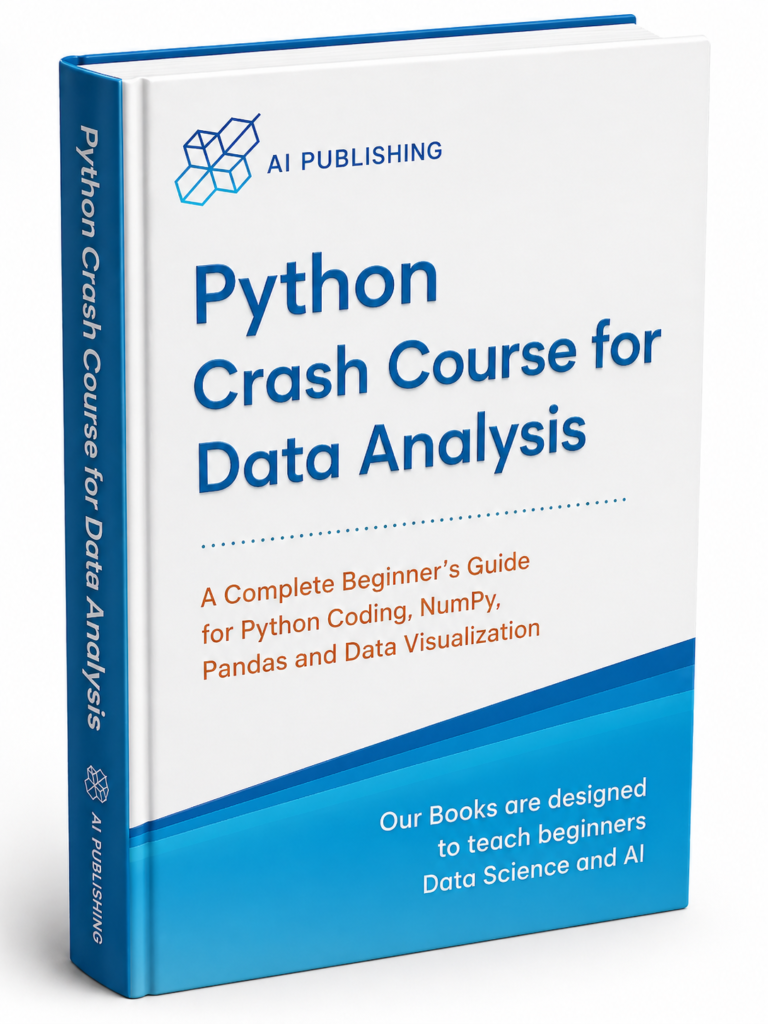
🚀 Python Crash Course for Data Analysis: A Complete Beginner Guide to Python Coding, NumPy, Pandas, and Data Visualization 📊
📘 Introduction
Data has become the new fuel of modern engineering, science, business, and technology. From predicting customer behavior in e-commerce to analyzing sensor data in civil engineering structures, the ability to process and interpret data is now a core skill for engineers and professionals.
Among all programming languages, Python has emerged as the most powerful and beginner-friendly tool for data analysis. Its simplicity, combined with powerful libraries like NumPy, Pandas, and Matplotlib, makes it an essential skill for students and professionals in the USA, UK, Canada, Australia, and Europe.
This crash course is designed to take you from zero knowledge to a confident data analyst mindset, even if you have never written a single line of code before.
We will cover:
- Python fundamentals for data analysis
- NumPy for numerical computing
- Pandas for data manipulation
- Data visualization techniques
- Real-world engineering applications
- Case studies and practical examples
By the end, you will understand how engineers turn raw data into meaningful insights.
🧠 Background Theory
📌 Why Python for Data Analysis?
Python is widely used in engineering and scientific computing because:
✔ Simplicity
Python syntax is easy to read and write, making it ideal for beginners.
✔ Powerful Libraries
- NumPy → Numerical computing
- Pandas → Data manipulation
- Matplotlib & Seaborn → Visualization
- SciPy → Scientific computing
✔ Industry Adoption
Used in:
- NASA 🚀
- Tesla
- Microsoft
- Engineering research labs worldwide
📌 What is Data Analysis in Engineering?
Data analysis is the process of:
- Collecting data
- Cleaning data
- Processing data
- Visualizing patterns
- Making decisions
In engineering, this could mean:
- Analyzing stress in materials
- Monitoring machine performance
- Predicting structural failure
- Optimizing energy consumption
🧾 Technical Definition
📌 Python Data Analysis
Python data analysis refers to the use of Python programming language and its libraries to:
- Handle large datasets
- Perform mathematical operations
- Clean and transform data
- Generate visual insights
- Support decision-making processes
📌 Key Libraries Explained
🔢 NumPy (Numerical Python)
- Works with arrays and matrices
- Performs mathematical operations efficiently
- Foundation for scientific computing
📊 Pandas
- Handles tabular data (like Excel sheets)
- Provides DataFrame structure
- Enables filtering, grouping, and transformation
📉 Matplotlib / Seaborn
- Used for visualization
- Helps create charts, graphs, histograms
🪜 Step-by-Step Explanation
🧩 Step 1: Installing Python and Libraries
💻 Installation Commands:
pip install pandas
pip install matplotlib
🧩 Step 2: Understanding Python Basics
📌 Variables
name = “Engineering Data”
📌 Lists
📌 Loops
print(i)
🧩 Step 3: NumPy Fundamentals
🔢 Creating Arrays
import numpy as np
arr = np.array([1, 2, 3, 4])
print(arr)
📌 Mathematical Operations
arr + 10
⚙️ Why NumPy is Fast?
Because it uses optimized C-based operations.
🧩 Step 4: Pandas Basics
📊 Creating DataFrame
import pandas as pd
data = {
“Name”: [“Ahmed”, “John”, “Sara”],
“Score”: [90, 85, 88]
}
df = pd.DataFrame(data)
print(df)
📌 Reading CSV Files
🧩 Step 5: Data Cleaning
❌ Handling Missing Values
df.fillna(0)
🔄 Renaming Columns
🧩 Step 6: Data Visualization
📊 Basic Plot
import matplotlib.pyplot as plt
plt.plot([1,2,3], [4,5,6])
plt.show()
📉 Bar Chart
plt.show()
⚖️ Comparison
📊 Python vs Excel for Data Analysis
| Feature | Python | Excel |
|---|---|---|
| Data Size | Large datasets | Limited |
| Automation | High | Low |
| Speed | Very fast | Moderate |
| Flexibility | High | Low |
| Visualization | Advanced | Basic |
🆚 NumPy vs Pandas
| Feature | NumPy | Pandas |
|---|---|---|
| Data Type | Arrays | Tables |
| Performance | Faster | Slightly slower |
| Use Case | Math operations | Data analysis |
📈 Diagrams & Tables
🧠 Data Analysis Workflow
📊 Example Dataset Table
| ID | Temperature | Pressure | Result |
|---|---|---|---|
| 1 | 25°C | 1 atm | OK |
| 2 | 40°C | 1.5 atm | Warning |
| 3 | 60°C | 2 atm | Fail |
🧪 Examples
🔧 Example 1: Engineering Sensor Data
import numpy as np
temperature = np.array([20, 25, 30, 35])
avg_temp = np.mean(temperature)
print(“Average Temperature:”, avg_temp)
📊 Example 2: Student Performance Analysis
import pandas as pd
data = {
“Student”: [“A”, “B”, “C”],
“Marks”: [78, 85, 90]
}
df = pd.DataFrame(data)
print(df.describe())
🌍 Real-World Applications
🏗 Civil Engineering
- Bridge load analysis
- Structural health monitoring
⚙ Mechanical Engineering
- Machine performance tracking
- Predictive maintenance
⚡ Electrical Engineering
- Power consumption analysis
- Signal processing
💼 Business Engineering
- Sales forecasting
- Market trend analysis
⚠️ Common Mistakes
❌ 1. Ignoring Data Cleaning
Dirty data leads to wrong results.
❌ 2. Misusing Pandas
Using loops instead of vectorized operations.
❌ 3. Not Visualizing Data
Skipping graphs leads to poor interpretation.
❌ 4. Overcomplicating Code
Writing unnecessary complex logic.
🚧 Challenges & Solutions
⚠️ Challenge 1: Large Dataset Performance
💡 Solution:
Use NumPy vectorization and optimized Pandas operations.
⚠️ Challenge 2: Missing Data
💡 Solution:
Use:
⚠️ Challenge 3: Visualization Confusion
💡 Solution:
Start with simple charts (line, bar, histogram).
📚 Case Study
🏭 Industrial Machine Monitoring System
📌 Problem:
A factory wanted to reduce machine failure rates.
📊 Approach:
- Collected sensor data using Python
- Used Pandas for cleaning data
- Applied NumPy for statistical analysis
- Visualized patterns using Matplotlib
📈 Results:
- 30% reduction in machine downtime
- Early detection of failures
- Improved maintenance scheduling
💡 Tools Used:
- Python
- Pandas
- NumPy
- Matplotlib
🧠 Tips for Engineers
💡 Tip 1: Practice Daily
Even 30 minutes improves coding skills.
💡 Tip 2: Work on Real Data
Use Kaggle datasets or engineering data samples.
💡 Tip 3: Learn Visualization Early
Graphs make analysis easier to understand.
💡 Tip 4: Automate Repetitive Tasks
Use Python scripts instead of manual Excel work.
💡 Tip 5: Think Like an Engineer
Always ask: What problem does this data solve?
❓ FAQs
❓ 1. Is Python hard for beginners?
No, Python is one of the easiest programming languages.
❓ 2. Do I need math for data analysis?
Basic math helps, especially statistics.
❓ 3. Can engineers use Python without coding experience?
Yes, starting with basics is enough.
❓ 4. What is better: Excel or Python?
Python is more powerful and scalable.
❓ 5. How long does it take to learn?
2–3 months for basic data analysis skills.
❓ 6. Is Python used in engineering jobs?
Yes, widely in all engineering fields.
❓ 7. Do I need a strong computer?
No, a basic laptop is enough.
🎯 Conclusion
Python has revolutionized the way engineers and professionals handle data. With tools like NumPy, Pandas, and visualization libraries, complex datasets can be transformed into clear, actionable insights.
Whether you are a student learning engineering fundamentals or a professional working in industry, mastering Python for data analysis gives you a significant advantage in today’s data-driven world.
From cleaning datasets to building predictive models, Python enables you to move from raw data → insights → decisions efficiently and accurately.
🚀 Start small, practice consistently, and gradually build real-world projects. The journey into data analysis is not just about coding—it is about thinking like an engineer who solves problems using data.