Going Pro in Data Science: What It Takes to Succeed as a Professional Data Scientist
Introduction 🚀
Data science has evolved from an emerging technical discipline into a professional field that influences engineering, finance, healthcare, manufacturing, transportation, energy, marketing, and countless other industries. Organizations no longer need people who can simply build a predictive model. They need professionals who can understand a business problem, work with imperfect data, choose appropriate analytical methods, communicate findings, and turn analysis into measurable improvements.
Going pro in data science therefore requires much more than learning Python or completing a machine learning course. A professional data scientist operates at the intersection of statistics, programming, domain knowledge, engineering, communication, and decision-making.
For students, this can seem overwhelming. There are programming languages to learn, statistical concepts to understand, databases to explore, machine learning algorithms to practice, and projects to build. For working professionals, the challenge is different: how do you transform technical knowledge into business value?
The answer is a deliberate progression from learning → practicing → building → communicating → delivering → improving. 💡


This article presents a practical framework for developing the mindset and capabilities required to succeed as a professional data scientist in the United States, United Kingdom, Canada, Australia, and Europe.
Background Theory 🧠
Data science combines several disciplines rather than belonging exclusively to one technical area.
The multidisciplinary nature of data science
A professional data scientist commonly works across:
- Statistics 📊
- Programming 💻
- Machine learning 🤖
- Database systems 🗄️
- Data visualization 📈
- Software engineering ⚙️
- Business analysis 💼
- Domain-specific knowledge
- Communication and presentation
The strongest professionals understand how these areas interact.
For example, knowing how to train a machine learning model is valuable. However, knowing when a machine learning model is unnecessary can be even more valuable.
A simple analytical report may solve a problem that would otherwise become an unnecessarily complicated artificial intelligence project.
From data to decisions
Professional data science is fundamentally about converting information into better decisions.
A typical workflow might look like:
Business problem → Data → Analysis → Insight → Model → Evaluation → Decision → Deployment → Monitoring
Each stage creates potential failure points.
Poorly defined objectives can produce irrelevant analysis. Poor-quality data can produce misleading results. An inappropriate model can perform poorly in production. A technically accurate result can still fail if decision-makers cannot understand it.
The professional mindset
A professional data scientist asks questions such as:
🔎 What problem are we actually solving?
🔎 Who will use the result?
🔎 What decision will change because of this analysis?
🔎 Is the available data trustworthy?
🔎 What could make the result misleading?
🔎 How will success be measured?
These questions distinguish professional data science from simply experimenting with algorithms.
Definition 📘
Going pro in data science means developing the technical, analytical, engineering, communication, and business capabilities required to solve real-world problems reliably and responsibly using data.
A professional data scientist is not simply someone who knows machine learning.
Instead, a professional should be able to:
- Define analytical problems.
- Acquire and understand relevant data.
- Clean and prepare datasets.
- Explore patterns and anomalies.
- Select suitable analytical techniques.
- Build and evaluate models when appropriate.
- Communicate findings clearly.
- Collaborate with engineers and domain experts.
- Understand operational constraints.
- Document decisions.
- Monitor analytical solutions after deployment.
- Continuously improve their skills.
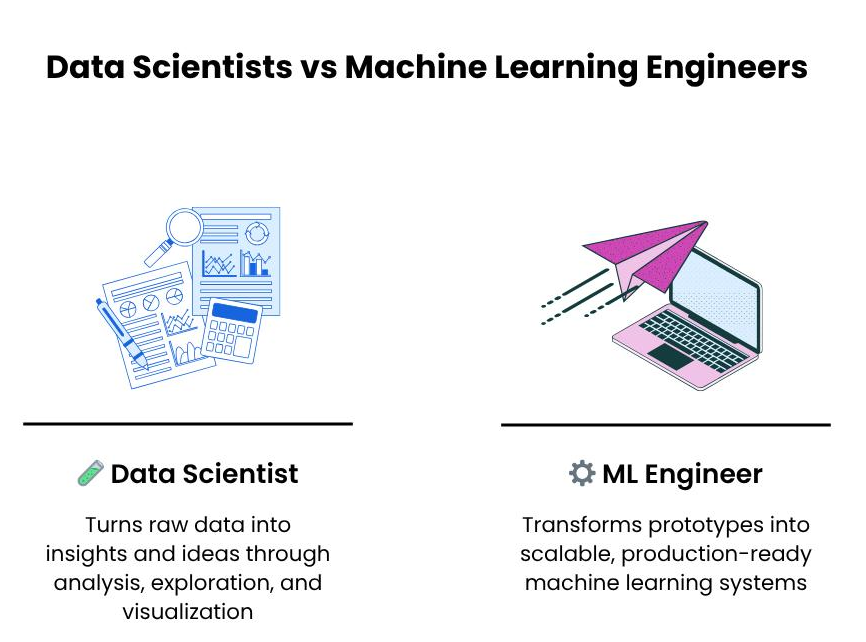
Data scientist versus data analyst
These roles can overlap significantly.
| Area | Data Analyst | Data Scientist |
|---|---|---|
| Reporting | Strong focus | Often involved |
| Visualization | Core skill | Important |
| SQL | Essential | Essential |
| Statistics | Important | Advanced |
| Machine Learning | Sometimes | Common |
| Programming | Moderate to strong | Strong |
| Experimentation | Common | Common |
| Predictive systems | Limited | Common |
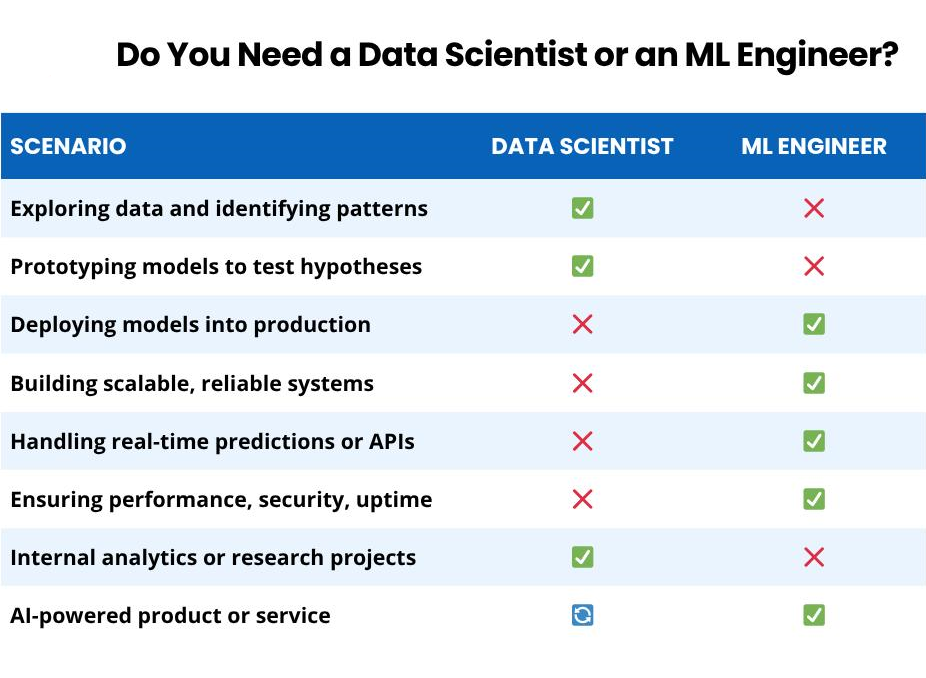
| Deployment | Usually limited | Increasingly important |
| Business communication | Essential | Essential |
The exact responsibilities vary between organizations, so job titles should never be interpreted too rigidly.
Step-by-Step Path to Becoming a Professional Data Scientist 🛠️


Step 1: Build strong programming foundations
Python is one of the most useful languages for modern data science.
Focus on understanding:
- Variables and data types
- Functions
- Loops
- Data structures
- Modules
- Object-oriented concepts
- File handling
- Exceptions
- Virtual environments
- Package management
- Testing
Do not focus only on memorizing syntax.
A professional needs to write code that another person can understand, maintain, test, and eventually integrate into a larger system.
Step 2: Learn SQL seriously 🗄️
SQL is one of the most valuable skills in professional data work.
Learn how to:
- Filter records
- Join tables
- Aggregate information
- Work with dates
- Create analytical queries
- Use subqueries
- Understand window functions
- Investigate data quality
- Optimize inefficient queries
A data scientist who understands SQL can work much more effectively with production databases and data warehouses.
Step 3: Develop statistical thinking
Statistics provides the reasoning framework behind data science.
Important areas include:
- Descriptive statistics
- Probability
- Distributions
- Sampling
- Confidence intervals
- Hypothesis testing
- Experimental design
- Regression
- Correlation
- Bias
- Variance
- Statistical significance
- Causal reasoning
The goal is not to become a theoretical mathematician.
The goal is to understand what the data can—and cannot—support.
Step 4: Master exploratory data analysis
Before building a model, investigate the dataset.
Look for:
- Missing values
- Duplicate records
- Outliers
- Unexpected categories
- Data leakage
- Inconsistent units
- Distribution changes
- Suspicious relationships
Visualization is particularly useful here.
Charts often reveal problems that are difficult to identify by reading raw tables.
Step 5: Learn machine learning systematically 🤖
Avoid learning algorithms as an isolated list.
Instead, understand the broader workflow:
Problem definition → Feature preparation → Model selection → Training → Validation → Evaluation → Interpretation
Study major areas such as:
- Linear models
- Decision trees
- Ensemble methods
- Clustering
- Dimensionality reduction
- Classification
- Regression
- Time-series methods
- Recommendation systems
- Neural networks
More algorithms do not automatically make someone a better data scientist.
Step 6: Learn model evaluation
A professional should never ask only:
“Does the model work?”
Ask:
“How well does it work, under what conditions, and compared with what alternative?”
Consider:
- Appropriate evaluation metrics
- Validation strategies
- Baseline models
- Data leakage
- Class imbalance
- Robustness
- Interpretability
- Generalization
- Operational costs
Step 7: Build real projects 🏗️
Projects are where theoretical knowledge becomes professional capability.
Instead of creating dozens of tiny tutorial projects, build several substantial projects.
A strong project might include:
- A clearly defined problem
- A realistic dataset
- Data-quality investigation
- Exploratory analysis
- Baseline solution
- Model development
- Evaluation
- Visualization
- Business interpretation
- Documentation
- Reproducible code
- Deployment or demonstration
Step 8: Learn data engineering fundamentals
You do not necessarily need to become a data engineer, but understanding data pipelines is extremely valuable.
Learn the basics of:
- ETL and ELT
- Data warehouses
- Data lakes
- APIs
- Batch processing
- Data pipelines
- Cloud platforms
- Data orchestration
- Version control
This knowledge makes it easier to understand where datasets come from and how analytical systems operate in production.
Step 9: Develop communication skills 🗣️
Technical expertise has limited value if stakeholders cannot understand your conclusions.
A professional should be able to explain:
- What happened?
- Why did it happen?
- What does the evidence suggest?
- How confident are we?
- What should happen next?
- What are the limitations?
Avoid overwhelming executives with technical terminology when a simple explanation communicates the same idea.
Step 10: Learn deployment and MLOps
Professional machine learning does not end when a notebook produces a good result.
Production systems may require:
- APIs
- Containers
- Cloud infrastructure
- CI/CD
- Model versioning
- Data validation
- Monitoring
- Logging
- Retraining strategies
- Security controls
This is where data science increasingly intersects with software engineering.
Comparison: Learner vs Professional Data Scientist ⚖️
| Characteristic | Beginner Approach | Professional Approach |
|---|---|---|
| Dataset | Perfect tutorial dataset | Messy real-world data |
| Goal | Build a model | Solve a measurable problem |
| Coding | Notebook-focused | Maintainable and reproducible |
| Evaluation | One metric | Multiple relevant criteria |
| Communication | Technical explanation | Audience-specific explanation |
| Failure | Frustration | Investigation and learning |
| Documentation | Minimal | Structured and reproducible |
| Deployment | Optional | Considered when required |
| Business value | Secondary | Central |
| Security | Often ignored | Considered |
| Monitoring | Rare | Important for production |
Diagrams and Professional Skill Framework 📊
A useful way to visualize professional development is as a layered structure:
                 PROFESSIONAL IMPACT
                        ▲
              Business & Domain Knowledge
                        ▲
                 Communication Skills
                        ▲
             Machine Learning & Statistics
                        ▲
              Python + SQL + Visualization
                        ▲
             Data & Engineering Foundations
                        ▲
                  Problem-Solving Mindset
The lower layers support the upper layers.
A person with excellent machine learning knowledge but weak communication may struggle to create organizational impact. Similarly, someone with strong communication but insufficient technical depth may struggle with complex analytical problems.
Core professional skill matrix
| Skill | Student | Junior | Mid-Level | Senior |
|---|---|---|---|---|
| Python | ⭐⭐⭐ | ⭐⭐⭐⭐ | ⭐⭐⭐⭐⭐ | ⭐⭐⭐⭐⭐ |
| SQL | ⭐⭐ | ⭐⭐⭐⭐ | ⭐⭐⭐⭐⭐ | ⭐⭐⭐⭐⭐ |
| Statistics | ⭐⭐⭐ | ⭐⭐⭐⭐ | ⭐⭐⭐⭐⭐ | ⭐⭐⭐⭐⭐ |
| Machine Learning | ⭐⭐ | ⭐⭐⭐ | ⭐⭐⭐⭐⭐ | ⭐⭐⭐⭐⭐ |
| Communication | ⭐⭐ | ⭐⭐⭐ | ⭐⭐⭐⭐ | ⭐⭐⭐⭐⭐ |
| Business knowledge | ⭐ | ⭐⭐ | ⭐⭐⭐⭐ | ⭐⭐⭐⭐⭐ |
| System design | ⭐ | ⭐⭐ | ⭐⭐⭐ | ⭐⭐⭐⭐⭐ |
| Leadership | ⭐ | ⭐ | ⭐⭐⭐ | ⭐⭐⭐⭐⭐ |


Practical Examples 💡
Example 1: Customer churn
A telecommunications company wants to understand why customers leave.
A beginner might immediately train a classification model.
A professional first asks:
- How is churn defined?
- What period should be analyzed?
- Which customers are eligible?
- Is customer cancellation data reliable?
- Are there variables that become available only after cancellation?
- What action will the company take with high-risk customers?
The model becomes one component of a broader solution.
Example 2: Predictive maintenance
A manufacturing company wants to reduce unexpected equipment failures.
A professional data scientist may combine:
- Sensor information
- Maintenance history
- Operating conditions
- Failure records
- Production schedules
The goal is not simply predicting failure. The solution should help maintenance teams decide when and how to intervene.
Example 3: Demand forecasting
A retailer wants to improve inventory planning.
The data scientist investigates:
- Historical sales
- Promotions
- Holidays
- Product changes
- Seasonality
- Regional behavior
- Stock availability
A technically impressive forecasting model is useless if the business cannot integrate its predictions into purchasing decisions.
Real-World Applications 🌍
Professional data science is used throughout modern engineering and business.
Engineering
Applications include:
- Predictive maintenance
- Structural monitoring
- Quality control
- Energy optimization
- Manufacturing automation
- Fault detection
- Digital twins
Finance
Applications include:
- Fraud detection
- Risk analysis
- Credit assessment
- Forecasting
- Customer segmentation
- Portfolio analytics
Healthcare
Data science can support:
- Medical research
- Operational planning
- Patient-flow analysis
- Image analysis
- Risk modeling
- Resource allocation
Transportation
Organizations use data science for:
- Demand prediction
- Route optimization
- Fleet management
- Traffic analysis
- Predictive maintenance
Technology
Technology companies commonly apply data science to:
- Search
- Recommendations
- Personalization
- Anomaly detection
- Product analytics
- Experimentation
Common Mistakes 🚨
Learning too many tools
A common mistake is collecting technologies instead of developing competence.
Learning Python, R, Julia, TensorFlow, PyTorch, Spark, dozens of cloud services, and many visualization platforms simultaneously can create superficial knowledge.
Choose a practical core and develop depth.
Focusing only on machine learning
Machine learning is important, but professional data science includes much more.
SQL, statistics, experimentation, communication, data quality, and business understanding frequently determine whether a project succeeds.
Building portfolio projects with no story
A portfolio should demonstrate problem-solving, not just screenshots.
Explain:
- The problem
- The data
- Your decisions
- The challenges
- The results
- The limitations
- The potential business impact
Ignoring software engineering
Unstructured notebooks can be acceptable during exploration but become problematic when analytical work moves toward production.
Learn Git, testing, modular design, documentation, and reproducibility.
Ignoring ethics and privacy
Data can contain sensitive information.
Professionals should consider:
- Privacy
- Fairness
- Security
- Bias
- Transparency
- Responsible data usage
Challenges and Solutions 🧩
| Challenge | Practical Solution |
|---|---|
| Too many technologies | Establish a focused learning roadmap |
| Lack of experience | Build realistic end-to-end projects |
| Weak statistics | Study concepts through practical datasets |
| Weak programming | Write reusable projects outside notebooks |
| Poor communication | Practice executive-style summaries |
| No domain knowledge | Choose an industry and learn its terminology |
| Difficulty finding jobs | Build demonstrable evidence of competence |
| Model works poorly | Investigate data before changing algorithms |
| Production complexity | Learn MLOps and software fundamentals |
| Career stagnation | Develop specialization and leadership skills |
Case Study: From Dashboard Builder to Data Science Professional 🏢
Imagine an analyst working for an international manufacturing company.
Initially, the analyst produces weekly reports describing production performance. The reports are accurate, but management primarily receives information about problems after they occur.
Phase 1: Understand the problem
The analyst works with engineers and operations managers to identify a major source of production downtime.
Phase 2: Investigate the data
The team combines:
- Machine sensor information
- Maintenance records
- Production schedules
- Equipment age
- Operating conditions
- Historical failure events
They discover inconsistencies in timestamps and incomplete maintenance records.
Phase 3: Establish a baseline
Instead of immediately developing a sophisticated model, the team creates a simple baseline approach and establishes how existing processes perform.
Phase 4: Develop predictive capabilities
The data scientist experiments with several analytical approaches and evaluates them using realistic validation procedures.
Phase 5: Connect predictions to decisions
The project becomes useful only when maintenance engineers receive actionable information.
The system therefore provides alerts through an operational workflow rather than simply displaying predictions in a notebook.
Phase 6: Monitor performance
After deployment, the team monitors:
- Data quality
- Prediction quality
- Equipment changes
- Operational outcomes
- False alarms
- User feedback
The result is a complete data science solution rather than a model isolated from the organization.
The important lesson: professional data science is not about producing the most complicated model. It is about creating a reliable connection between data, evidence, decisions, and outcomes.
Essential Tips for Going Pro ⭐
Build depth before breadth
Become genuinely good at a core stack before constantly adding new technologies.
A strong foundation could include:
Python + SQL + Statistics + Machine Learning + Visualization + Git + Cloud Fundamentals
Think like an engineer
Ask whether your solution is:
- Reliable
- Reproducible
- Maintainable
- Testable
- Scalable
- Secure
Think like a business professional
Ask:
What decision does this analysis improve?
That question can completely change your project design.
Build a professional portfolio
Create projects demonstrating different abilities.
For example:
📊 An exploratory analytics project
🤖 A machine learning project
⏱️ A forecasting project
🗄️ A SQL/data warehouse project
⚙️ An end-to-end deployed project
Read technical documentation
Professional developers and data scientists frequently learn from documentation rather than tutorials alone.
Develop the habit of reading:
- API documentation
- Library documentation
- Cloud documentation
- Technical specifications
- Research papers
- Engineering blogs
Develop domain expertise
Specialization can significantly differentiate you.
Possible directions include:
- Financial data science
- Healthcare analytics
- Manufacturing analytics
- Energy data science
- Marketing analytics
- Scientific computing
- Engineering data science
- AI and machine learning
Learn to say “I don’t know”
This is an underrated professional skill.
A responsible data scientist should be comfortable saying:
“The available evidence isn’t sufficient to answer that question.”
That is much better than producing a confident but unreliable conclusion.
FAQs ❓
What degree do I need to become a data scientist?
A degree in computer science, statistics, mathematics, engineering, economics, physics, or another quantitative discipline can be helpful. However, practical ability, project experience, and professional evidence can also play a major role.
Do I need advanced mathematics?
You need enough mathematics and statistics to understand the methods you use and evaluate their limitations. The required depth depends on your specialization.
Is Python enough for data science?
Python is extremely useful, but professional data science normally requires additional capabilities such as SQL, statistics, visualization, version control, and often cloud or engineering knowledge.
Should I learn machine learning before statistics?
You can experiment with machine learning early, but strong statistical foundations make it much easier to understand model behavior, evaluation, uncertainty, and experimental results.
How many portfolio projects should I build?
Quality matters more than quantity. A small collection of carefully documented, realistic projects can demonstrate more professional ability than dozens of simple tutorial exercises.
Is SQL really necessary for data scientists?
Yes, in many professional environments. Data scientists frequently need to extract, join, filter, aggregate, and investigate data stored in databases or warehouses.
Should a data scientist learn cloud computing?
Basic cloud knowledge is increasingly useful, particularly when working with large datasets, production systems, managed machine learning services, or distributed applications.
What separates a senior data scientist from a junior one?
Senior professionals generally handle greater ambiguity, make stronger technical decisions, understand business constraints, communicate with stakeholders, mentor others, and take responsibility for outcomes rather than simply completing assigned analytical tasks.
Conclusion 🎯
Going pro in data science is not a race to learn every algorithm, framework, or artificial intelligence platform.
It is a process of developing technical competence, analytical judgment, engineering discipline, communication ability, and business awareness.
The professional journey can be viewed as a progression:
Learn → Practice → Build → Explain → Deploy → Measure → Improve
For beginners, start with the foundations: Python, SQL, statistics, data analysis, and visualization.
For intermediate practitioners, focus on realistic projects, machine learning, software engineering, experimentation, and domain knowledge.
For experienced professionals, expand toward system design, MLOps, strategic thinking, leadership, and measurable organizational impact.
The most valuable data scientist is rarely the person who knows the largest number of algorithms.
It is the professional who can take a messy real-world problem, ask the right questions, extract reliable evidence, build an appropriate solution, communicate it clearly, and help an organization make a better decision. 🚀📊🤖
That is what it truly takes to go pro in data science.