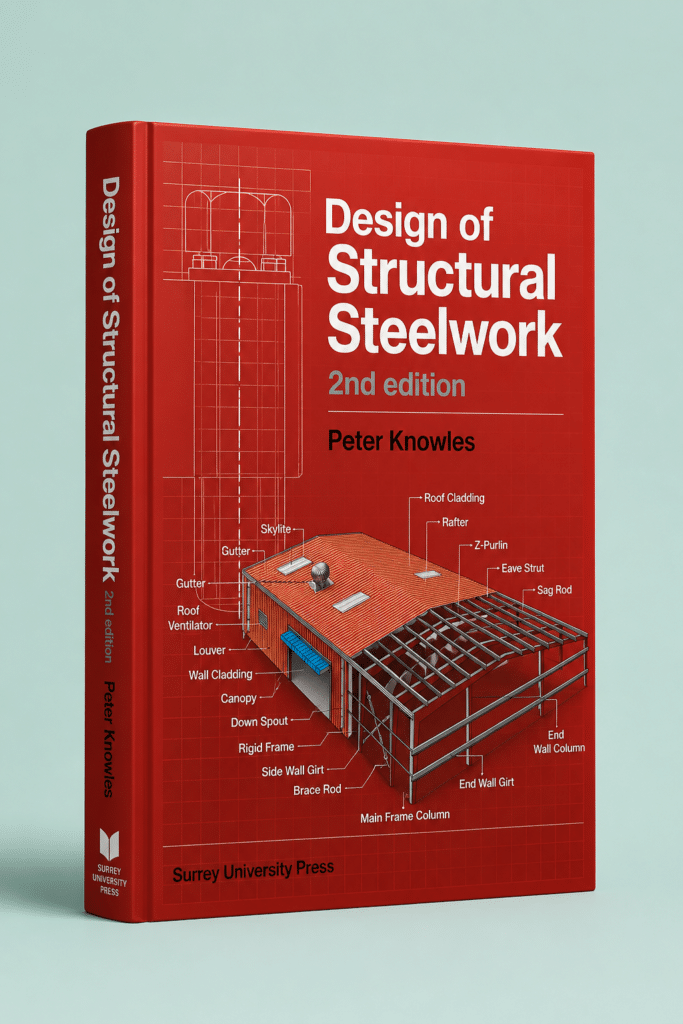
📘 Design of Structural Steel Work 2nd Edition – A Comprehensive Guide for Engineers
🔧 Introduction
Structural steel design is one of the most pivotal disciplines in civil and structural engineering. Whether constructing skyscrapers, bridges, stadiums, or industrial facilities, engineers depend on robust design principles to ensure safety, stability, and efficiency.
Design of Structural Steel Work 2nd Edition represents a cornerstone reference — blending theory with practical standards widely used in the USA, UK, Canada, Australia, and across Europe. This article breaks down its core concepts into digestible segments for students and professionals alike.
In this article, we explore technical definitions, industry-standard calculations, diagrams, case studies, real-world applications, and FAQs designed to empower engineers at every career stage.🚀
📐 Background Theory
What Is Structural Steel? 🏗️
Structural steel refers to high-strength alloy steel used in building frameworks and load-bearing systems. Due to its versatility, tensile strength, ductility, and recyclability, it dominates modern structural engineering.
Why Steel?
✔ Uniform quality
✔ Predictable performance
✔ High strength-to-weight ratio
✔ Ductility under load
✔ Efficient construction
Historical Context
Structural steel became prominent during the Industrial Revolution. Early use began in bridges and factories, but widespread architectural adoption followed with skyscraper construction in the late 19th and 20th centuries.
Standards evolved accordingly — in the USA through ASTM and AISC, in the UK via British Standards (BS), and across Europe through Eurocode 3 (EN 1993). Design of Structural Steel Work 2nd Edition ties these into a cohesive framework.
🎯 This background prepares the reader to understand how steel design standards grew to match real-world demands.
📌 Technical Definition
Structural Steel Design:
The engineering discipline that deals with the analysis and sizing of steel members to safely support loads, following accepted standards, codes, and design philosophies.
Key Concepts
- Load Types: Dead, live, wind, seismic, thermal.
- Stress & Strain
- Elastic & Plastic Behavior
- Buckling & Lateral-Torsional Buckling
- Connections (bolted, welded)
- Design Philosophies
- Allowable Stress Design (ASD)
- Load & Resistance Factor Design (LRFD) (USA)
- Limit State Design (LSD) (UK/Europe)
Steel Grades
Different grades exist (e.g., S275, S355, A36, A992), each with distinct yield strengths and properties — vital for accurate design.
📊 Step-by-Step Explanation (Core Processes)
Below is a structured workflow for steel design based on Design of Structural Steel Work 2nd Edition:
🔹 Step 1: Define Project Requirements
- Load estimations
- Structural use (building, bridge, industrial)
- Environmental factors (wind, earthquake)
- Standards (AISC, BS EN 1993)
🔹 Step 2: Choose Steel Grade
Selection based on:
| Grade | Yield Strength | Typical Use |
|---|---|---|
| S275 / A36 | 275 MPa / 36 ksi | General structures |
| S355 / A992 | 355 MPa / 50 ksi | High-strength beams |
🔹 Step 3: Preliminary Member Sizing
Use basic strength formulas:
- P=FyA
- M=Zf
- V=AvFv
🔹 Step 4: Calculate Loads
Loads include:
- DL – Dead load
- LL – Live load
- EQ – Earthquake loads
- WL – Wind loads
- S – Snow loads
Codes like ASCE 7 or Eurocode give load combinations.
🔹 Step 5: Check Strength & Stability
Apply relevant equations depending on element:
- Bending
- Shear
- Buckling
- Combined stresses
🔹 Step 6: Design Connections
Types:
✔ Bolted (shear, bearing)
✔ Welded (fillet, groove)
✔ Combined
🔹 Step 7: Deflection Checks
Codes specify maximum allowable deflections:
- L/360 for floors
- L/500 for partitions
🔹 Step 8: Detailing & Drafting
- Prepare fabrication drawings
- Annotate all lengths, sections, connections
🔍 Comparison of Design Philosophies
| Feature | ASD | LRFD | LSD |
|---|---|---|---|
| Safety Approach | Factor of Safety | Load & Resistance Factors | Limit States |
| Popular In | Older US Projects | Modern US Projects | UK & Europe |
| Calculations | Simpler | More conservative | Statistically balanced |
🧠 Diagrams & Tables
Diagram: Beam Under Load
↓ ↓ ↓ ↓ ↓ ↓ ↓
↔ L = Span of beam ↔|————–|
| |
A | | B
Structure supports Load distribution
Table: Steel Properties
| Property | Symbol | Unit |
|---|---|---|
| Yield Strength | fyf_y | MPa / ksi |
| Ultimate Strength | fuf_u | MPa / ksi |
| Modulus of Elasticity | E | GPa |
| Shear Modulus | G | GPa |
📘 Examples
🧮 Example 1 – Simple Beam Design
Given:
- Span = 8 m
- Uniform load = 10 kN/m
- Steel grade = S355
Procedure:
- Calculate total load
- Determine bending moment
- Select appropriate section
- Check shear capacity
- Compute deflection
👉 The final section ensures stresses are below allowable code limits.
🧱 Example 2 – Column Buckling
Determine smallest section for a pin-ended steel column subjected to 500 kN.
Steps:
- Determine slenderness ratio
- Check Euler buckling
- Choose suitable profile (e.g., I-beam)
🌍 Real-World Applications
Structural steel is everywhere:
🎯 High-Rise Buildings – Skyscrapers depend on steel frames for vertical load support.
🎯 Bridges – Truss, arch, suspension designs rely on steel strength.
🎯 Industrial Facilities – Factories and warehouses use wide-span steel systems.
🎯 Marine Structures – Offshore platforms use corrosion-resistant steel.
🎯 Aircraft Hangars – Large, column-free spaces enabled by steel.
⚠️ Common Mistakes in Structural Steel Design
❌ Neglecting Lateral-Torsional Buckling
Often causes premature failure — ensure proper bracing.
❌ Improper Load Combination
Using incorrect code combinations leads to unsafe designs.
❌ Ignoring Connection Behavior
Connections must transfer forces without undue deformation.
❌ Wrong Deflection Criteria
Courses often underestimate deflection checks — always adhere to code limits.
🧩 Challenges & Solutions
Challenge 1 – Seismic Loads
Solution: Use ductile detailing and capacity design.
Challenge 2 – Wind-Induced Vibrations
Solution: Add stiffeners and tuned mass dampers where applicable.
Challenge 3 – Fire Resistance
Solution: Use fireproof coatings or intumescent paints.
Challenge 4 – Corrosion
Solution: Use weathering steel or protective galvanization.
📊 Case Study – Steel Frame Building (Hypothetical)
Project: Skyline Tower
Location: Chicago, USA
Height: 40 stories
Design Codes: AISC 360-16; ASCE 7-16
Highlights:
- Seismic load combination evaluated with LRFD
- Beam-to-column connections optimized for fabrication
- Wind load controlled drift within 1/500 limits
- Fireproofing achieved with sprayed insulation
Outcome:
Design achieved 15% cost savings over budget due to optimized steel selection and modular fabrication.
🛠️ Tips for Engineers
🔹 Always follow current national and international standards.
🔹 Cross-check results using at least two independent methods.
🔹 Use software (SAP2000, STAAD, Tekla) to validate hand calculations.
🔹 Understand practical aspects of fabrication and erection.
🔹 Engage with multidisciplinary teams early.
❓ FAQs
Q1: What is the difference between ASD and LRFD?
A: ASD uses a simple factor of safety approach, while LRFD applies separate load and resistance factors — generally more conservative and modern.
Q2: Which codes are referenced in Design of Structural Steel Work 2nd Edition?
A: Primarily AISC (USA), BS EN 1993 (Eurocode 3), and corresponding national standards in Canada and Australia.
Q3: What is lateral-torsional buckling?
A: A failure mode where a beam twists and bends out of plane under bending — requires bracing or section selection.
Q4: How do I check deflection?
A: Use beam formulas from codes; ensure deflection is less than allowable values (e.g., span/360).
Q5: Are welded connections better than bolted?
A: Each has advantages — welds ensure monolithic strength; bolts allow easier fabrication and replacement.
Q6: Can this book be used for bridge design?
A: Yes — fundamental concepts extend to bridge members, though specialized guides may be needed for complex bridges.
Q7: How do steel grades affect design?
A: Higher grades increase load capacity and can reduce member size, but must meet fabrication requirements.
Q8: What software is recommended for steel design?
A: Structural analysis tools like SAP2000, ETABS, Robot, and Tekla Structures for detailed modeling and checking.
✅ Conclusion
Design of Structural Steel Work 2nd Edition represents a foundational engineering resource. From beginners learning steel basics to professionals seeking optimization strategies, mastering steel design principles empowers better structural decisions — safer designs, efficient material use, and higher performance outcomes.