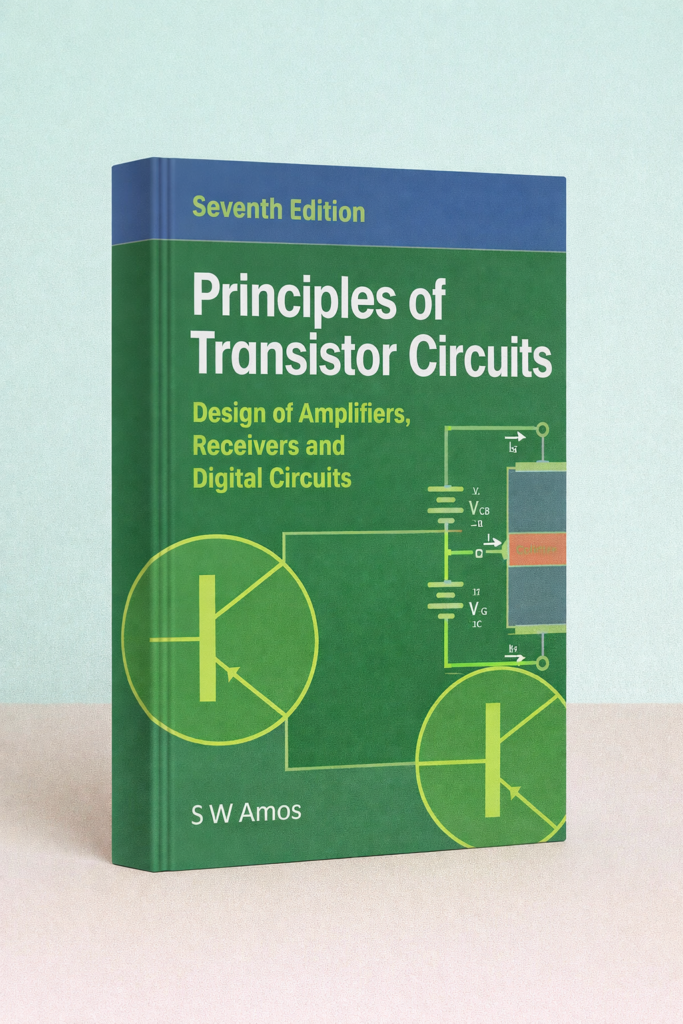
🔧 Principles of Transistor Circuits 7th Edition: Introduction to the Design of Amplifiers, Receivers and Digital Circuits
🚀 Introduction
Transistors are the backbone of modern electronics. From smartphones and computers to medical devices and space technology, nearly every electronic system relies on transistor circuits. Understanding how these circuits function is essential for engineers, students, and technology professionals working in electronics, telecommunications, and embedded systems.
The principles of transistor circuits form the foundation of electronic design. They allow engineers to amplify weak signals, build reliable communication systems, and implement digital logic operations used in modern computing. Whether designing an audio amplifier or constructing a high-speed microprocessor, transistor circuits play a critical role.
The Principles of Transistor Circuits (7th Edition) introduces the fundamental theories and practical techniques required to design three key electronic systems:
-
Amplifiers 🔊
-
Radio Receivers 📡
-
Digital Circuits 💻
These systems represent three major areas of electronics engineering:
-
Analog Signal Processing
-
Communication Systems
-
Digital Electronics
This article provides a comprehensive explanation of transistor circuits, covering both theoretical concepts and practical engineering applications. It is written for beginners who want to understand the fundamentals and experienced engineers seeking deeper insight into transistor circuit design.
📚 Background Theory
🔬 Evolution of Transistor Technology
Before transistors were invented, electronic circuits relied on vacuum tubes. Vacuum tubes were large, fragile, inefficient, and consumed significant power. Early computers filled entire rooms due to the size of these components.
The invention of the transistor in 1947 revolutionized electronics.
Advantages of transistors over vacuum tubes include:
-
Smaller size 📏
-
Lower power consumption ⚡
-
Higher reliability 🔧
-
Faster switching speeds ⏱️
-
Longer operational life
These improvements allowed the development of modern electronics including:
-
Personal computers
-
Smartphones
-
Satellites
-
High-speed communication networks
Today, billions of transistors exist inside a single microprocessor.
⚡ Semiconductor Fundamentals
Transistors are built from semiconductor materials, primarily silicon.
Semiconductors possess electrical properties between:
| Material Type | Conductivity |
|---|---|
| Insulator | Very Low |
| Semiconductor | Medium |
| Conductor | High |
Semiconductor conductivity can be controlled through a process called doping.
Two types of semiconductor materials are created:
| Type | Charge Carrier | Example |
|---|---|---|
| N-Type | Electrons | Phosphorus doped silicon |
| P-Type | Holes | Boron doped silicon |
When these materials are combined, they form PN junctions, which are essential for transistor operation.
🔋 Transistor Structure
A transistor consists of three terminals:
| Terminal | Function |
|---|---|
| Emitter | Injects charge carriers |
| Base | Controls current flow |
| Collector | Collects charge carriers |
Two primary transistor types exist:
1️⃣ BJT (Bipolar Junction Transistor)
2️⃣ FET (Field Effect Transistor)
However, the traditional transistor circuits discussed in classical electronics often focus on BJT transistors.
⚙️ Technical Definition
A transistor circuit is an electrical configuration where a transistor is used to control, amplify, or switch electronic signals and electrical power.
The transistor operates by controlling a large current flowing between the collector and emitter using a small current applied at the base.
Mathematically:
IC=βIB
Where:
-
IC = Collector current
-
IB = Base current
-
β = Current gain of the transistor
This property makes the transistor an effective amplifier and switch.
🧠 Step-by-Step Explanation of Transistor Circuit Operation
Step 1: Biasing the Transistor
Biasing sets the operating point of the transistor.
Proper biasing ensures:
-
Linear amplification
-
Stable operation
-
Reduced distortion
Common biasing methods include:
-
Fixed bias
-
Voltage divider bias
-
Collector feedback bias
Voltage divider bias is widely used due to its stability.
Step 2: Establishing the Operating Point (Q-Point)
The Q-point determines the transistor’s operating condition.
It defines:
-
Collector voltage
-
Collector current
A stable Q-point ensures the amplifier operates without distortion.
Step 3: Applying the Input Signal
A small signal is applied to the base of the transistor.
Example:
-
Microphone signal
-
Radio frequency signal
-
Sensor output
The transistor amplifies this signal by increasing its power.
Step 4: Amplification Process
Because the transistor has current gain, a small input produces a larger output signal.
Amplification types include:
| Amplifier Type | Gain |
|---|---|
| Voltage amplifier | Increases voltage |
| Current amplifier | Increases current |
| Power amplifier | Increases power |
Step 5: Output Signal Delivery
The amplified signal is delivered to a load such as:
-
Speaker
-
Antenna
-
Digital circuit input
🔁 Comparison of Transistor Circuit Configurations
Three main transistor amplifier configurations exist.
| Configuration | Input | Output | Gain | Application |
|---|---|---|---|---|
| Common Emitter | Base | Collector | High | Audio amplifiers |
| Common Base | Emitter | Collector | High frequency | RF circuits |
| Common Collector | Base | Emitter | Buffer | Impedance matching |
🔊 Common Emitter Amplifier
Most widely used amplifier configuration.
Advantages:
-
High voltage gain
-
Moderate current gain
-
Phase inversion
📊 Diagrams & Tables
Simplified Transistor Amplifier Model
Amplifier Gain Formula
Voltage Gain=Output Voltage/Input Voltage
Example Bias Circuit Table
| Component | Typical Value |
|---|---|
| Base resistor | 10kΩ |
| Collector resistor | 4.7kΩ |
| Emitter resistor | 1kΩ |
| Supply voltage | 12V |
🔎 Examples of Transistor Circuits
Example 1: Audio Amplifier
Used in:
-
Radios
-
Speakers
-
Music systems
Function:
Amplifies weak microphone signals into strong signals capable of driving speakers.
Example 2: Radio Receiver Circuit
Transistor circuits are essential in radio receivers.
Main stages include:
1️⃣ RF amplifier
2️⃣ Mixer
3️⃣ Intermediate frequency amplifier
4️⃣ Detector
5️⃣ Audio amplifier
These circuits allow radios to receive and decode signals from broadcast stations.
Example 3: Digital Switching Circuit
Transistors can also operate as switches.
Two states exist:
| State | Output |
|---|---|
| OFF | Logic 0 |
| ON | Logic 1 |
This forms the basis of digital logic circuits used in:
-
Microprocessors
-
Memory devices
-
Logic gates
🌍 Real-World Applications
Transistor circuits power nearly every electronic device today.
💻 Computers
Microprocessors contain billions of transistors used as digital switches.
📱 Smartphones
Transistor circuits are used in:
-
Signal processing
-
Power management
-
Wireless communication
📡 Communication Systems
Used in:
-
Satellite receivers
-
Radio transmitters
-
Wireless networks
🚗 Automotive Electronics
Modern vehicles contain dozens of transistor circuits controlling:
-
Engine management
-
Sensors
-
Infotainment systems
🏥 Medical Devices
Applications include:
-
ECG monitors
-
Imaging equipment
-
Implantable electronics
❌ Common Mistakes in Transistor Circuit Design
1️⃣ Incorrect Biasing
Improper biasing leads to:
-
Distortion
-
Thermal instability
2️⃣ Ignoring Temperature Effects
Transistor performance changes with temperature.
Engineers must include:
-
Thermal stabilization
-
Heat sinks
3️⃣ Overloading the Transistor
Exceeding maximum ratings may destroy the device.
Important parameters:
-
Maximum collector current
-
Maximum voltage
-
Power dissipation
4️⃣ Poor Grounding
Grounding issues introduce noise and instability.
⚠️ Challenges & Solutions
Challenge 1: Signal Distortion
Solution:
-
Proper biasing
-
Negative feedback
Challenge 2: Noise
Solution:
-
Shielded components
-
Filtering circuits
Challenge 3: Thermal Runaway
Solution:
-
Emitter resistors
-
Heat sinks
Challenge 4: High Frequency Limitations
Solution:
-
Use RF-optimized transistors
-
Reduce parasitic capacitance
📖 Case Study: Designing a Simple Audio Amplifier
Objective
Amplify microphone signals to drive a speaker.
Circuit Components
| Component | Function |
|---|---|
| Transistor | Amplification |
| Resistors | Biasing |
| Capacitors | Signal coupling |
| Power supply | Energy source |
Design Steps
1️⃣ Choose transistor (e.g., general purpose NPN)
2️⃣ Set supply voltage (12V typical)
3️⃣ Design voltage divider bias
4️⃣ Add coupling capacitors
5️⃣ Calculate gain
Result
The amplifier successfully increases the signal power enough to drive a small speaker.
🧠 Tips for Engineers
💡 Understand the Physics
Understanding semiconductor physics improves circuit design.
💡 Use Simulation Tools
Software such as SPICE helps test circuits before building them.
💡 Consider Noise Reduction
Shielding and filtering improve signal quality.
💡 Always Check Component Ratings
Never exceed transistor specifications.
💡 Optimize Layout
Proper PCB layout reduces interference and improves reliability.
❓ Frequently Asked Questions (FAQs)
1️⃣ What is the main purpose of a transistor?
A transistor amplifies or switches electrical signals in electronic circuits.
2️⃣ Why are transistors important in electronics?
They allow control of electrical signals, enabling modern computers, communication systems, and digital devices.
3️⃣ What is transistor biasing?
Biasing sets the correct operating point for the transistor to function properly.
4️⃣ What is the difference between analog and digital transistor circuits?
Analog circuits amplify continuous signals, while digital circuits switch between binary states (0 and 1).
5️⃣ What is a common emitter amplifier?
It is a transistor configuration that provides high voltage gain and is widely used in audio amplifiers.
6️⃣ How many transistors exist in modern processors?
Modern processors can contain billions of transistors integrated into a single chip.
7️⃣ What causes transistor failure?
Common causes include overheating, overcurrent, and excessive voltage.
🎯 Conclusion
Transistor circuits form the foundation of modern electronic systems. From amplifiers and receivers to digital logic circuits, transistors enable the design of powerful and efficient electronic devices.
Understanding the principles of transistor circuits allows engineers to design systems that amplify signals, process information, and control electrical power with precision. The concepts discussed in Principles of Transistor Circuits (7th Edition) provide essential knowledge for both beginners and experienced professionals working in electronics engineering.
As technology advances, transistor circuits continue to evolve through innovations such as nanoscale transistors, integrated circuits, and quantum electronics. However, the fundamental principles of transistor operation remain essential for engineers designing the next generation of electronic systems.
Mastering these principles not only improves technical expertise but also opens the door to exciting opportunities in fields such as telecommunications, embedded systems, robotics, and artificial intelligence.
In the modern world of electronics, transistors truly remain the building blocks of innovation. ⚡🔬💡