🚀📊 Statistical Methods for Machine Learning: Discover How to Transform Data into Knowledge with Python 🐍💡
🌟 Introduction
In today’s data-driven world, engineers and scientists across the USA, UK, Canada, Australia, and Europe rely heavily on data to make decisions. But raw data alone has little value. The real power lies in transforming that data into meaningful insights. This transformation is made possible through statistical methods for machine learning.
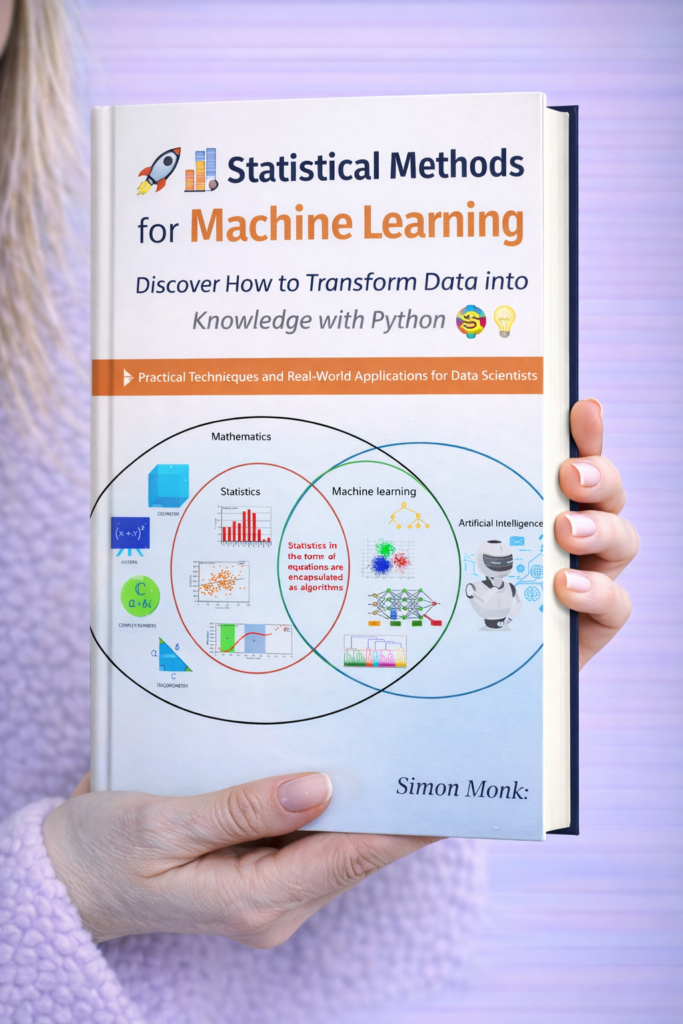
Machine learning (ML) is often described as a branch of artificial intelligence that enables systems to learn from data. However, beneath every machine learning algorithm lies a solid statistical foundation. Without statistics, machine learning would not exist.
This article provides a comprehensive, beginner-to-advanced engineering-level explanation of statistical methods used in machine learning. We will explore theory, definitions, comparisons, diagrams, tables, real-world examples, Python implementations, challenges, and case studies. Whether you are a student or a professional engineer, this guide will help you bridge the gap between raw data and actionable knowledge.
📚 Background Theory
Statistical methods have existed for centuries, long before computers. Early statisticians developed techniques for understanding uncertainty, modeling randomness, and drawing conclusions from data.
Machine learning evolved from:
-
Statistics
-
Probability theory
-
Linear algebra
-
Optimization theory
-
Computer science
🔢 Probability Theory
Probability measures uncertainty. In machine learning, uncertainty is everywhere:
-
Sensor noise
-
Measurement errors
-
Human behavior
-
Market fluctuations
Core probability concepts include:
-
Random variables
-
Probability distributions
-
Expected value
-
Variance
-
Conditional probability
-
Bayes’ theorem
These form the backbone of predictive modeling.
📈 Inferential Statistics
Inferential statistics allows engineers to:
-
Estimate unknown parameters
-
Test hypotheses
-
Make predictions
-
Evaluate model performance
Key tools include:
-
Confidence intervals
-
Hypothesis testing
-
Regression analysis
-
ANOVA
-
Likelihood estimation
Machine learning automates and extends these classical methods to large-scale data problems.
🧠 Technical Definition
Statistical methods for machine learning are mathematical techniques based on probability theory and statistical inference that enable computers to learn patterns, relationships, and structures from data to make predictions or decisions under uncertainty.
In simpler terms:
Statistics = Understanding uncertainty
Machine Learning = Learning patterns
Statistical ML = Learning patterns under uncertainty
🔍 Step-by-Step Explanation: From Data to Knowledge
Let us break down the transformation process step by step.
🔎 Step 1: Data Collection
Data sources may include:
-
Sensors
-
Databases
-
APIs
-
Surveys
-
IoT devices
Python tools:
-
pandas
-
requests
-
numpy
🧹 Step 2: Data Cleaning
Raw data often contains:
-
Missing values
-
Outliers
-
Duplicates
-
Inconsistent formats
Statistical methods help detect anomalies.
Example in Python:
import pandas as pd
data = pd.read_csv(“dataset.csv”)
data.isnull().sum()
📊 Step 3: Exploratory Data Analysis (EDA)
EDA uses statistical summaries:
-
Mean
-
Median
-
Standard deviation
-
Correlation matrix
Visualization tools:
-
matplotlib
-
seaborn
EDA reveals hidden patterns before modeling.
📐 Step 4: Statistical Modeling
This step applies mathematical models:
-
Linear regression
-
Logistic regression
-
Naïve Bayes
-
Gaussian models
-
Bayesian inference
Example: Linear regression formula
y = β₀ + β₁x + ε
Where:
-
β₀ = intercept
-
β₁ = slope
-
ε = error term
🧪 Step 5: Model Evaluation
Statistical metrics evaluate performance:
-
Mean Squared Error (MSE)
-
R² score
-
Accuracy
-
Precision & Recall
-
ROC-AUC
🚀 Step 6: Deployment & Decision Making
Engineers deploy models into:
-
Web applications
-
Cloud systems
-
Embedded systems
-
Industrial automation
Knowledge is now extracted from data.
⚖️ Comparison: Statistical Learning vs Traditional Programming
| Feature | Traditional Programming | Statistical Machine Learning |
|---|---|---|
| Logic | Rule-based | Data-driven |
| Flexibility | Low | High |
| Uncertainty Handling | Limited | Strong |
| Adaptability | Static | Learns over time |
| Mathematical Foundation | Algorithms | Probability & Statistics |
📊 Diagrams & Tables
📈 Bias-Variance Tradeoff Diagram
Model Complexity →

|----------------------------|

Low Bias      High Variance

Underfitting  Overfitting
📋 Common Statistical Methods Table
| Method | Type | Use Case | Python Library |
|---|---|---|---|
| Linear Regression | Supervised | Predict continuous values | sklearn |
| Logistic Regression | Supervised | Binary classification | sklearn |
| Naïve Bayes | Supervised | Text classification | sklearn |
| K-Means | Unsupervised | Clustering | sklearn |
| PCA | Dimensionality Reduction | Feature compression | sklearn |
🧮 Detailed Examples
📌 Example 1: House Price Prediction
Problem: Predict house prices in California.
Statistical method: Multiple Linear Regression
Python Example:
from sklearn.linear_model import LinearRegression

from sklearn.model_selection import train_test_split

import pandas as pdX = data[[‘size’, ‘bedrooms’]]
y = data[‘price’]
model.fit(X_train, y_train)
predictions = model.predict(X_test)
📌 Example 2: Email Spam Detection
Statistical method: Naïve Bayes
Why it works:
-
Based on Bayes’ theorem
-
Assumes conditional independence
-
Efficient for large text datasets
📌 Example 3: Customer Segmentation
Method: K-Means Clustering
Used in:
-
Retail analytics
-
Marketing optimization
-
Recommendation systems
🏗️ Real-World Applications in Modern Projects
🚗 Autonomous Vehicles
-
Sensor fusion uses Bayesian statistics.
-
Probability models estimate object location uncertainty.
🏥 Healthcare Analytics
-
Disease prediction models.
-
Survival analysis.
-
Risk scoring systems.
💰 Financial Engineering
-
Fraud detection
-
Credit scoring
-
Stock price modeling
-
Risk management models
🏭 Industrial IoT
-
Predictive maintenance
-
Failure prediction
-
Quality control monitoring
❌ Common Mistakes
⚠️ Ignoring Data Distribution
Engineers often assume normal distribution without testing.
⚠️ Overfitting the Model
High complexity models memorize noise.
⚠️ Data Leakage
Using future data in training.
⚠️ Small Sample Bias
Insufficient training data leads to unreliable models.
🛠️ Challenges & Solutions
🔥 Challenge 1: High-Dimensional Data
Solution:
-
PCA
-
Feature selection
-
Regularization (L1, L2)
🔥 Challenge 2: Imbalanced Data
Solution:
-
SMOTE
-
Resampling
-
Class weighting
🔥 Challenge 3: Interpretability
Solution:
-
SHAP values
-
LIME
-
Simpler models
🏢 Case Study: Predictive Maintenance in Manufacturing
🎯 Objective
Reduce unexpected equipment failures.
📊 Data
-
Temperature sensors
-
Vibration readings
-
Operating hours
🧠 Method Used
Logistic regression + Bayesian updating.
💻 Implementation
Python + Scikit-learn + Pandas
📈 Results
-
35% reduction in downtime
-
20% maintenance cost savings
-
Improved production efficiency
This case demonstrates how statistical modeling transforms sensor data into actionable industrial knowledge.
💡 Tips for Engineers
-
Always visualize your data.
-
Test statistical assumptions.
-
Start simple before complex models.
-
Validate with cross-validation.
-
Monitor deployed models.
-
Document statistical reasoning.
❓ FAQs
1️⃣ Is machine learning purely statistical?
No. It combines statistics, linear algebra, optimization, and computer science.
2️⃣ Why is probability important in ML?
Because real-world data contains uncertainty.
3️⃣ Do engineers need advanced math?
Basic statistics and probability are essential. Advanced math helps in research roles.
4️⃣ Is Python mandatory?
Python is widely used due to:
-
Large ecosystem
-
Simplicity
-
Libraries like NumPy, Pandas, Scikit-learn
5️⃣ What is the most important statistical concept?
Bias-variance tradeoff.
6️⃣ Can statistical methods work without big data?
Yes. Quality matters more than quantity.
7️⃣ How do I avoid overfitting?
Use:
-
Cross-validation
-
Regularization
-
Simpler models
🏁 Conclusion
Statistical methods are the backbone of machine learning. They allow engineers to:
-
Handle uncertainty
-
Extract patterns
-
Make predictions
-
Optimize systems
-
Improve decision-making
By combining probability theory, inferential statistics, and computational tools like Python, students and professionals can transform raw data into valuable knowledge.
In modern engineering across the USA, UK, Canada, Australia, and Europe, mastering statistical machine learning is no longer optional—it is essential.
Whether designing autonomous vehicles, financial systems, healthcare solutions, or industrial automation, statistical thinking empowers engineers to build intelligent systems that learn from data and continuously improve.
The future belongs to engineers who understand not just code—but the statistics behind it.