Machine Learning Algorithms From Scratch With Python: A Practical Engineering Guide
Introduction
Machine learning has moved from a specialized research field into a practical engineering technology used in software, robotics, finance, healthcare, manufacturing, transportation, energy, and many other industries. 🚀
For students and professionals, however, simply calling a library function such as fit() is not always enough. Understanding what happens underneath the library can make machine learning systems easier to design, debug, optimize, and explain.
Building machine learning algorithms from scratch with Python provides that understanding. Instead of treating an algorithm as a black box, engineers can explore how data enters a model, how parameters are initialized, how predictions are produced, how errors are measured, and how the model improves during training.


Python is particularly useful for this purpose because its syntax is accessible to beginners while its ecosystem is powerful enough for professional engineering work. Libraries such as NumPy, Pandas, Matplotlib, and Scikit-learn can later be used to move from educational implementations toward production systems.
The goal of this article is not to reproduce proprietary material or a particular textbook. Instead, it presents an original engineering-oriented explanation of how major machine learning concepts can be understood and implemented from first principles.

Background Theory
Machine learning is fundamentally concerned with creating systems that can identify useful patterns in data and use those patterns to make predictions or decisions.
Traditional software generally follows this structure:
Rules + Input → Output
Machine learning changes the approach:
Data + Learning Algorithm → Model
The trained model can then be used as:
New Data + Model → Prediction
This distinction is important for engineering applications. Rather than manually defining every possible rule, an engineer provides representative data and a learning procedure.
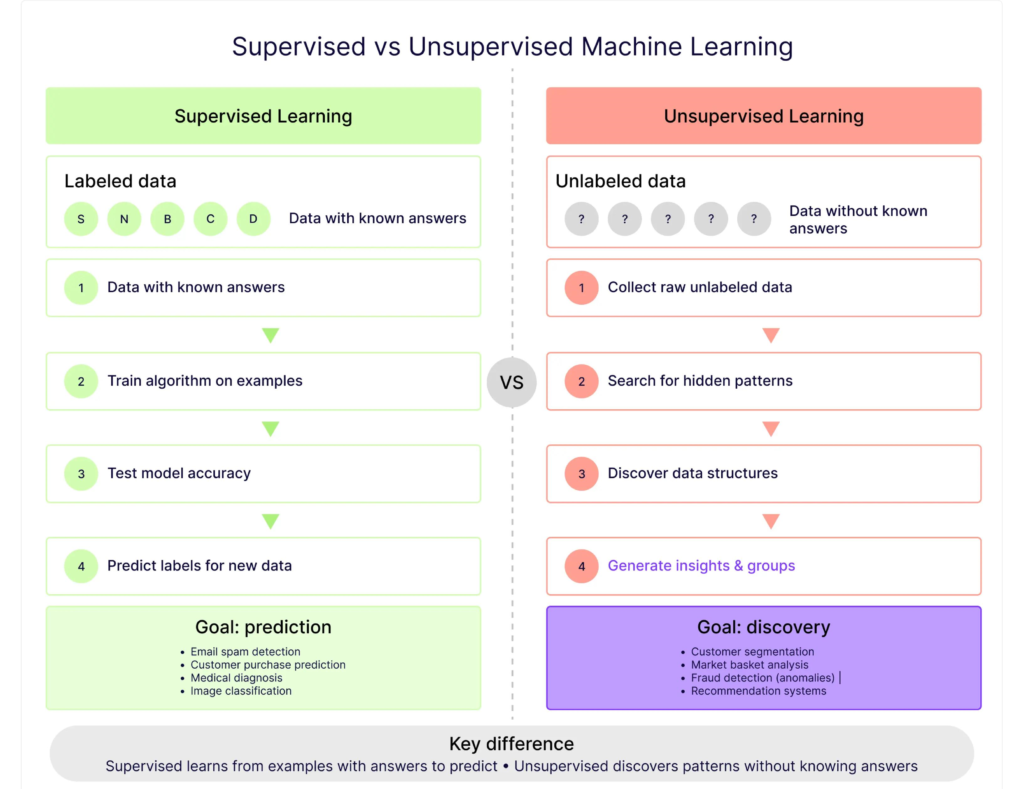
The Main Learning Categories
Machine learning algorithms are commonly divided into several broad groups.
Supervised Learning
Supervised learning uses examples where the desired output is known.
Typical tasks include:
- Predicting house prices
- Detecting defective components
- Classifying emails
- Estimating energy consumption
- Predicting customer behavior
Two major supervised-learning problems are classification and regression.
Classification predicts categories, while regression predicts continuous values.
Unsupervised Learning
Unsupervised learning works with data without predefined target labels.
Examples include:
- Customer segmentation
- Anomaly discovery
- Document grouping
- Industrial sensor analysis
- Pattern discovery
Clustering algorithms are among the most common unsupervised techniques.
Reinforcement Learning
Reinforcement learning involves an agent interacting with an environment and learning from feedback.
It is particularly relevant to:
- Robotics 🤖
- Autonomous systems
- Game AI
- Resource management
- Industrial control
Definition
Machine learning algorithms from scratch with Python means implementing the fundamental logic of a learning algorithm manually rather than relying entirely on a high-level machine learning library.
This does not necessarily mean avoiding every Python library.
For educational engineering work, an implementation might use:
- Python lists
- NumPy arrays
- Basic functions
- Loops
- Conditional statements
- Random initialization
- Visualization tools
while deliberately avoiding a ready-made implementation of the algorithm itself.
For example, instead of directly calling a prebuilt clustering function, an engineer could manually implement the process of assigning observations to clusters and updating the cluster centers.
The objective is understanding—not reinventing an entire industrial software ecosystem.
Why Build Algorithms From Scratch?
There are several important reasons.
1. Conceptual understanding 🧠
You see how learning actually occurs.
2. Debugging ability 🔧
Understanding internal operations makes model failures easier to investigate.
3. Algorithm selection
You can better understand why one method may outperform another.
4. Engineering intuition
Implementation exposes the relationship between data, parameters, optimization, and predictions.
5. Educational value
Students develop stronger foundations before moving to advanced frameworks.
Step-by-Step Explanation: Building a Learning Algorithm
A useful way to learn machine learning from scratch is to treat every algorithm as a sequence of engineering operations.


Step 1: Understand the Dataset
Before writing the model, inspect the data.
Identify:
- Number of observations
- Number of features
- Target variable
- Missing values
- Data types
- Outliers
- Feature ranges
Poor understanding of the dataset can cause more problems than poor algorithm implementation.
Step 2: Prepare the Data
Data preparation may involve:
- Removing duplicates
- Handling missing values
- Encoding categorical information
- Scaling numerical features
- Removing irrelevant variables
- Splitting data into training and testing sets
A sophisticated algorithm cannot compensate for fundamentally unsuitable input data.
Step 3: Initialize the Model
Many algorithms require internal parameters.
For example, a model might initialize:
- Weights
- Bias values
- Cluster centers
- Decision thresholds
- Random states
Initialization can influence the learning process, especially in iterative algorithms.
Step 4: Generate Predictions
The model processes input features and produces an output.
At this stage, the model may be inaccurate because it has not learned sufficiently from the training data.
Step 5: Measure the Error
The difference between the expected result and the model’s prediction provides information about model performance.
Different problems require different evaluation strategies.
Examples include:
- Accuracy
- Precision
- Recall
- F1-score
- Mean absolute error
- Mean squared error
Step 6: Update Model Parameters
The learning mechanism changes internal parameters based on the observed error.
This is the central idea behind many optimization-based algorithms.
Step 7: Repeat
The training process may repeat many times.
A typical loop looks conceptually like:
Initialize → Predict → Evaluate → Update → Repeat
Step 8: Test the Model
After training, evaluate the model using data that was not used during learning.
This helps determine whether the algorithm has learned useful patterns rather than simply memorizing the training examples.
Core Algorithms to Implement
Linear Regression
Linear regression is one of the simplest algorithms for understanding predictive modeling.
It attempts to identify a relationship between input features and a continuous output.
From scratch, the implementation helps students understand:
- Model parameters
- Predictions
- Prediction error
- Optimization
- Training iterations
Potential applications include demand forecasting, cost estimation, and engineering measurements.
Logistic Regression
Despite its name, logistic regression is widely used for classification.
It produces a probability-like output that can be converted into a class decision.
It provides a useful introduction to:
- Classification
- Decision boundaries
- Loss functions
- Gradient-based optimization
K-Nearest Neighbors
K-Nearest Neighbors, or KNN, is conceptually straightforward.
When a new observation arrives, the algorithm examines nearby training observations and uses them to determine the likely class or value.
Its simplicity makes it excellent for understanding the role of:
- Distance
- Neighborhood size
- Feature scaling
- Training data
Decision Trees
Decision trees repeatedly divide data according to feature conditions.
For example, an engineering inspection system might conceptually ask:
Is vibration high? → Is temperature abnormal? → Is pressure outside the expected range?
This creates a decision structure that leads toward a prediction.
K-Means Clustering
K-Means groups observations into clusters.
The basic process is:
- Select initial cluster centers.
- Assign observations to their nearest center.
- Recalculate cluster centers.
- Repeat until the groups stabilize.


Comparison of Machine Learning Algorithms
| Algorithm | Learning Type | Typical Task | Main Advantage | Main Limitation |
|---|---|---|---|---|
| Linear Regression | Supervised | Regression | Simple and interpretable | Limited nonlinear relationships |
| Logistic Regression | Supervised | Classification | Efficient and interpretable | May struggle with complex boundaries |
| KNN | Supervised | Classification/Regression | Easy to understand | Prediction can become expensive |
| Decision Tree | Supervised | Classification/Regression | Highly interpretable | Can overfit |
| K-Means | Unsupervised | Clustering | Simple grouping mechanism | Requires choosing cluster count |
| Neural Network | Supervised/Unsupervised | Complex prediction | Powerful nonlinear modeling | More complex to train |
| Naive Bayes | Supervised | Classification | Fast and lightweight | Assumptions may not fit all datasets |
Diagrams and Engineering Workflow
A useful conceptual architecture for a from-scratch machine learning project is:
              ┌─────────────────┐
              │   Raw Dataset   │
              └────────┬────────┘
                       ↓
              ┌─────────────────┐
              │ Data Preparation│
              └────────┬────────┘
                       ↓
              ┌─────────────────┐
              │ Feature Design  │
              └────────┬────────┘
                       ↓
              ┌─────────────────┐
              │ Model Training  │
              └────────┬────────┘
                       ↓
              ┌─────────────────┐
              │ Model Evaluation│
              └────────┬────────┘
                       ↓
              ┌─────────────────┐
              │    Prediction   │
              └─────────────────┘
Algorithm Selection Table
| Engineering Requirement | Suitable Starting Algorithm |
|---|---|
| Predict a numerical quantity | Linear Regression |
| Binary classification | Logistic Regression |
| Small classification dataset | KNN |
| Explainable decision system | Decision Tree |
| Discover groups | K-Means |
| Complex nonlinear patterns | Neural Network |
| Text classification | Naive Bayes |


Examples
Example 1: Predicting Energy Demand
Imagine an energy-management system containing historical information about:
- Temperature
- Time of day
- Day of week
- Previous consumption
- Building occupancy
A regression algorithm can learn relationships among these variables and estimate future demand.
An engineer could initially build a simple model from scratch to understand the prediction process and later compare it with a production implementation.
Example 2: Detecting Manufacturing Defects
Suppose a manufacturing line collects sensor measurements from machines.
Each historical observation is labeled either:
Normal or Defective
A classification algorithm can learn patterns associated with defective production.
The same conceptual pipeline can later be integrated into an automated quality-control system.
Example 3: Grouping Customers
A company may have thousands of customers but no predefined customer categories.
K-Means can group customers according to characteristics such as:
- Purchase frequency
- Average transaction value
- Product preferences
- Engagement
The resulting groups can support marketing and business analysis.
Real-World Applications
Machine learning from scratch is primarily an educational and prototyping technique, but the underlying algorithms are used extensively in real engineering systems.
Manufacturing
Machine learning can support:
- Predictive maintenance
- Fault detection
- Quality inspection
- Process optimization
- Production forecasting
Robotics
Robotic systems can use machine learning for:
- Object recognition
- Sensor interpretation
- Motion prediction
- Navigation
- Adaptive control
Energy Engineering
Applications include:
- Load forecasting
- Renewable-energy prediction
- Equipment monitoring
- Building-energy optimization
Civil Engineering
Machine learning can assist with:
- Structural condition assessment
- Construction forecasting
- Material-property prediction
- Infrastructure monitoring
- Traffic prediction
Software Engineering
Developers can use machine learning for:
- Spam detection
- Recommendation systems
- Anomaly detection
- Log analysis
- Predictive analytics
Common Mistakes
Ignoring Data Quality
A model cannot reliably learn from unreliable data.
Solution: Perform systematic data inspection before training.
Using the Wrong Evaluation Metric
Accuracy alone may be misleading when classes are highly unbalanced.
Solution: Select metrics according to the engineering objective.
Forgetting Feature Scaling
Distance-based algorithms can behave poorly when features have dramatically different numerical ranges.
Solution: Normalize or standardize appropriate features.
Overfitting the Training Data
A model may perform extremely well on training data while performing poorly on unseen observations.
Solution: Use validation strategies and evaluate on independent test data.
Treating a Scratch Implementation as Production Software
Educational code often prioritizes transparency rather than speed, security, testing, and scalability.
Solution: Use scratch implementations for learning and experimentation, then use robust libraries and engineering practices for production.
Challenges and Solutions
| Challenge | Why It Happens | Practical Solution |
|---|---|---|
| Slow execution | Python loops can be inefficient | Use vectorized operations where appropriate |
| Poor predictions | Insufficient or unsuitable data | Improve data quality |
| Overfitting | Model learns training-specific patterns | Use validation and regularization |
| Unstable training | Poor parameter configuration | Tune learning settings |
| Difficult debugging | Many interacting components | Build and test incrementally |
| Reproducibility problems | Random initialization | Control random seeds |
| Data leakage | Test information enters training | Separate preprocessing and evaluation correctly |
Case Study: Predictive Maintenance Prototype
Consider a factory that wants to predict whether a machine may require maintenance.
The engineering team collects historical sensor information such as:
- Temperature
- Vibration
- Operating duration
- Pressure
- Historical maintenance status
Stage 1: Data Collection
The team gathers historical sensor observations and corresponding maintenance records.
Stage 2: Data Preparation
Invalid measurements are investigated, missing values are handled, and relevant features are selected.
Stage 3: Scratch Model
A simple classification algorithm is implemented in Python.
The objective is not immediately to achieve the highest possible accuracy. Instead, engineers use the prototype to understand how the model transforms sensor observations into predictions.
Stage 4: Evaluation
The model is evaluated against observations that were not used during training.
Engineers examine multiple performance measures rather than relying on a single number.
Stage 5: Improvement
The team experiments with:
- Better feature selection
- Different preprocessing
- Alternative algorithms
- Parameter tuning
- Additional historical data
Stage 6: Production Transition
Once the approach demonstrates value, the prototype can be replaced or supplemented by a tested machine-learning framework suitable for deployment.
This illustrates an important engineering principle:
Learn from scratch, validate systematically, then engineer for production.
Essential Tips
Start With Small Datasets
Small datasets make it easier to inspect every stage of the algorithm.
Understand Every Variable
Before implementing an algorithm, know what each input represents and why it matters.
Write the Algorithm in Small Functions
Separate tasks such as:
- Initialization
- Prediction
- Error calculation
- Parameter updates
- Evaluation
This makes debugging much easier.
Visualize the Results
Charts can reveal:
- Incorrect predictions
- Outliers
- Clusters
- Training behavior
- Class imbalance
Compare With Established Libraries
After implementing an algorithm yourself, compare the result with a trusted implementation.
This is an excellent debugging exercise.
Keep a Baseline
Always establish a simple baseline before developing a sophisticated model.
A complex model is not automatically a better engineering solution.
Learn NumPy
For Python-based machine learning, understanding NumPy arrays and vectorized operations can dramatically improve both comprehension and implementation quality.
Document Assumptions
Record:
- Dataset assumptions
- Feature definitions
- Training settings
- Evaluation methodology
- Randomization choices
Good documentation makes experiments reproducible.
FAQs
What does “machine learning from scratch” mean?
It means implementing the core logic of an algorithm yourself rather than relying entirely on a ready-made machine-learning function. The purpose is to understand how the algorithm operates internally.
Do I need advanced mathematics?
Not initially. Beginners can learn the concepts using intuitive explanations and progressively introduce mathematics as their understanding improves. For professional machine-learning engineering, however, knowledge of statistics, linear algebra, probability, and optimization becomes increasingly valuable.
Is Python good for learning machine learning algorithms?
Yes. Python has readable syntax and an extensive ecosystem for numerical computing, visualization, data analysis, and machine learning.
Should I avoid Scikit-learn when learning?
Not necessarily. A useful strategy is to first implement a simplified algorithm yourself and then compare your implementation with a professional library implementation.
Which algorithm should beginners implement first?
Linear regression is an excellent starting point because its workflow is relatively easy to visualize. KNN and K-Means are also accessible choices.
Can scratch implementations be used in production?
Usually, a simple educational implementation should not be deployed directly in a production environment. Production systems require extensive testing, optimization, security controls, monitoring, scalability, and maintenance.
How does implementing algorithms help engineers?
It develops intuition about data preprocessing, model behavior, parameter optimization, prediction errors, computational complexity, and model evaluation.
What should I learn after implementing basic algorithms?
A strong progression is:
Python → NumPy → Statistics → Linear Algebra → Classical ML → Model Evaluation → Deep Learning → MLOps → Production Deployment
Conclusion
Learning machine learning algorithms from scratch with Python is one of the most effective ways to move beyond treating artificial intelligence as a black box. 🧠🐍
The process teaches engineers how data becomes information, how parameters evolve during training, how predictions are generated, and why models succeed or fail.
Beginners can start with relatively simple algorithms such as linear regression, KNN, and K-Means. More advanced learners can explore logistic regression, decision trees, neural networks, optimization techniques, feature engineering, and model evaluation.
The most important lesson is that machine learning is not simply about choosing an algorithm. Successful engineering requires a complete workflow:
Reliable Data → Appropriate Features → Suitable Algorithm → Careful Training → Meaningful Evaluation → Robust Deployment
Building models from scratch provides the foundation. Combining that knowledge with professional Python libraries, software engineering, statistics, and domain expertise creates the skills needed to develop practical machine-learning systems for modern engineering applications. 🚀