Introduction to Machine Learning: A Practical Guide for Students and Engineers
Introduction
Machine Learning (ML) has become one of the most influential technologies in modern engineering, software development, scientific research, and business. Instead of programming a computer with every possible instruction, machine learning allows a system to learn patterns from data and use those patterns to make predictions or decisions. 🤖📊
From detecting defects in manufactured components to predicting energy consumption, optimizing transportation, analyzing medical images, and powering intelligent software, ML is increasingly becoming part of everyday engineering workflows.

For students, learning ML provides a foundation for careers in data science, artificial intelligence, robotics, automation, software engineering, and computational engineering. For professionals, it offers tools for solving problems that may be difficult to handle using conventional rule-based programming.
The most important idea is simple:
Data → Learning → Model → Prediction or Decision
This article introduces the fundamental concepts of machine learning while gradually moving from beginner-friendly ideas toward practical engineering considerations. 🚀
Background Theory
From Traditional Programming to Machine Learning
Traditional programming generally follows a straightforward approach:
Rules + Input → Output
A developer analyzes a problem, creates explicit rules, implements those rules in software, and provides input to obtain an output.
Machine learning approaches the problem differently:
Data + Expected Outcomes → Learning Process → Model
The resulting model can then receive new data and generate predictions.
For example, imagine an engineering company wants to identify whether a manufactured component is defective. A conventional program might rely on manually defined thresholds for dimensions, temperature, vibration, or surface characteristics.
A machine learning system can instead learn patterns from historical examples labeled as acceptable or defective.
Why Data Matters
Data is the foundation of machine learning. A sophisticated algorithm cannot compensate indefinitely for poor-quality information.
A useful ML dataset may contain:
- Numerical measurements
- Text
- Images
- Audio
- Sensor readings
- Time-series information
- Geographic information
- Historical records
- User interactions
The quality, quantity, relevance, and consistency of this information strongly influence model performance.
Training and Generalization
A machine learning model should not simply memorize its training data.
Its real purpose is generalization—performing well when presented with new information that was not used during training.
This creates an important engineering principle:
A model that performs extremely well on historical data is not automatically a good model.
Testing with previously unseen data is therefore essential.
Definition
What Is Machine Learning?
Machine Learning is a branch of artificial intelligence in which computer systems learn useful patterns from data to perform predictions, classifications, recommendations, or other tasks without requiring every decision rule to be explicitly programmed.
Machine learning can be divided into several major approaches.
Supervised Learning
In supervised learning, the algorithm learns from examples where the desired outcome is known.
Common tasks include:
- Classification
- Regression
- Prediction
- Risk assessment
- Fault detection
For instance, an organization could provide historical equipment records labeled as “normal” or “fault.”
The model learns relationships between the input characteristics and the known outcomes.
Unsupervised Learning
Unsupervised learning works with data where predefined labels are unavailable.
The system attempts to discover structure within the dataset.
Typical applications include:
- Customer segmentation
- Anomaly detection
- Pattern discovery
- Data clustering
- Dimensionality reduction
Reinforcement Learning
Reinforcement learning involves an agent interacting with an environment.
The agent receives feedback based on its actions and gradually learns strategies that improve its future performance.
It is particularly relevant to:
- Robotics 🤖
- Autonomous systems
- Industrial control
- Game intelligence
- Resource optimization
Step-by-Step Machine Learning Workflow
A successful machine learning project is much more than selecting an algorithm. It is a complete engineering workflow.


Step 1: Define the Problem
Start with the engineering or business problem rather than the algorithm.
Ask:
- What needs to be predicted?
- Who will use the prediction?
- What data is available?
- What would constitute a successful result?
- What are the consequences of an incorrect prediction?
A clearly defined problem prevents unnecessary model complexity.
Step 2: Collect Data
Gather relevant information from appropriate sources.
For an engineering application, this might include sensor measurements, maintenance records, production information, environmental conditions, or inspection results.
Data should be representative of the conditions under which the final system will operate.
Step 3: Clean the Dataset
Real-world data is rarely perfect.
It may contain:
- Missing values
- Duplicate records
- Incorrect measurements
- Inconsistent formats
- Outliers
- Irrelevant variables
Data cleaning can consume a significant portion of an ML project.
Step 4: Explore the Data
Before training a model, engineers should understand the dataset.
Exploratory analysis can reveal:
- Important patterns
- Unexpected relationships
- Imbalanced categories
- Potential errors
- Trends
- Correlations
Visualization is particularly useful here. 📈
Step 5: Prepare Features
Features are the pieces of information used by the model.
For example, an industrial prediction system might use:
- Temperature
- Pressure
- Vibration
- Operating time
- Load
- Maintenance history
Feature engineering involves transforming raw information into useful representations.
Step 6: Select a Model
Different problems require different approaches.
Possible choices include:
- Linear models
- Decision trees
- Random forests
- Support vector machines
- Gradient boosting
- Neural networks
- Clustering algorithms
The most complicated model is not necessarily the best model.
Step 7: Train the Model
Training allows the algorithm to identify patterns within the available data.
During this process, the model adjusts internal parameters to improve its performance on the training examples.
Step 8: Evaluate Performance
A model must be evaluated using appropriate metrics and data that provide an honest assessment of its performance.
Depending on the task, engineers might consider:
- Accuracy
- Precision
- Recall
- F1 score
- Mean absolute error
- Mean squared error
- Area under the ROC curve
The appropriate metric depends on the actual problem.
Step 9: Deploy the Model
A trained model becomes useful when integrated into a real system.
Deployment could involve:
- A web application
- Mobile software
- Industrial equipment
- Cloud infrastructure
- Embedded hardware
- Engineering simulation software
Step 10: Monitor and Improve
Deployment is not the final step.
Real-world data can change over time. Equipment may age, customer behavior may shift, environmental conditions may change, and new types of failures may appear.
Continuous monitoring helps maintain reliability. 🔄
Comparison of Machine Learning Approaches
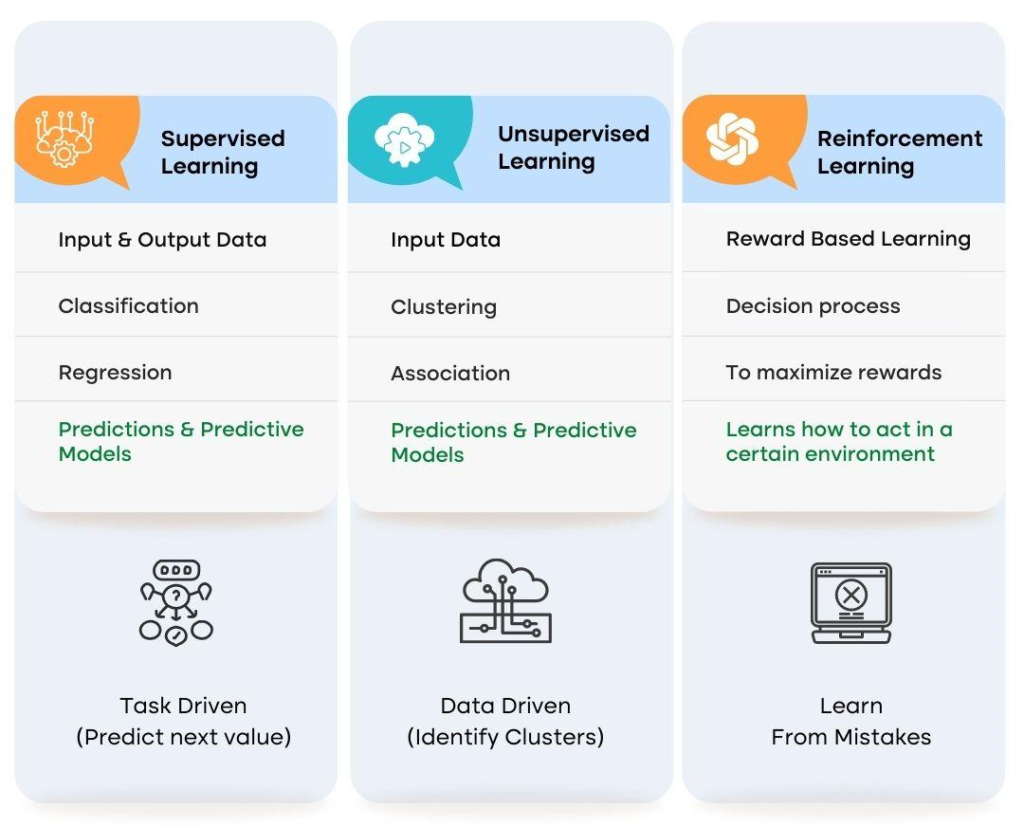


| Approach | Training Information | Typical Goal | Example |
|---|---|---|---|
| Supervised Learning | Labeled data | Predict known outcomes | Defect classification |
| Unsupervised Learning | Unlabeled data | Discover patterns | Equipment grouping |
| Reinforcement Learning | Feedback/rewards | Learn actions | Robot navigation |
| Semi-Supervised Learning | Mixed labeled and unlabeled data | Improve learning with limited labels | Image classification |
Traditional Programming vs Machine Learning
| Feature | Traditional Programming | Machine Learning |
|---|---|---|
| Main input | Rules and data | Data and examples |
| Rules | Explicitly written | Learned from data |
| Adaptability | Usually requires code changes | Can retrain with new data |
| Interpretability | Often straightforward | Depends on model |
| Data requirement | Often moderate | Frequently substantial |
| Typical strength | Clearly defined rules | Complex patterns |
Diagrams and Tables
A simple conceptual architecture for an ML system can be represented as:
Raw Data → Data Preparation → Features → ML Algorithm → Trained Model → Prediction → Decision
For an engineering monitoring application:
Sensors → Data Collection → Cleaning → Feature Extraction → Model → Condition Prediction → Engineer Action


Key Components
| Component | Purpose |
|---|---|
| Dataset | Provides information for learning |
| Features | Represent useful characteristics |
| Algorithm | Defines the learning strategy |
| Model | Stores learned patterns |
| Training | Creates the model |
| Validation | Helps select and tune models |
| Testing | Measures generalization |
| Deployment | Makes predictions available |
| Monitoring | Detects performance changes |
Practical Examples
Predictive Maintenance
Imagine a factory containing hundreds of rotating machines.
Sensors continuously collect vibration, temperature, and operating information.
A machine learning system can learn patterns associated with previous equipment failures. When a new pattern resembles conditions that historically preceded a failure, the system can notify maintenance engineers.
Instead of waiting for equipment to break, the organization can investigate the machine earlier.
Email Classification
An email system can analyze message characteristics and learn to distinguish unwanted messages from legitimate communication.
As new examples become available, the system can be updated to recognize emerging patterns.
Image-Based Quality Inspection
A manufacturing facility can use cameras to capture images of products.
A computer vision model can learn to identify visual characteristics associated with scratches, cracks, missing components, or manufacturing defects.
Energy Prediction
Buildings can generate large quantities of information from heating, cooling, lighting, occupancy, and environmental systems.
ML can help estimate future energy demand and support more efficient building management. ⚡
Real-World Applications
Machine learning is now used across many engineering disciplines.
Mechanical Engineering
Applications include:
- Predictive maintenance
- Fault diagnosis
- Manufacturing optimization
- Quality inspection
- Remaining useful life prediction
- Robotics
Civil Engineering
ML can support:
- Structural health monitoring
- Construction planning
- Traffic prediction
- Building energy analysis
- Infrastructure inspection
- Material property prediction
Electrical Engineering
Applications include:
- Load forecasting
- Fault detection
- Power quality analysis
- Smart-grid optimization
- Renewable-energy forecasting
Software Engineering
ML contributes to:
- Recommendation systems
- Fraud detection
- Automated testing
- Intelligent search
- Code analysis
- Cybersecurity monitoring
Aerospace Engineering
Machine learning can assist with:
- Aircraft maintenance
- Sensor analysis
- Flight-data analysis
- Anomaly detection
- Autonomous systems
Common Mistakes
Starting With the Algorithm
A common beginner mistake is asking, “Which algorithm should I use?” before defining the problem.
Start with the objective and available data.
Ignoring Data Quality
Poor measurements can produce unreliable models.
Data validation should therefore be treated as an engineering activity rather than an optional preparation step.
Training on Everything
Using all available data for training can make it difficult to determine whether the model actually generalizes.
Separate datasets for training and evaluation are important.
Overfitting
Overfitting occurs when a model becomes excessively specialized to its training examples.
The model may appear excellent during development but perform poorly on new data.
Using Too Many Features
More information does not automatically mean better predictions.
Irrelevant or redundant features can increase complexity and sometimes reduce model quality.
Ignoring Deployment Requirements
A model may perform extremely well in a research environment but be impractical in production because of latency, hardware, cost, security, or maintenance requirements.
Challenges and Solutions
Limited Data
Challenge: Some engineering problems have only a small number of historical examples.
Solution: Improve data collection, use appropriate validation strategies, carefully engineer features, and consider techniques designed for limited datasets.
Imbalanced Data
Challenge: Some events, such as serious equipment failures, may be rare.
Solution: Select evaluation metrics that reflect the real objective and investigate appropriate sampling or weighting strategies.
Explainability
Challenge: Complex models can be difficult for engineers to interpret.
Solution: Use interpretable models when appropriate and apply model-explanation techniques when complex models provide substantial benefits.
Data Drift
Challenge: Real-world data can change after deployment.
Solution: Monitor input distributions and model performance continuously.
Computational Cost
Challenge: Some advanced models require substantial computing resources.
Solution: Consider whether the additional complexity produces enough practical value to justify the cost.
Case Study: Machine Learning for Predictive Maintenance
Consider a hypothetical manufacturing company operating a large fleet of industrial pumps.
The company historically performed maintenance according to fixed schedules. However, some pumps were serviced unnecessarily while others experienced unexpected failures between scheduled inspections.
Problem
The engineering team wanted to identify pumps showing early signs of abnormal behavior.
Data Collection
The company collected:
- Temperature readings
- Vibration measurements
- Operating duration
- Pressure information
- Maintenance history
- Historical failure records
Development
Engineers cleaned the dataset and created features describing the operating condition of each pump.
Several machine learning approaches were evaluated using historical information.
Rather than selecting a model solely because it achieved the highest development score, the engineers also considered interpretability, computational requirements, false alarms, and integration with existing maintenance systems.
Deployment
The final system generated risk indicators for pumps during normal operation.
When an unusual pattern appeared, the maintenance team received an alert and inspected the equipment.
Result
The value of the system was not simply “using AI.”
The real benefit came from combining:
Reliable sensors + Quality data + Engineering knowledge + Machine learning + Human decision-making
This illustrates an important principle: machine learning works best when integrated with domain expertise rather than treated as a replacement for engineering judgment.
Essential Tips for Learning Machine Learning
Build the Fundamentals First
Learn:
- Python
- Data structures
- Statistics
- Probability
- Linear algebra
- Data visualization
- Basic optimization
You do not need to master advanced mathematics before starting, but mathematical understanding becomes increasingly valuable as you progress.
Practice With Real Datasets
Small practical projects are often more educational than reading theory alone.
Try projects involving:
- Classification
- Regression
- Clustering
- Time-series prediction
- Image recognition
Learn the Complete Workflow
Do not focus exclusively on model training.
A professional ML engineer needs to understand:
Problem Definition → Data → Cleaning → Features → Training → Evaluation → Deployment → Monitoring
Compare Simple Models First
Start with a baseline.
If a simple model solves the problem adequately, there may be little reason to introduce unnecessary complexity.
Think Like an Engineer
Always ask:
Does this model solve the actual problem reliably, economically, and safely?
A slightly less accurate model that is fast, explainable, inexpensive, and easy to maintain may be more valuable than a highly complex model.
Frequently Asked Questions
What is machine learning in simple terms?
Machine learning is a method of teaching computers to recognize patterns in data so they can make predictions or decisions on new information.
Is machine learning difficult for beginners?
It can seem challenging initially because it combines programming, statistics, data analysis, and problem-solving. However, beginners can learn it progressively by starting with simple projects.
Do I need advanced mathematics to learn machine learning?
Not at the beginning. Basic statistics and probability are useful early on. More advanced mathematics becomes increasingly important when studying optimization, neural networks, and the theoretical foundations of ML.
Is Python necessary for machine learning?
Python is not theoretically required, but it is one of the most widely used programming languages for machine learning because of its extensive ecosystem for data analysis, scientific computing, visualization, and ML development.
What is the difference between AI and machine learning?
Artificial intelligence is the broader field concerned with creating systems capable of intelligent behavior. Machine learning is one major approach used to build such systems.
Which machine learning algorithm is the best?
There is no universally best algorithm. The appropriate choice depends on the dataset, objective, computational resources, interpretability requirements, and deployment environment.
Can machine learning replace engineers?
Machine learning is generally better viewed as an engineering tool rather than a complete replacement for engineers. Domain expertise remains essential for defining problems, validating results, managing risks, and making decisions.
What should I learn after the basics?
After understanding fundamental ML concepts, consider studying feature engineering, model evaluation, neural networks, deep learning, computer vision, natural language processing, MLOps, and model deployment.
Conclusion
Machine learning represents a fundamental shift in how engineers and developers can create intelligent systems. Instead of manually specifying every possible rule, ML enables computers to learn useful patterns from data and apply those patterns to new situations. 🤖⚙️
The technology has applications across mechanical, civil, electrical, aerospace, software, manufacturing, energy, and many other engineering fields.
However, successful machine learning is not simply about choosing a sophisticated algorithm. The complete process matters:
Define the problem → Collect quality data → Prepare the information → Train the model → Evaluate honestly → Deploy carefully → Monitor continuously.
For students, the best way to begin is to combine programming fundamentals with practical datasets and small projects. For professionals, the emphasis should also include reliability, explainability, deployment, security, cost, and domain-specific engineering requirements.
Ultimately, machine learning is most powerful when data-driven intelligence and human engineering expertise work together. 🚀📊⚙️